
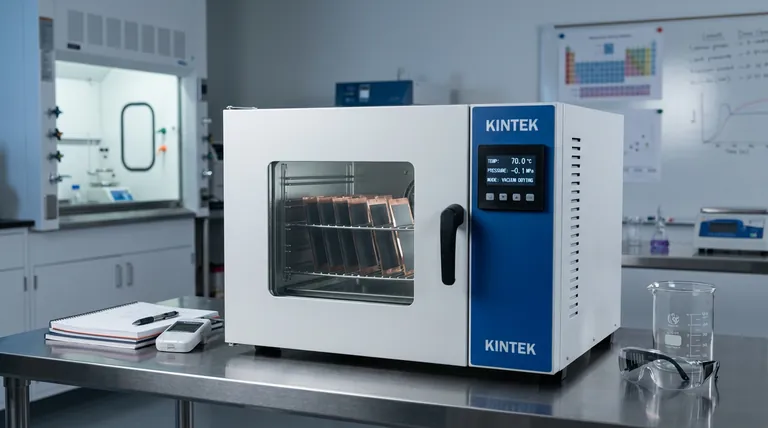
A laboratory vacuum oven is strictly necessary for processing Nickel Oxide electrodes to ensure the complete removal of high-boiling point organic solvents, most notably N-Methyl-2-pyrrolidone (NMP). Operating typically at a stable 70°C under vacuum, this process prevents the electrode active material from peeling off the current collector and eliminates solvent residues that would otherwise compromise electrochemical data accuracy.
Core Takeaway The vacuum oven solves the conflict between needing to remove stubborn solvents and needing to protect delicate materials. By lowering the boiling point of solvents like NMP, it achieves deep drying and strong structural adhesion without subjecting the Nickel Oxide to damagingly high temperatures or oxidative stress.
The Critical Role of Solvent Removal
Overcoming High Boiling Points
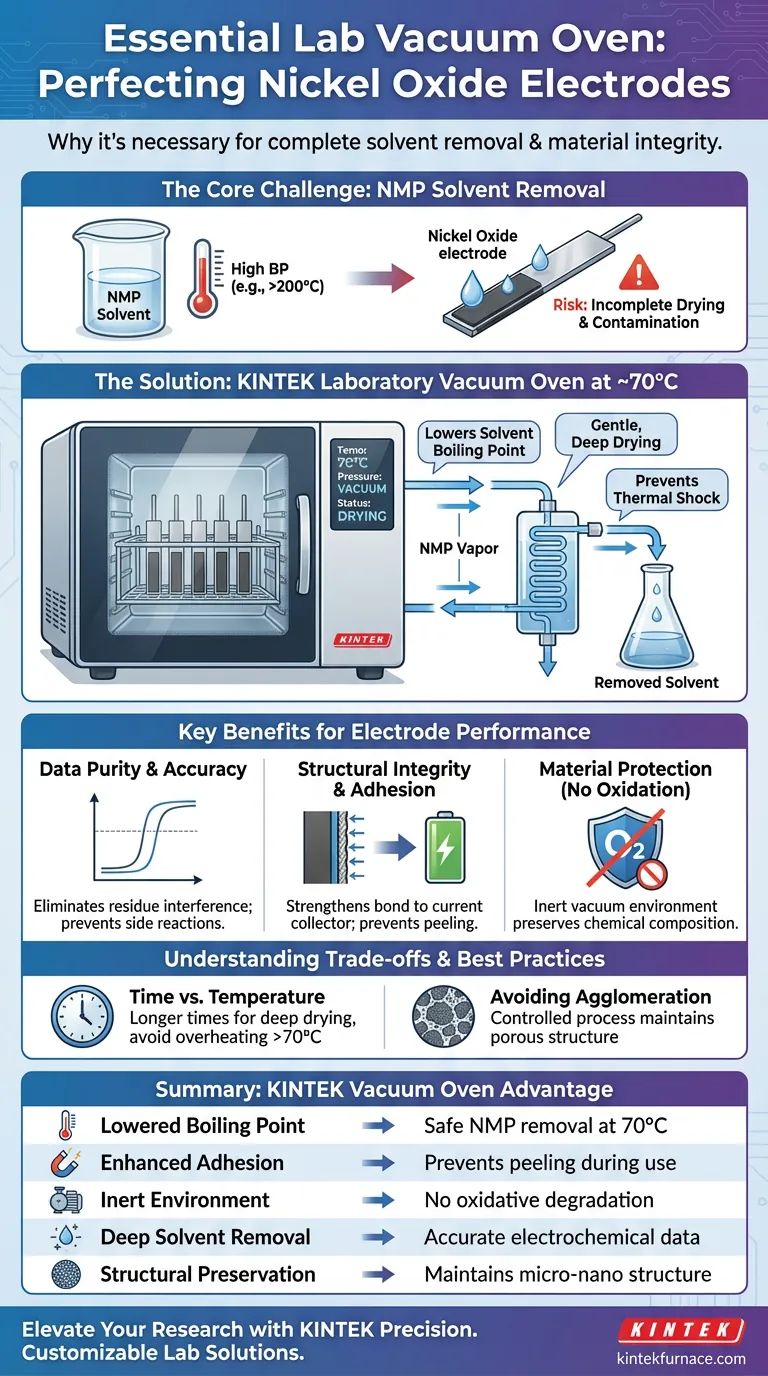
The primary challenge in processing Nickel Oxide electrodes is removing the solvent used in the coating slurry, such as N-Methyl-2-pyrrolidone (NMP).
NMP has a high boiling point, making it difficult to evaporate under standard atmospheric conditions without excessive heat.
The vacuum environment significantly lowers the boiling point of these solvents. This allows for their complete removal at a moderate temperature (around 70°C), ensuring the electrode is dry without requiring thermal extremes that could alter the material's properties.
Preventing Electrochemical Interference
Removing solvent residues is not just about drying; it is about data purity.
If NMP residues remain within the electrode structure, they can interfere with subsequent electrochemical measurements.
Vacuum drying eliminates these trace residues, preventing them from triggering side reactions or skewing the performance data. This ensures that the results reflect the true capabilities of the Nickel Oxide, rather than artifacts caused by contamination.
Structural Integrity and Performance
Maximizing Adhesion
A critical failure point in electrode manufacturing is the detachment of the active material from the current collector.
Vacuum drying increases the adhesion between the active Nickel Oxide material, conductive additives, and the current collector.
By thoroughly removing the solvent, the physical bond between these layers is strengthened. This prevents the electrode from peeling off when exposed to the electrolyte, ensuring mechanical stability during battery assembly and operation.
Protecting Against Oxidation
While the primary reference highlights solvent removal, the vacuum environment offers a secondary benefit: protection from oxidation.
Drying in a vacuum excludes oxygen, which prevents the oxidative degradation of the electrode materials during the heating process.
This preserves the chemical composition of the Nickel Oxide, ensuring that the material tested is chemically identical to the material synthesized.
Understanding the Trade-offs
Temperature vs. Time
While vacuum ovens allow for lower drying temperatures, they often require longer processing times to achieve "deep drying."
Rushing this process by arbitrarily increasing the temperature (e.g., beyond the recommended 70°C for this specific application) can lead to thermal shock or binder degradation.
The Risk of Agglomeration
Improper drying protocols can lead to the "hard agglomeration" of powders.
The vacuum process must be controlled to maintain the loose, porous characteristics of the material. If the drying is too aggressive, the fine micro-nano structure of the catalyst can be compromised, reducing the active surface area available for electrochemical reactions.
Making the Right Choice for Your Goal
To optimize your Nickel Oxide electrode processing, tailor your drying protocol to your specific objective:
- If your primary focus is Mechanical Stability: Prioritize a slow, steady vacuum ramp to maximize the physical bond and preventing peeling from the current collector.
- If your primary focus is Data Precision: Ensure the drying cycle is sufficiently long to remove all trace NMP residues, guaranteeing that your electrochemical measurements are free from solvent interference.
Success in electrode processing relies not just on heating, but on using vacuum pressure to remove solvents gently and completely.
Summary Table:
| Key Feature | Benefit for Nickel Oxide Electrodes |
|---|---|
| Lowered Boiling Point | Facilitates NMP removal at a safe 70°C, preventing material damage. |
| Enhanced Adhesion | Prevents active material from peeling off the current collector during use. |
| Inert Environment | Eliminates oxygen to prevent oxidative degradation during the drying cycle. |
| Deep Solvent Removal | Removes trace residues that cause side reactions or skewed electrochemical data. |
| Structural Preservation | Maintains porous micro-nano structures by avoiding aggressive thermal shock. |
Elevate Your Electrode Research with KINTEK Precision
Don't let solvent residues or material peeling compromise your electrochemical data. KINTEK provides industry-leading lab vacuum ovens specifically designed to handle delicate drying processes for Nickel Oxide and other advanced materials.
Backed by expert R&D and manufacturing, KINTEK offers Muffle, Tube, Rotary, Vacuum, and CVD systems, all fully customizable to meet your unique laboratory requirements. Whether you are scaling up production or refining sensitive microstructures, our high-temperature solutions ensure consistent, high-purity results.
Ready to optimize your material processing? Contact KINTEK today to discuss your custom furnace needs!
Visual Guide
References
- Mamta Bulla, Ajay Kumar Mishra. Natural resource-derived NiO nanoparticles via aloe vera for high-performance symmetric supercapacitor. DOI: 10.1038/s41598-024-57606-w
This article is also based on technical information from Kintek Furnace Knowledge Base .
Related Products
- Laboratory Muffle Oven Furnace with Bottom Lifting
- 1200℃ Muffle Oven Furnace for Laboratory
- High Temperature Muffle Oven Furnace for Laboratory Debinding and Pre Sintering
- 1400℃ Muffle Oven Furnace for Laboratory
- Laboratory Vacuum Tilt Rotary Tube Furnace Rotating Tube Furnace
People Also Ask
- Why is a high-temperature muffle furnace required for FeOx-MOx/TiO2? Engineering High-Performance Nanocomposites
- Why is a high-temperature laboratory muffle furnace essential for the alkali fusion process in zeolite synthesis?
- What is the importance of the calcination process? Master High-Purity Calcium Phosphate Nanopowder Production
- What function does a muffle furnace perform in Ba0.75Ca0.25TiO3 calcination? Ensure Phase Purity & Synthesis
- What are the primary functions of a high-temperature laboratory muffle furnace in the preparation of biosorbent materials?













