
The primary significance of a vacuum diffusion annealing furnace is its ability to produce reliable, equilibrium-state samples for scientific validation. By subjecting specimens to long-term heat treatments—such as 1100°C for up to 336 hours—under vacuum conditions, these furnaces facilitate thorough elemental diffusion. This process transforms the alloy's microstructure into a state of thermodynamic equilibrium, providing the physical ground truth required to verify thermodynamic calculation models like ThermoCalc.
Core Takeaway
Theoretical models often assume a state of perfect balance that rarely exists in raw cast materials. A vacuum diffusion annealing furnace bridges this gap by providing a stable, oxidation-free environment that forces the material to evolve from a metastable state to true thermodynamic equilibrium, ensuring experimental data aligns with theoretical predictions.
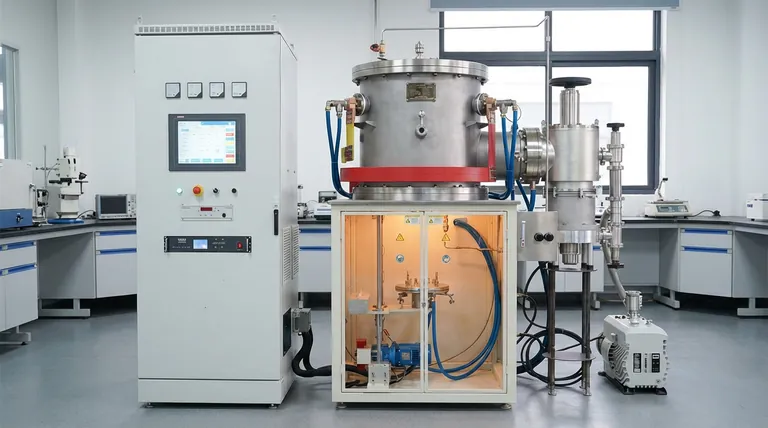
Achieving Thermodynamic Equilibrium
The Necessity of Long-Term Diffusion
In alloy studies, achieving equilibrium is not instantaneous; it is a kinetic process driven by atomic migration.
A vacuum diffusion annealing furnace is designed to maintain high temperatures for extended durations, such as 336 hours at 1100°C. This prolonged thermal exposure provides the necessary energy and time for atoms to diffuse thoroughly throughout the matrix.
The Critical Role of Vacuum Conditions
High-temperature treatment carries the risk of oxidation, which can alter the chemical composition of the sample surface and invalidate results.
By operating in a vacuum, the furnace protects the specimen from environmental contamination. This ensures that the observed microstructure results solely from internal thermodynamic drivers rather than external chemical reactions.
From As-Cast to Equilibrium
Eliminating Segregation and Stress
Raw alloys often contain component segregation and internal stresses generated during initial synthesis or rapid cooling.
The stable thermal field provided by these furnaces allows for homogenization. Over time, concentration gradients level out, and internal stresses are relieved, ensuring the material properties are uniform throughout the sample.
Transforming Metastable Phases
Initial synthesis often traps materials in "metastable" phases—temporary structures that are not energetically minimized.
Through controlled annealing, these metastable phases are given the thermal activation energy required to transform into stable equilibrium structures. This is essential for accurate phase diagram construction.
Validating Theoretical Models
Modern materials science relies heavily on predictive software like ThermoCalc.
However, these models must be ground-truthed against physical reality. The vacuum diffusion annealing furnace provides the experimental benchmark—a sample that actually matches the equilibrium assumptions made by the software—allowing researchers to confirm the accuracy of their calculations.
Understanding the Trade-offs
Resource Intensity
The pursuit of perfect equilibrium is resource-heavy. Running a furnace at 1100°C for two weeks consumes significant energy and occupies equipment for long periods, potentially creating bottlenecks in high-throughput research.
Surface Volatilization
While the vacuum prevents oxidation, high-vacuum environments at high temperatures can sometimes lead to the volatilization of specific alloying elements with high vapor pressures. This can inadvertently alter the composition of the sample's surface layers if not carefully managed or compensated for.
Making the Right Choice for Your Goal
- If your primary focus is Thermodynamic Modeling: Prioritize the vacuum integrity and temperature stability over speed to ensure your physical samples perfectly match the theoretical equilibrium assumptions of your software.
- If your primary focus is Microstructural Analysis: Ensure the annealing time is sufficient to fully dissolve metastable phases, transforming them into the stable structures required for accurate phase diagram construction.
Ultimately, the vacuum diffusion annealing furnace is the bridge between theoretical prediction and physical reality, ensuring your data reflects the true nature of the alloy.
Summary Table:
| Feature | Significance in Equilibrium Studies |
|---|---|
| High-Temp Stability | Enables long-term treatments (e.g., 336h at 1100°C) for full atomic diffusion. |
| Vacuum Environment | Prevents surface oxidation and contamination during extended heating cycles. |
| Homogenization | Eliminates segregation and internal stresses for uniform material properties. |
| Phase Stability | Facilitates the transformation of metastable phases into stable equilibrium structures. |
| Model Validation | Provides experimental benchmarks to verify software predictions like ThermoCalc. |
Elevate Your Alloy Research with KINTEK Precision
Bridge the gap between theoretical modeling and physical reality with KINTEK’s advanced thermal solutions. Backed by expert R&D and world-class manufacturing, we provide high-performance Muffle, Tube, Rotary, Vacuum, and CVD systems tailored for the rigorous demands of thermodynamic equilibrium studies.
Whether you require precise temperature uniformity for long-term annealing or superior vacuum integrity to prevent oxidation, our customizable lab high-temp furnaces are built to deliver the "physical ground truth" your research deserves.
Ready to optimize your material synthesis?
Contact KINTEK Experts Today to discuss your unique project requirements.
References
- H. SCHAEFER, Jonathan Lentz. Phase Analysis and Measurement of Local Carbon Contents in Hypoeutectic Alloys in the System Fe-C-B-Cr-W. DOI: 10.1007/s00501-024-01436-w
This article is also based on technical information from Kintek Furnace Knowledge Base .
Related Products
- Controlled Inert Nitrogen Hydrogen Atmosphere Furnace
- Vacuum Heat Treat Sintering and Brazing Furnace
- Vacuum Heat Treat Sintering Furnace with Pressure for Vacuum Sintering
- Vacuum Induction Melting Furnace
- Vacuum Heat Treat Sintering Furnace Molybdenum Wire Vacuum Sintering Furnace
People Also Ask
- How does hydrogen furnace annealing assist in preparing mechanically alloyed powders for compaction?
- How does atmospheric annealing in a controlled hydrogen furnace affect the cold compaction behavior of metal powders?
- What are the characteristics and uses of hydrogen atmospheres in furnaces? Unlock Clean Metal Processing
- What are the characteristics and uses of hydrogen atmosphere in furnaces? Achieve Superior Surface Purity and Bonding
- What controlled-atmosphere furnace conditions are required for sintering powder metallurgy copper alloy compacts? Ideal Setup



















