
A laboratory high-temperature oven is critical because it establishes a controlled thermal environment, typically around 180 °C, to finalize the processing of solid residues derived from metal salt solutions. This step ensures the complete elimination of moisture and residual solvents while triggering the initial decomposition necessary to stabilize the material for mechanical processing.
The oven serves a distinct dual function: it acts as a final drying stage for solvents and an initiation stage for chemical decomposition. This thermal stability is the prerequisite for converting raw residues into grindable, uniform catalyst powders.
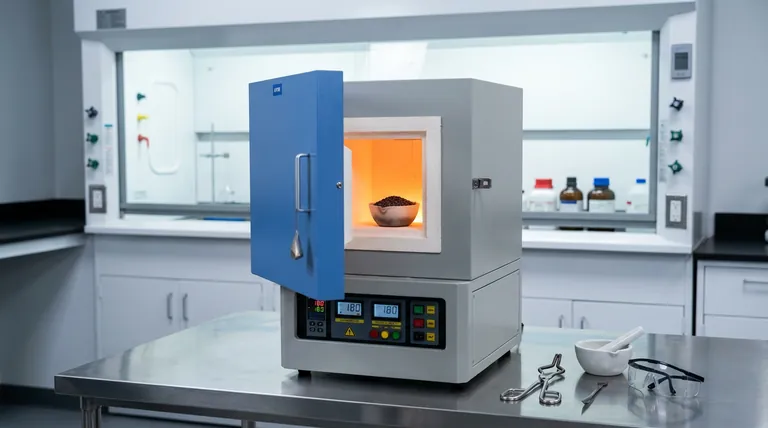
The Role of Thermal Treatment in Precursor Preparation
Achieving Complete Solvent Removal
Evaporation alone is often insufficient to remove trapped liquids within solid residues. A high-temperature oven ensures that all traces of moisture and residual solvents are driven out of the material.
Inducing Initial Decomposition
Beyond simple drying, the thermal environment at 180 °C initiates a chemical change. This step induces the initial decomposition of the metal precursors.
Transitioning from Solution to Solid
This phase marks the definitive shift from liquid-phase chemistry to solid-state processing. It locks the chemical composition into a fixed state, preventing uncontrolled reactions during subsequent handling.
Preparing for Mechanical Processing
Stabilizing the Catalyst Powder
For hierarchical carbon fibers, uniformity is key. The oven treatment converts the potentially sticky or unstable residue into a stable catalyst powder.
Enabling Fine Grinding
One of the primary goals of this thermal step is to facilitate fine grinding. Without the drying and hardening provided by the oven, the material would likely clump or resist fracture, making it impossible to achieve the necessary particle size distribution.
Understanding the Trade-offs
The Risk of Incomplete Drying
If the oven temperature is unstable or the duration is too short, residual moisture will remain. This often leads to agglomeration during the grinding phase, ruining the consistency of the catalyst.
The Danger of Thermal Overshoot
While 180 °C is the standard target, significantly exceeding this temperature could alter the metal precursors too aggressively. This might degrade the catalyst's reactivity before it is ever introduced to the carbon fiber growth process.
Ensuring Consistency in Carbon Fiber Synthesis
To achieve high-quality hierarchical carbon fibers, you must view the oven not just as a dryer, but as a chemical reactor.
- If your primary focus is powder consistency: Ensure the residues are completely dried to a brittle state to prevent clogging or uneven particle sizes during the grinding phase.
- If your primary focus is chemical stability: Maintain the temperature strictly around 180 °C to induce decomposition without degrading the active metal sites required for catalysis.
Precise thermal control at this intermediate stage is the key to transforming raw chemical solutions into high-performance structural materials.
Summary Table:
| Process Stage | Goal | Key Outcome |
|---|---|---|
| Thermal Drying | Complete solvent & moisture removal | Prevents clumping and ensures dry residue |
| Initial Decomposition | Chemical initiation at 180 °C | Stabilizes metal precursors for catalysis |
| Solid-State Transition | Hardening and stabilization | Converts sticky residue into grindable powder |
| Mechanical Prep | Fine grinding facilitation | Achieves uniform particle size distribution |
Precision Heat for Advanced Carbon Synthesis
Uniformity in hierarchical carbon fibers starts with flawless precursor preparation. KINTEK provides the specialized thermal control your lab needs to bridge the gap between liquid chemistry and solid-state success.
Backed by expert R&D and manufacturing, KINTEK offers Muffle, Tube, Rotary, Vacuum, and CVD systems—all customizable to meet your unique temperature and atmospheric requirements. Don't let unstable residues compromise your material properties; ensure consistent decomposition and grinding results with our industry-leading high-temp furnaces.
Contact KINTEK today to discuss your customization needs!
Visual Guide

References
- Sura Nguyen, Sergio O. Martínez‐Chapa. Synthesis and characterization of hierarchical suspended carbon fiber structures decorated with carbon nanotubes. DOI: 10.1007/s10853-024-09359-0
This article is also based on technical information from Kintek Furnace Knowledge Base .
Related Products
- 1800℃ High Temperature Muffle Oven Furnace for Laboratory
- 1700℃ High Temperature Muffle Oven Furnace for Laboratory
- 1200℃ Muffle Oven Furnace for Laboratory
- 1400℃ Muffle Oven Furnace for Laboratory
- High Temperature Muffle Oven Furnace for Laboratory Debinding and Pre Sintering
People Also Ask
- What is the primary function of a high-temperature laboratory muffle furnace in chemical synthesis? Achieve Precision.
- How does a high-temperature laboratory muffle furnace affect material properties? Transform Anodic Oxide Films Fast
- What role does a muffle furnace play in plant bark mineral analysis? Essential for Precise Dry Ashing & Trace Extraction
- Why is a laboratory high-temperature muffle furnace required for LaNixFe1-xO3 catalysts? Optimize Two-Stage Synthesis
- What functions does a laboratory muffle furnace perform for AISI 1025 steel post-processing? Precision Thermal Control














