
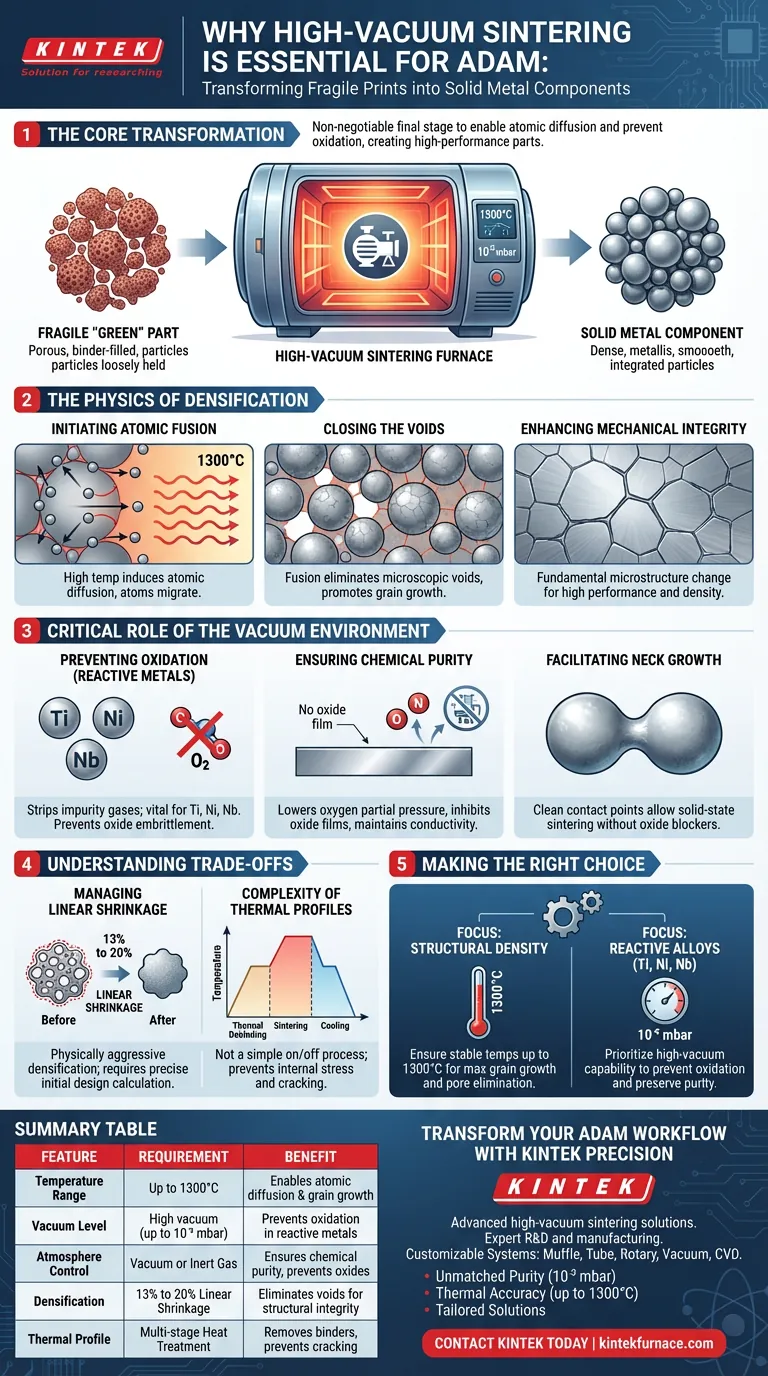
A high-vacuum sintering furnace is the non-negotiable final stage in the Atomic Diffusion Additive Manufacturing (ADAM) process because it transforms a fragile, binder-filled print into a solid metal component. By reaching extreme temperatures up to 1300°C in a controlled vacuum or inert atmosphere, the furnace enables atomic diffusion to fuse metal particles together while strictly preventing oxidation.
The furnace acts as a crucible for material transformation, creating a contaminant-free environment where metal particles merge at the atomic level. This eliminates voids and residual binders, bridging the gap between a printed "green" part and a final component with high mechanical performance and near-full density.
The Physics of Densification
Initiating Atomic Fusion
The primary function of the sintering furnace is to induce atomic diffusion. By raising the temperature to levels near the melting point of the metal—often up to 1300°C—the thermal energy causes metal atoms to migrate across particle boundaries.
Closing the Voids
As the metal powder particles fuse, the material undergoes significant densification. The furnace environment promotes grain boundary growth, which systematically eliminates the microscopic voids originally occupied by the binding agent.
Enhancing Mechanical Integrity
This fusion process does more than just harden the part; it fundamentally changes its microstructure. The result is a solid metal component that possesses the high mechanical performance and structural density required for functional engineering applications.
The Critical Role of the Vacuum Environment
Preventing Oxidation in Reactive Metals
Standard heating causes immediate oxidation in metals like titanium (Ti), nickel (Ni), and niobium (Nb). A high-vacuum environment—capable of reaching pressures as low as 10⁻⁵ mbar—is essential to strip away impurity gases and oxygen.
Ensuring Chemical Purity
Oxygen and nitrogen are highly reactive at sintering temperatures. The vacuum environment lowers the oxygen partial pressure to inhibit the formation of oxide films, which would otherwise compromise the material's electrical conductivity and phase structure.
Facilitating Neck Growth
For atomic diffusion to occur, particles must form "necks" or connection points. A vacuum ensures these contact points remain pure, allowing solid-state sintering to proceed without oxide layers blocking the connection between particles.
Understanding the Trade-offs
Managing Linear Shrinkage
The densification process is physically aggressive. As voids are removed and particles pull together, the part experiences linear shrinkage of 13% to 20%. This volume change must be perfectly calculated during the initial design phase to ensure dimensional accuracy.
Complexity of Thermal Profiles
Sintering is not a simple "on/off" heating process. The furnace must execute complex heat treatment profiles, transitioning carefully from thermal debinding (removing residual binder) to high-temperature sintering to prevent internal stress or cracking.
Making the Right Choice for Your Goal
Achieving the optimal result in ADAM processing depends on matching your furnace capabilities to your material requirements.
- If your primary focus is Structural Density: Ensure your furnace can maintain stable temperatures up to 1300°C to maximize grain boundary growth and eliminate internal porosity.
- If your primary focus is Reactive Alloys (Ti, Ni, Nb): Prioritize a furnace capable of high-vacuum levels (10⁻⁵ mbar) to prevent oxide embrittlement and preserve chemical purity.
The high-vacuum sintering furnace is not merely an oven; it is the precision instrument that dictates the final mechanical reality of your manufactured part.
Summary Table:
| Feature | Requirement in ADAM Process | Benefit to Final Metal Part |
|---|---|---|
| Temperature Range | Up to 1300°C | Enables atomic diffusion and grain boundary growth |
| Vacuum Level | High vacuum (up to 10⁻⁵ mbar) | Prevents oxidation and embrittlement in reactive metals |
| Atmosphere Control | Vacuum or Inert Gas | Ensures chemical purity and prevents oxide film formation |
| Densification | 13% to 20% Linear Shrinkage | Eliminates voids for high structural integrity |
| Thermal Profile | Multi-stage Heat Treatment | Removes binders and prevents internal cracking |
Transform Your ADAM Workflow with KINTEK Precision
Transition from a fragile 'green' part to a high-performance metal component with KINTEK’s advanced high-vacuum sintering solutions. Backed by expert R&D and manufacturing, we offer customizable Muffle, Tube, Rotary, Vacuum, and CVD systems designed to meet the rigorous demands of atomic diffusion and material densification.
Why choose KINTEK for your lab?
- Unmatched Purity: Achieve vacuum levels down to 10⁻⁵ mbar to protect reactive alloys like Titanium and Nickel.
- Thermal Accuracy: Precise control up to 1300°C for consistent shrinkage and mechanical integrity.
- Tailored Solutions: Equipment customized for your unique high-temperature research or production needs.
Ready to elevate your material science? Contact KINTEK today to discuss your furnace requirements!
Visual Guide
References
- Andrej Czán, Dominik Krišák. Analysis of the Basic Characteristics of the Working Accuracy of the Atomic Diffusion Additive Manufacturing ADAM Process by Comparison with the Selective Laser Melting SLM Process. DOI: 10.21062/mft.2024.015
This article is also based on technical information from Kintek Furnace Knowledge Base .
Related Products
- 2200 ℃ Tungsten Vacuum Heat Treat and Sintering Furnace
- 9MPa Air Pressure Vacuum Heat Treat and Sintering Furnace
- 2200 ℃ Graphite Vacuum Heat Treat Furnace
- Vacuum Heat Treat Sintering Furnace Molybdenum Wire Vacuum Sintering Furnace
- 600T Vacuum Induction Hot Press Vacuum Heat Treat and Sintering Furnace
People Also Ask
- How does a tungsten-heated vacuum sintering furnace prepare (TbxY1-x)2O3 ceramics? Achieve 99%+ Density & Purity
- What wear-resistance enhancements are achieved by powder coating? The Role of Vacuum Sintering Furnaces
- How do compaction pressure and vacuum sintering optimize porous ceramics? Maximize Density & Toughness
- What role does a high-temperature vacuum sintering furnace play in the densification of WC-10(Ni, Ni/Co) alloys?
- What core role does a high-temperature vacuum sintering furnace play in Sm:YAG ceramics? Mastering Optical Clarity



















