
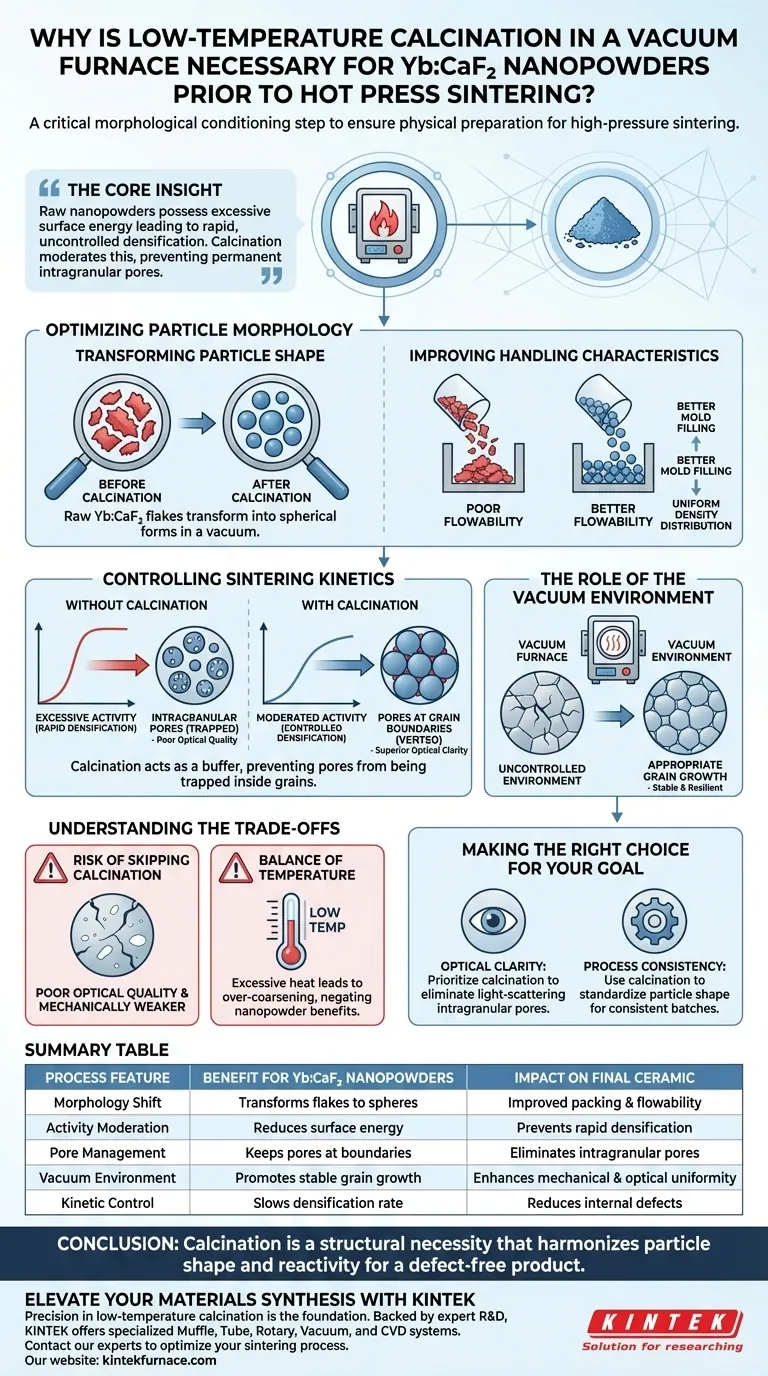
Low-temperature calcination serves as a critical morphological conditioning step for Yb:CaF2 nanopowders. It primarily functions to transform the particle shape from irregular, flake-like structures into uniform spheres, ensuring the material is physically prepared for the high pressures of sintering.
The Core Insight Raw nanopowders often possess excessive surface energy that leads to rapid, uncontrolled densification. Calcination moderates this activity, preventing the formation of permanent defects known as intragranular pores.
Optimizing Particle Morphology
Transforming Particle Shape
Raw Yb:CaF2 nanopowders often exist as irregular, flake-like particles. Low-temperature calcination in a vacuum environment induces a physical transformation, reshaping these particles into spherical forms.
Improving Handling Characteristics
This morphological shift significantly improves the flowability and dispersibility of the powder. Spherical particles pack more efficiently and move more freely than flakes, which facilitates better mold filling and uniform density distribution prior to the main sintering phase.
Controlling Sintering Kinetics
Reducing Excessive Sintering Activity
Nanopowders naturally have high surface activity, which can trigger densification too early or too quickly. Calcination acts as a buffer, reducing this excessive sintering activity to a manageable level.
Preventing Intragranular Pores
If densification occurs too rapidly, grain boundaries sweep past pores before they can be eliminated, trapping them inside the grains. These intragranular pores are notoriously difficult to remove later. By moderating the densification rate, calcination ensures pores remain at the grain boundaries where they can be effectively vented.
The Role of the Vacuum Environment
Promoting Appropriate Grain Growth
The vacuum furnace environment does not just reshape particles; it promotes appropriate grain growth. This controlled growth ensures the grains are stable enough to withstand sintering without coarsening to the point where material properties degrade.
Understanding the Trade-offs
The Risk of Skipping Calcination
Attempting to hot press raw, flake-like nanopowders typically results in a ceramic with poor optical quality. The rapid densification traps microscopic air pockets inside the crystal structure, rendering the final material less transparent and mechanically weaker.
The Balance of Temperature
While calcination is necessary, it must be kept at a "low temperature" relative to the final sintering point. Excessive heat during this pre-processing stage could lead to over-coarsening of grains, negating the benefits of using nanopowders in the first place.
Making the Right Choice for Your Goal
To maximize the quality of your Yb:CaF2 ceramics, align your process with these objectives:
- If your primary focus is Optical Clarity: Prioritize calcination to eliminate intragranular pores, which are the main scatterers of light in sintered ceramics.
- If your primary focus is Process Consistency: Use calcination to standardize particle shape, ensuring consistent flow and packing density from batch to batch.
Conclusion: Calcination is not merely a cleaning step; it is a structural necessity that harmonizes particle shape and reactivity to ensure a defect-free final product.
Summary Table:
| Process Feature | Benefit for Yb:CaF2 Nanopowders | Impact on Final Ceramic |
|---|---|---|
| Morphology Shift | Transforms flake-like particles into uniform spheres | Improved packing density & flowability |
| Activity Moderation | Reduces excessive surface energy of nanopowders | Prevents rapid, uncontrolled densification |
| Pore Management | Keeps pores at grain boundaries for venting | Eliminates light-scattering intragranular pores |
| Vacuum Environment | Promotes stable and appropriate grain growth | Enhances mechanical & optical uniformity |
| Kinetic Control | Slows densification to a manageable rate | Reduces internal defects and air pockets |
Elevate Your Materials Synthesis with KINTEK
Precision in low-temperature calcination is the foundation of high-performance Yb:CaF2 ceramics. Backed by expert R&D and manufacturing, KINTEK offers specialized Muffle, Tube, Rotary, Vacuum, and CVD systems designed to meet the rigorous demands of nanopowder processing.
Whether you need precise atmosphere control or customizable heating profiles for your unique lab requirements, our high-temperature furnaces provide the stability needed to prevent intragranular pores and ensure superior optical quality.
Ready to optimize your sintering process? Contact our experts today to find the perfect customizable solution for your laboratory.
Visual Guide
Related Products
- Vacuum Hot Press Furnace Machine Heated Vacuum Press Tube Furnace
- Vacuum Hot Press Furnace Machine Heated Vacuum Press
- 600T Vacuum Induction Hot Press Vacuum Heat Treat and Sintering Furnace
- 2200 ℃ Tungsten Vacuum Heat Treat and Sintering Furnace
- Vacuum Heat Treat Sintering Furnace with Pressure for Vacuum Sintering
People Also Ask
- Why use Vacuum Hot Press (VHP) for ZnS Ceramics? Achieve Superior IR Transparency and Mechanical Strength
- What are the benefits of the vacuum environment system in a vacuum hot press furnace? Unlock High-Density Sintering
- What safety features are incorporated in vacuum hot press furnaces? Ensure Operator and Equipment Protection
- What temperature control features do vacuum hot press furnaces have? Achieve Precision in High-Temp Material Processing
- How does a vacuum hot press furnace promote densification in the manufacturing of graphite flake/copper composites? Achieve Superior Composite Materials



















