
A high vacuum furnace is technically essential for the solution treatment of cold-rolled TNZTSF alloys because it maintains the strict oxygen-free environment required at high processing temperatures. Specifically, when treating these alloys at 850°C, the vacuum prevents surface oxidation and gas-induced embrittlement, ensuring the material remains ductile and free from environmental defects.
The primary role of the vacuum is not just to facilitate heating, but to act as a barrier against contamination. It allows for deep microstructural healing and recrystallization without the chemical interference that would otherwise compromise the alloy's structural integrity.
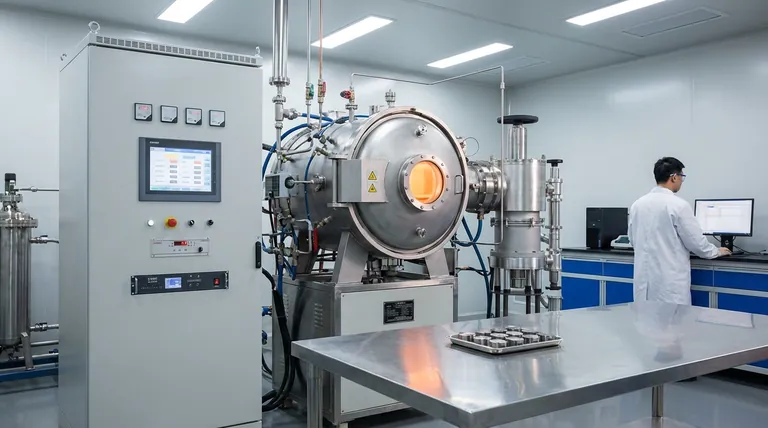
The Critical Role of Environmental Control
Preventing Surface Oxidation
At the required treatment temperature of 850°C, TNZTSF alloys become highly reactive to the atmosphere. Without a protective vacuum, the metal surface would rapidly bond with oxygen. This leads to severe surface oxidation, creating a scale that degrades the material's surface quality and dimensional accuracy.
Eliminating Gas-Induced Embrittlement
Beyond surface scaling, atmospheric gases can diffuse into the metal matrix. This absorption causes gas-induced embrittlement, drastically reducing the alloy's ductility. A high vacuum removes these gases, ensuring the final product retains the toughness required for structural applications.
Enabling Microstructural Evolution
Allowing for Long-Duration Treatment
Solution treatment often requires holding the material at high temperatures for extended periods. A high vacuum furnace provides a stable environment where the alloy can withstand this long-duration exposure without degrading. This stability is crucial for ensuring the heat permeates the entire cross-section of the material uniformly.
Facilitating Complete Recrystallization
Cold-rolling introduces significant internal stresses and deforms the grain structure of the alloy. The vacuum environment allows for complete recrystallization to occur unimpeded. This resets the microstructure, relieving internal stresses and restoring the mechanical properties lost during the cold-rolling process.
Ensuring Pure Phase Evolution
The goal of solution treatment is specific microstructural evolution. By eliminating environmental variables, the furnace ensures that changes in the material are driven solely by thermal energy. This prevents performance defects that arise when contaminants interfere with the alloy's natural phase changes.
Understanding the Trade-offs
The Risk of Vacuum Leaks
The reliance on high vacuum makes the process intolerant to equipment failure. Even a minor leak or insufficient vacuum level can introduce enough oxygen to ruin the batch. This often results in a brittle surface layer (often called an "alpha case" in titanium-based alloys) that acts as a crack initiation site.
Thermal Uniformity Challenges
While vacuum protects the chemistry, the furnace must also manage heat distribution. As seen in broader annealing applications, a uniform thermal field is necessary to eliminate residual stresses. If the vacuum furnace has poor thermal distribution, you may achieve chemical purity but suffer from inconsistent mechanical properties across the part.
Making the Right Choice for Your Goal
To maximize the performance of your TNZTSF alloys, align your processing parameters with your specific mechanical requirements.
- If your primary focus is Maximum Ductility: Ensure your furnace maintains a deep vacuum throughout the entire cycle to absolutely minimize gas absorption and prevent embrittlement.
- If your primary focus is Fatigue Strength: Prioritize thermal uniformity within the vacuum chamber to ensure consistent phase transformation and the complete elimination of residual stresses.
True material performance is achieved only when thermal precision meets absolute chemical isolation.
Summary Table:
| Feature | Impact on TNZTSF Alloy | Benefit of High Vacuum |
|---|---|---|
| Atmosphere Control | Prevents surface oxidation | Maintains surface integrity & dimensional accuracy |
| Gas Removal | Eliminates gas-induced embrittlement | Restores ductility and toughness |
| Thermal Stability | Enables long-duration exposure | Ensures uniform heat permeation and microstructural healing |
| Phase Evolution | Prevents chemical interference | Facilitates pure recrystallization and stress relief |
Elevate Your Material Performance with KINTEK
Precise solution treatment of cold-rolled TNZTSF alloys demands an uncompromising vacuum environment and thermal uniformity. KINTEK provides industry-leading Vacuum, Muffle, Tube, and CVD systems designed to eliminate contamination and ensure complete recrystallization. Backed by expert R&D and manufacturing, our high-temperature lab furnaces are fully customizable to meet your unique metallurgical needs.
Ready to achieve absolute chemical isolation and thermal precision? Contact our experts today to find the perfect furnace solution for your laboratory.
References
- Vasile Dănuț Cojocaru, Bogdan Mihai Gălbinaşu. The Effect of Solution Treatment Duration on the Microstructural and Mechanical Properties of a Cold-Deformed-by-Rolling Ti-Nb-Zr-Ta-Sn-Fe Alloy. DOI: 10.3390/ma17040864
This article is also based on technical information from Kintek Furnace Knowledge Base .
Related Products
- 2200 ℃ Tungsten Vacuum Heat Treat and Sintering Furnace
- High Pressure Laboratory Vacuum Tube Furnace
- Molybdenum Vacuum Heat Treat Furnace
- 2200 ℃ Graphite Vacuum Heat Treat Furnace
- 9MPa Air Pressure Vacuum Heat Treat and Sintering Furnace
People Also Ask
- How does a tungsten-heated vacuum sintering furnace prepare (TbxY1-x)2O3 ceramics? Achieve 99%+ Density & Purity
- How do compaction pressure and vacuum sintering optimize porous ceramics? Maximize Density & Toughness
- What wear-resistance enhancements are achieved by powder coating? The Role of Vacuum Sintering Furnaces
- What role does a high-temperature vacuum sintering furnace play in the densification of WC-10(Ni, Ni/Co) alloys?
- How does high-temp vacuum sintering influence Y-TZP mechanical properties? Achieve Max Toughness



















