
A High-Temperature Vacuum Tube Furnace is essential because it provides the strictly controlled environment necessary to reorganize an alloy's atomic structure after melting. It delivers the precise thermal energy required to drive atomic diffusion while maintaining a vacuum to ensure the process occurs without contamination.
By maintaining a stable high-temperature environment under vacuum, this equipment transforms a segregated, non-equilibrium casting into a uniform, single-phase solid solution.
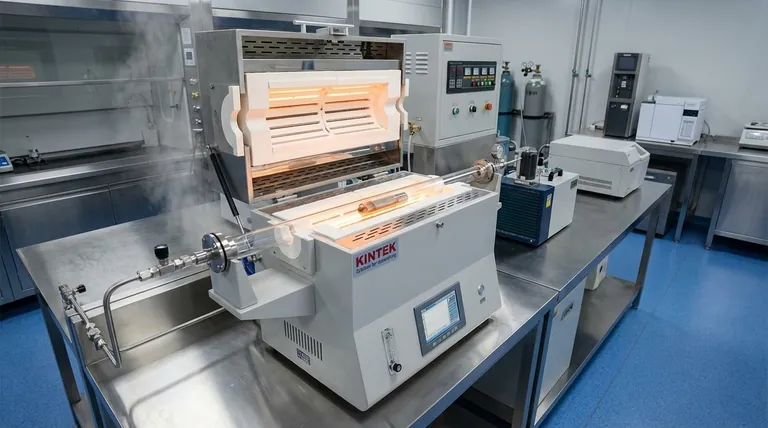
Eliminating Structural Deficiencies
Addressing Melt-Induced Segregation
When alloy ingots are initially prepared via melting, they rarely cool into a perfect, uniform state. The solidification process generates segregation and non-equilibrium structures.
The Necessity of Correction
These structural inconsistencies result in a material that is chemically and mechanically unstable. To create a usable high-performance alloy, these initial defects must be eliminated through post-preparation treatment.
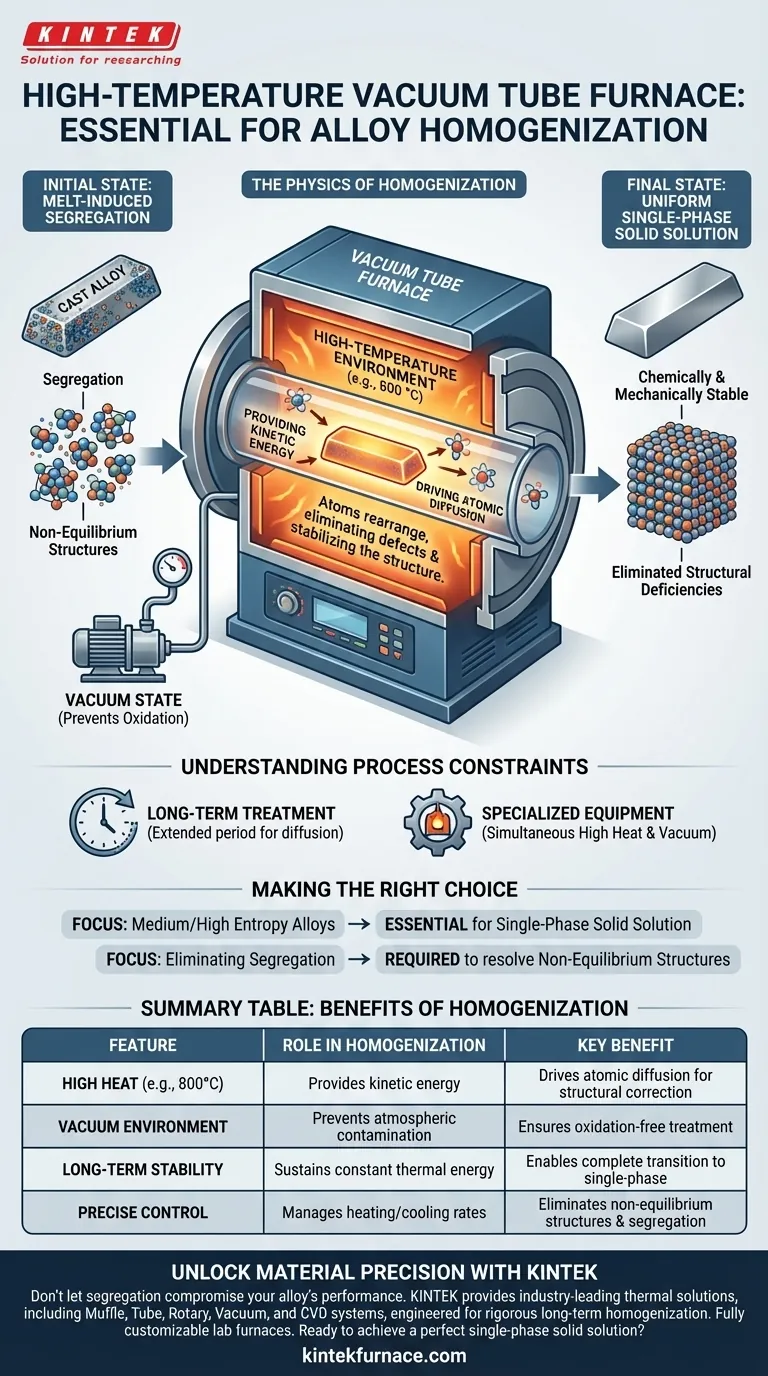
The Physics of Homogenization
Providing Kinetic Energy
Correcting the structure requires atoms to physically move and rearrange themselves within the solid material. The furnace creates a stable high-temperature environment, such as 800 °C.
Driving Atomic Diffusion
This intense heat provides the atoms with sufficient kinetic energy to diffuse. Without this added energy, the atoms would remain locked in their segregated positions.
Stabilizing the Solid Solution
As atoms diffuse, the chemical composition becomes uniform throughout the ingot. This thermal treatment is critical for stabilizing the single-phase solid solution structure, particularly for medium and high entropy alloys.
Understanding the Process Constraints
The Commitment to Long-Term Treatment
This method is not an instantaneous fix; it is a "long-term" homogenization process. It requires maintaining high temperatures and a vacuum state over an extended period to allow sufficient diffusion.
Equipment Dependency
You cannot achieve this result with standard heating methods. The requirement for simultaneous high heat and a vacuum necessitates specialized tube furnace architecture to prevent oxidation while energizing the atoms.
Making the Right Choice for Your Goal
To determine if this step is critical for your workflow, consider your specific material requirements:
- If your primary focus is Medium or High Entropy Alloys: You must use this process to stabilize the single-phase solid solution structure essential for these materials.
- If your primary focus is Eliminating Segregation: You require this specific thermal treatment to provide the kinetic energy needed to resolve non-equilibrium structures generated during melting.
Success in alloy preparation relies on recognizing that melting is only the beginning; true material stability is achieved through controlled heat and vacuum.
Summary Table:
| Feature | Role in Homogenization | Key Benefit |
|---|---|---|
| High Heat (e.g., 800°C) | Provides necessary kinetic energy | Drives atomic diffusion for structural correction |
| Vacuum Environment | Prevents atmospheric contamination | Ensures oxidation-free treatment of sensitive alloys |
| Long-term Stability | Sustains constant thermal energy | Enables complete transition to single-phase solid solution |
| Precise Control | Manages heating/cooling rates | Eliminates non-equilibrium structures and segregation |
Unlock Material Precision with KINTEK
Don't let segregation compromise your alloy's performance. KINTEK provides industry-leading thermal solutions, including Muffle, Tube, Rotary, Vacuum, and CVD systems, all engineered for rigorous long-term homogenization. Backed by expert R&D and precision manufacturing, our lab high-temperature furnaces are fully customizable to meet your specific material requirements.
Ready to achieve a perfect single-phase solid solution? Contact us today to discuss your unique research or production needs with our technical team.
Visual Guide
References
- Chao-hong Wang, Yue-Han Li. Liquid-State Interfacial Reactions of Lead-Free Solders with FeCoNiCr and FeCoNiMn Medium-Entropy Alloys at 250 °C. DOI: 10.3390/ma18102379
This article is also based on technical information from Kintek Furnace Knowledge Base .
Related Products
- 1400℃ High Temperature Laboratory Tube Furnace with Alumina Tube
- 1700℃ High Temperature Laboratory Tube Furnace with Alumina Tube
- 2200 ℃ Tungsten Vacuum Heat Treat and Sintering Furnace
- 1200℃ Split Tube Furnace Laboratory Quartz Tube Furnace with Quartz Tube
- Molybdenum Vacuum Heat Treat Furnace
People Also Ask
- How does zone-melting in tube furnaces synthesize bismuth micro-wires? Master Single-Crystal Thermoelectric Growth
- How are high-temp tube furnaces used to measure diffusion coefficients per Fick's law? Master Precision Annealing
- How are high-temperature laboratory tube furnaces applied in long-term vacuum homogenization heat treatments for intermetallic samples?
- How do high-temperature laboratory tube furnaces ensure environmental stability? Precision Thermal Reduction Tips
- How are high-temperature tube furnaces applied in testing ceramic-supported alloy membranes? Insights



















