
High-temperature vacuum annealing is the definitive purification step for graphene aerogels. This process exposes the material to extreme heat—specifically between 1300 and 2700 degrees Celsius—in an oxygen-deprived environment to completely strip away residual oxygen functional groups. By doing so, it repairs atomic defects within the lattice, transforming the material from lower-quality reduced graphene oxide into a pristine, highly conductive pure carbon network.
Core Insight: Without this specific thermal treatment, graphene aerogels remain chemically impure and structurally defective. The vacuum annealing furnace does not just "dry" the material; it fundamentally restructures the atomic lattice to unlock the high electrical conductivity and stability required for advanced applications.
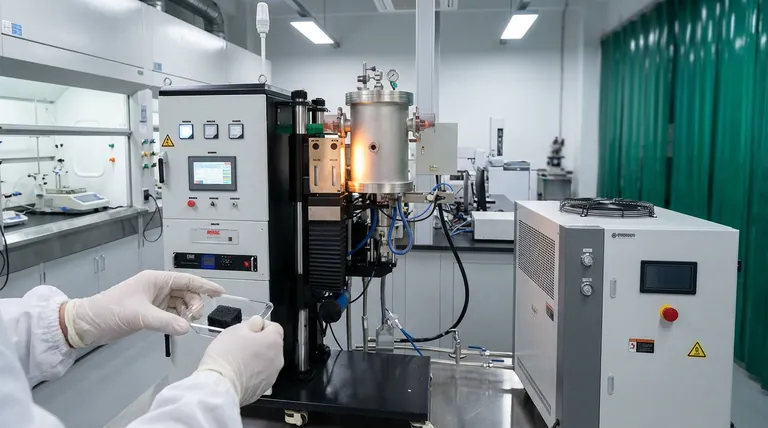
Mechanisms of Structural Transformation
Eliminating Residual Oxygen
The synthesis of graphene aerogels often leaves behind oxygen functional groups chemically bonded to the carbon structure. A high-temperature vacuum annealing furnace provides the immense thermal energy required to break these bonds.
Operating at temperatures ranging from 1300 to 2700 degrees Celsius, the furnace ensures the complete removal of these impurities. This converts the material from a chemically active oxide state into a stable carbon form.
Repairing Lattice Defects
Initial processing methods frequently damage the honeycomb lattice of graphene, introducing holes or atomic misalignments. The intense heat of the annealing process provides the activation energy needed for carbon atoms to migrate and realign.
This "healing" process repairs the structural integrity of the graphene sheets. The result is a continuous, robust network rather than a fragmented structure.
Enhancing Material Properties
Optimizing Electrical Conductivity
The presence of oxygen groups and lattice defects acts as a barrier to electron flow. By removing these scattering centers, vacuum annealing significantly enhances the electrical conductivity of the aerogel.
This step is non-negotiable if the aerogel is intended for use in conductive electrodes, sensors, or electronic components.
Achieving Material Purity
Before annealing, the material is technically "reduced graphene oxide" (rGO), which has inferior properties compared to pure graphene.
The furnace facilitates a phase transformation, converting the rGO into a high-quality, pure carbon graphene network. This purity is essential for consistent performance in precision applications.
Understanding the Operational Trade-offs
The Necessity of Vacuum
You cannot achieve these results in a standard air furnace. At temperatures exceeding 1000°C, carbon reacts aggressively with oxygen.
Without a high-quality vacuum or inert atmosphere, the graphene aerogel would simply oxidize (burn away) rather than anneal. The vacuum environment is critical to protect the matrix while allowing thermal restructuring to occur.
Process Intensity and Cost
It is important to recognize that this is an energy-intensive process. Reaching and maintaining temperatures up to 2700°C requires specialized heating elements and significant power consumption.
Furthermore, the process parameters must be strictly controlled. As noted in general vacuum processing, factors like heating rates and dwell times are critical; rushing this stage can lead to thermal shock or incomplete structural repair.
Making the Right Choice for Your Goal
To maximize the utility of your graphene aerogels, align your processing parameters with your specific performance targets:
- If your primary focus is maximum electrical conductivity: Push the annealing temperature toward the higher end of the spectrum (near 2700°C) to maximize lattice repair and electron mobility.
- If your primary focus is structural stability: Ensure your cycle times allow for sufficient atomic rearrangement to heal defects without inducing thermal stress.
The high-temperature vacuum annealing furnace is not merely a tool for drying; it is the engine that drives the evolution of your material from a raw precursor to a high-performance nanostructure.
Summary Table:
| Feature | Impact on Graphene Aerogel |
|---|---|
| Temperature (1300-2700°C) | Removes oxygen functional groups and heals lattice defects |
| Vacuum Environment | Prevents carbon oxidation (burning) and ensures material purity |
| Lattice Repair | Transforms rGO into a high-quality, pure carbon network |
| Conductivity Boost | Eliminates electron scattering centers for superior performance |
Elevate Your Material Science with KINTEK Precision
Transition from reduced graphene oxide to high-performance graphene networks with KINTEK’s industry-leading thermal solutions. Backed by expert R&D and world-class manufacturing, KINTEK offers specialized Muffle, Tube, Rotary, Vacuum, and CVD systems—all fully customizable to meet your specific annealing temperatures and atmosphere requirements.
Whether you are scaling production or conducting precision lab research, our high-temp furnaces provide the stability and control necessary to unlock the full potential of your nanostructures.
Ready to optimize your carbon material processing? Contact KINTEK today to discuss your unique needs!
References
- Martin Šilhavík, Jiří Červenka. Anderson Localization of Phonons in Thermally Superinsulating Graphene Aerogels with Metal‐Like Electrical Conductivity. DOI: 10.1002/smtd.202301536
This article is also based on technical information from Kintek Furnace Knowledge Base .
Related Products
- 2200 ℃ Tungsten Vacuum Heat Treat and Sintering Furnace
- Molybdenum Vacuum Heat Treat Furnace
- 1400℃ Controlled Inert Nitrogen Atmosphere Furnace
- 2200 ℃ Graphite Vacuum Heat Treat Furnace
- Vacuum Heat Treat Sintering Furnace Molybdenum Wire Vacuum Sintering Furnace
People Also Ask
- How does a tungsten-heated vacuum sintering furnace prepare (TbxY1-x)2O3 ceramics? Achieve 99%+ Density & Purity
- What wear-resistance enhancements are achieved by powder coating? The Role of Vacuum Sintering Furnaces
- How do compaction pressure and vacuum sintering optimize porous ceramics? Maximize Density & Toughness
- What role does a high-temperature vacuum sintering furnace play in the densification of WC-10(Ni, Ni/Co) alloys?
- What core role does a high-temperature vacuum sintering furnace play in Sm:YAG ceramics? Mastering Optical Clarity



















