
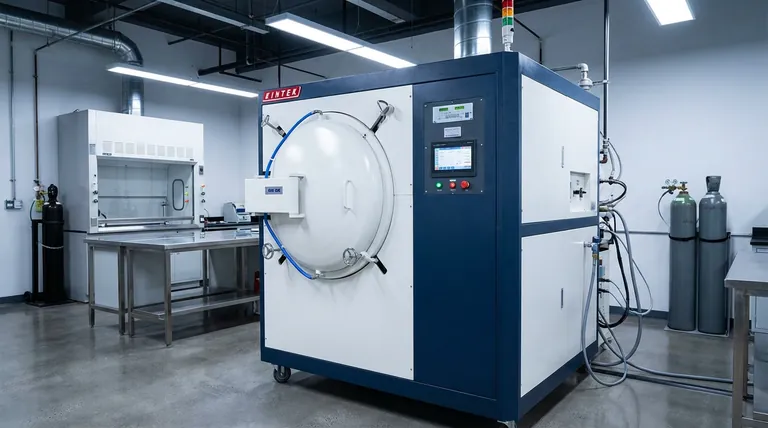
A vacuum annealing furnace is indispensable for processing Cu2Co1-xNaxSnS4 thin films because it creates the precise environment needed to balance chemical stability with structural reorganization. Specifically, it prevents the oxidation of sensitive metal components while supplying the thermal energy required to transform the material from a disordered state into a functional crystalline structure.
Core Takeaway The vacuum annealing process serves a dual purpose: it acts as a protective barrier against oxidation and as a thermodynamic catalyst for atomic rearrangement. This combination allows for the successful substitution of sodium into the crystal lattice, resulting in a stable, high-crystallinity stannite phase with minimized defects.
The Critical Role of the Vacuum Environment
Inhibiting Metal Oxidation
The presence of oxygen during high-temperature processing is detrimental to Cu2Co1-xNaxSnS4 thin films.
Vacuum conditions are required to strictly inhibit oxidation. Without this oxygen-free environment, the metal components within the film would react with atmospheric oxygen, degrading the material's purity and electronic properties before crystallization can occur.
Ensuring Uniform Heating
While the primary goal of the vacuum is chemical protection, the furnace also plays a role in thermal consistency.
Drawing from general metallurgy principles, vacuum annealing provides uniform heating characteristics. This ensures that the entire thin film experiences the same thermal conditions, preventing localized stress or uneven crystallization across the substrate.
Mechanisms of Structural Transformation
Promoting Atomic Diffusion
The "annealing" aspect of the process typically involves temperatures around 400 degrees Celsius.
At this temperature, the material undergoes significant atomic diffusion. This movement of atoms is necessary to transition the film from a disordered, amorphous state into a highly ordered, high-crystallinity stannite phase.
Facilitating Ion Substitution
For Cu2Co1-xNaxSnS4 specifically, the inclusion of Sodium (Na) is critical to the material's final properties.
The high-temperature environment provides the necessary thermodynamic conditions for this doping process. It allows sodium atoms to effectively substitute cobalt atoms within the crystal lattice, a precise structural change that cannot occur at lower energy levels.
Impact on Microstructure and Quality
Increasing Grain Size
The ultimate goal of this thermal treatment is to optimize the microscopic structure of the film.
The combination of heat and vacuum promotes the growth of crystal grains. Larger grain sizes are generally preferred in semiconductor thin films as they improve charge carrier transport.
Reducing Defects
Alongside grain growth, the annealing process heals imperfections within the material.
By reorganizing the lattice structure, the process significantly reduces grain boundary defects. This reduction in defects is essential for enhancing the overall efficiency and performance of the thin film.
Understanding the Trade-offs
While vacuum annealing is effective, it introduces specific processing constraints that must be managed.
Thermal Decomposition Risks
High temperatures facilitate necessary phase changes, but excessive heat can be destructive.
As seen in similar high-temperature processes (such as with FePt films), extreme heat can lead to the decomposition of template materials or volatile components. The temperature profile must be strictly controlled (e.g., capped at 400°C for this specific material) to ensure crystallization occurs without degrading the film or the substrate.
Making the Right Choice for Your Goal
To maximize the effectiveness of the vacuum annealing process for your specific application:
- If your primary focus is Material Purity: Prioritize the integrity of the vacuum seal to ensure absolute inhibition of oxidation during the ramp-up phase.
- If your primary focus is Electrical Performance: Optimize the temperature dwell time at 400°C to maximize grain size and ensure complete sodium substitution, which directly influences conductivity.
Success relies on balancing the protective vacuum environment with the thermodynamic energy required to drive the stannite phase transition.
Summary Table:
| Process Factor | Role in Crystallization | Impact on Thin Film |
|---|---|---|
| Vacuum Environment | Inhibits Metal Oxidation | Preserves material purity and electronic properties |
| 400°C Temperature | Thermodynamic Catalyst | Drives atomic diffusion and stannite phase formation |
| Atomic Diffusion | Structural Reorganization | Transforms amorphous states into ordered crystals |
| Ion Substitution | Facilitates Na Doping | Enables sodium atoms to substitute cobalt in the lattice |
| Controlled Cooling | Stress Management | Increases grain size and reduces boundary defects |
Elevate Your Thin Film Research with KINTEK
Achieving the perfect stannite phase requires more than just heat; it requires absolute atmospheric control and thermal precision. KINTEK provides industry-leading vacuum annealing solutions designed specifically for sensitive semiconductor applications.
Backed by expert R&D and manufacturing, KINTEK offers Muffle, Tube, Rotary, Vacuum, CVD systems, and other lab high-temp furnaces, all customizable for your unique material needs. Whether you are optimizing sodium substitution or scaling grain growth, our systems deliver the uniformity and reliability your research demands.
Ready to refine your crystallization process? Contact our technical experts today to find the ideal furnace for your laboratory.
References
- Ahmet Tumbul, Ferhat Aslan. Chemically derived quinary Cu2Co1–xNaxSnS4 photon absorber material and its photocatalytic application. DOI: 10.1007/s00339-024-07374-1
This article is also based on technical information from Kintek Furnace Knowledge Base .
Related Products
- Small Vacuum Heat Treat and Tungsten Wire Sintering Furnace
- Vacuum Heat Treat Sintering and Brazing Furnace
- Vacuum Heat Treat Sintering Furnace Molybdenum Wire Vacuum Sintering Furnace
- Vacuum Heat Treat Sintering Furnace with Pressure for Vacuum Sintering
- Vacuum Sealed Continuous Working Rotary Tube Furnace Rotating Tube Furnace
People Also Ask
- How does vacuum sintering improve dimensional tolerances? Achieve Uniform Shrinkage and Precision
- What are the key components of a vacuum sintering furnace? Essential Parts for Precision Material Processing
- What is the purpose of setting a mid-temperature dwell stage? Eliminate Defects in Vacuum Sintering
- What are the main structural components of a vacuum sintering furnace? Unlock Precision in High-Temperature Processing
- What are the main types of sintering furnaces? Find the Perfect Match for Your Materials



















