
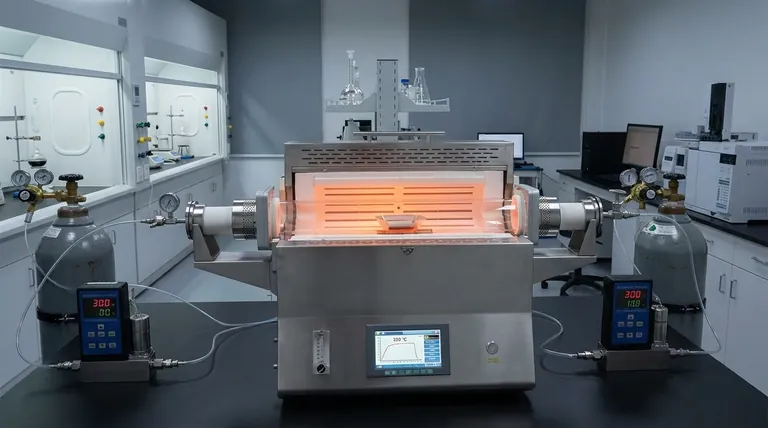
The primary requirement for a high-temperature tube furnace in this context is to create a precisely controlled thermal environment that facilitates annealing without oxidation. For composite anode materials, this specifically involves maintaining a temperature of 330 °C under an inert argon atmosphere to optimize the material's internal structure.
Core Takeaway The tube furnace enables a critical annealing process that increases material crystallinity and narrows diffraction peaks. By coupling precise heat with an inert argon shield, it enhances the electrode's electrochemical activity and structural stability while preventing the chemical degradation that would occur in air.
Optimizing Crystal Structure
The Annealing Process
The central purpose of the heat treatment is annealing.
By subjecting the composite anode material to a sustained temperature of 330 °C, the furnace provides the energy necessary for atomic rearrangement.
Enhancing Crystallinity
This thermal energy drives the optimization of the crystal structure within the composite components.
The process significantly increases the material's crystallinity.
In technical terms, this results in the narrowing of the half-width of diffraction peaks, indicating a more ordered and stable atomic lattice.
Improving Electrochemical Performance
A highly crystalline structure is directly linked to performance.
The optimized structure enhances the electrochemical activity of the anode.
Furthermore, it ensures greater structural stability, which is vital for the longevity and reliability of the composite electrode during battery cycling.
The Critical Role of the Argon Environment
Preventing Oxidation
High-temperature processing inherently increases the reactivity of materials.
Without a protective atmosphere, anode materials would react with oxygen in the air, leading to oxidation and the degradation of semiconductor properties.
Inert Shielding
Argon is an inert gas that creates a "shield" around the sample.
By displacing oxygen within the tube chamber, argon ensures that the chemical composition of the anode remains pure during the heating phase.
Mechanism of Control
Precise Thermal Regulation
A tube furnace is not just a heater; it is a precision instrument.
It utilizes thermocouples and PID controllers to maintain the temperature exactly at the required set point (in this case, 330 °C).
This stability is crucial because deviations can lead to incomplete annealing or thermal damage.
Uniform Heating Zone
The furnace design, featuring heating coils wrapped around a cylindrical chamber, creates a uniform temperature field.
This ensures that the entire sample receives consistent heat treatment, preventing gradients that could cause uneven structural properties.
Understanding the Trade-offs
Sample Volume Limitations
Tube furnaces are typically designed with a cylindrical cavity meant for small samples or thin films.
This geometry limits the volume of material you can process in a single batch compared to larger box furnaces.
Cycle Time and Throughput
The process requires a complete cycle: heating, holding, and gradual cooling.
Because the furnace must cool down gradually to prevent thermal shock, the total turnaround time for each batch can be significant.
Setup Complexity
Achieving the necessary atmosphere requires precise setup.
You must securely mount the appropriate tube material (quartz, alumina, etc.) and ensure gas lines are strictly sealed to maintain the argon environment.
Making the Right Choice for Your Goal
To maximize the benefits of this post-treatment process, align your approach with your specific objectives:
- If your primary focus is Electrochemical Performance: Prioritize the precision of the temperature hold at 330 °C to maximize crystallinity and reduce diffraction peak width.
- If your primary focus is Material Purity: Ensure your argon gas flow and sealing are flawless to prevent even trace oxidation during the heating phase.
The success of your composite anode relies on balancing rigorous thermal control with absolute atmospheric isolation.
Summary Table:
| Feature | Requirement | Impact on Anode Material |
|---|---|---|
| Temperature | 330 °C (Precise) | Facilitates atomic rearrangement and increases crystallinity |
| Atmosphere | Inert Argon | Prevents oxidation and maintains chemical purity |
| Thermal Control | PID Regulation | Ensures structural stability and uniform heating |
| Structural Change | Annealing | Narrows diffraction peaks for higher electrochemical activity |
Elevate Your Material Research with KINTEK
Maximize the electrochemical performance of your composite anodes with KINTEK’s precision thermal solutions. Backed by expert R&D and world-class manufacturing, we provide high-performance Tube, Muffle, Rotary, Vacuum, and CVD systems tailored for rigorous laboratory environments.
Whether you need customizable heating zones or advanced gas-shielding capabilities, our furnaces ensure the exact crystallinity and structural stability your research demands. Don't compromise on purity or precision.
Contact KINTEK experts today to find your custom furnace solution
Visual Guide

References
- Hyeongju Cha, Seok Ju Kang. Curved Nanographene–Graphite Hybrid Anodes with Sequential Li<sup>+</sup> Insertion for Fast‐Charging and Long‐Life Li‐Ion Batteries. DOI: 10.1002/adfm.202514795
This article is also based on technical information from Kintek Furnace Knowledge Base .
Related Products
- 1400℃ High Temperature Laboratory Tube Furnace with Alumina Tube
- 1700℃ High Temperature Laboratory Tube Furnace with Alumina Tube
- 1200℃ Split Tube Furnace Laboratory Quartz Tube Furnace with Quartz Tube
- Vertical Laboratory Quartz Tube Furnace Tubular Furnace
- 1700℃ High Temperature Muffle Oven Furnace for Laboratory
People Also Ask
- How are high-temp tube furnaces used to measure diffusion coefficients per Fick's law? Master Precision Annealing
- How do high-temperature laboratory tube furnaces ensure environmental stability? Precision Thermal Reduction Tips
- How are high-temperature laboratory tube furnaces applied in long-term vacuum homogenization heat treatments for intermetallic samples?
- How are high-temperature tube furnaces applied in testing ceramic-supported alloy membranes? Insights
- How does a laboratory high-temperature tube furnace contribute to the conversion of electrospun fibers? Expert Insights



















