
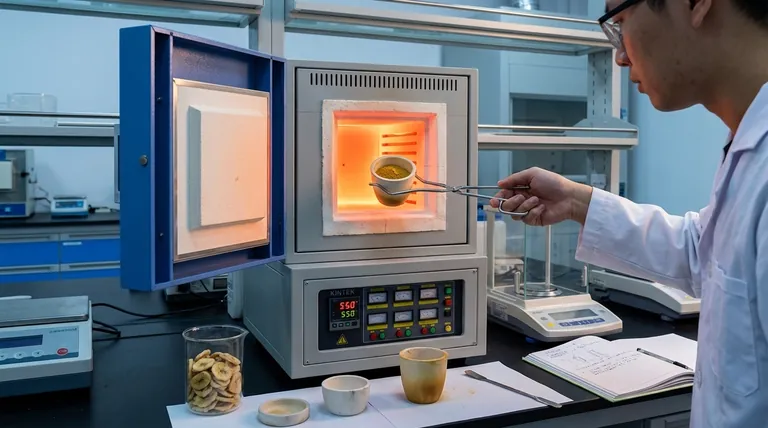
A high-temperature muffle furnace is indispensable for this analysis because it provides the sustained, extreme heat necessary to completely incinerate the organic matrix of the sample. Specifically, by maintaining a temperature of 550°C for extended periods, the furnace ensures the total oxidation of organic matter, isolating the inorganic mineral content for accurate measurement.
The muffle furnace facilitates the precise quantification of mineral content by eliminating all organic components, creating a reliable baseline to assess how different processing methods affect the nutritional value of the banana powder.
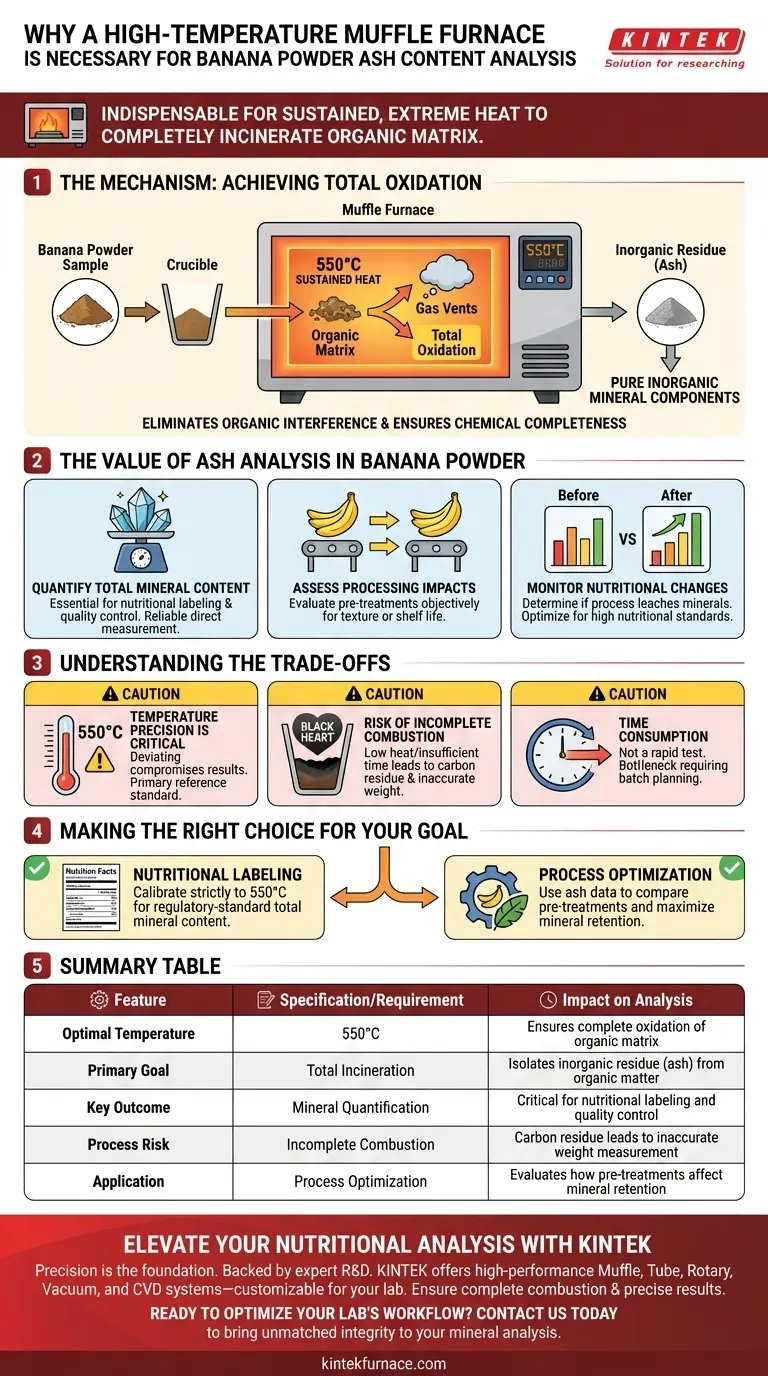
The Mechanism: Achieving Total Oxidation
Eliminating Organic Interference
The primary function of the muffle furnace is to create a controlled environment where organic matter cannot survive. At temperatures like 550°C, the carbon-based organic structures within the banana powder are chemically broken down and converted into gases.
Isolating Inorganic Residue
Once the organic material oxidizes and vents away, only the non-combustible material remains. This residue is the "ash," which represents the pure inorganic mineral components of the banana powder.
Ensuring Chemical Completeness
This process is not merely about heating; it is about driving a chemical reaction to completion. The furnace ensures that no organic carbon remains, which would otherwise falsely inflate the weight of the ash and skew analytical results.
The Value of Ash Analysis in Banana Powder
Quantifying Total Mineral Content
For researchers and producers, knowing the exact mineral payload is essential for nutritional labeling and quality control. The muffle furnace provides the only reliable method to strip away the "noise" of the organic material to measure these minerals directly.
Assessing Processing Impacts
Banana powder often undergoes various pre-treatments during manufacturing to improve texture or shelf life. Ash content analysis allows you to evaluate these treatments objectively.
Monitoring Nutritional Changes
By comparing the ash content before and after specific treatments, you can determine if a process is leaching minerals or altering the nutritional profile. This data is critical for optimizing production to maintain high nutritional standards.
Understanding the Trade-offs
Temperature Precision is Critical
While high heat is necessary, precision is equally important. The primary reference specifies 550°C for banana powder; deviating significantly from this standard can compromise results.
Risk of Incomplete Combustion
If the temperature drops too low or the time in the furnace is insufficient, organic matter will remain in the sample. This leads to "black heart" or carbon residue, rendering the weight measurement inaccurate.
Time Consumption
This is not a rapid test method. The requirement for "extended periods" of incineration means this process is a bottleneck in workflow, requiring batch planning rather than instant analysis.
Making the Right Choice for Your Goal
To effectively utilize a muffle furnace for banana powder analysis, align your procedure with your specific analytical objectives:
- If your primary focus is nutritional labeling: Ensure your furnace is calibrated strictly to 550°C to obtain a regulatory-standard measurement of total mineral content.
- If your primary focus is process optimization: Use ash content data to compare different pre-treatment batches, selecting the method that maximizes mineral retention.
Correctly utilizing a muffle furnace transforms raw data into a clear window into the purity and nutritional integrity of your final product.
Summary Table:
| Feature | Specification/Requirement | Impact on Analysis |
|---|---|---|
| Optimal Temperature | 550°C | Ensures complete oxidation of organic matrix |
| Primary Goal | Total Incineration | Isolates inorganic residue (ash) from organic matter |
| Key Outcome | Mineral Quantification | Critical for nutritional labeling and quality control |
| Process Risk | Incomplete Combustion | Carbon residue leads to inaccurate weight measurement |
| Application | Process Optimization | Evaluates how pre-treatments affect mineral retention |
Elevate Your Nutritional Analysis with KINTEK
Precision is the foundation of reliable ash content evaluation. Backed by expert R&D and manufacturing, KINTEK offers high-performance Muffle, Tube, Rotary, Vacuum, and CVD systems—all customizable to meet your unique laboratory requirements. Whether you are performing routine quality control or complex food science research, our high-temperature furnaces provide the thermal stability and accuracy you need to ensure complete combustion and precise results.
Ready to optimize your lab's workflow? Contact us today to discover how KINTEK’s advanced heating solutions can bring unmatched integrity to your mineral analysis.
Visual Guide
References
- IMPACT OF DIFFERENT PRETREATMENTS ON NUTRITIONAL, FUNCTIONAL, AND COLOR PROPERTIES OF BANANA FLOUR. DOI: 10.51470/plantarchives.2025.v25.no.1.278
This article is also based on technical information from Kintek Furnace Knowledge Base .
Related Products
- 1700℃ High Temperature Muffle Oven Furnace for Laboratory
- 1800℃ High Temperature Muffle Oven Furnace for Laboratory
- 1200℃ Muffle Oven Furnace for Laboratory
- 1400℃ Muffle Oven Furnace for Laboratory
- High Temperature Muffle Oven Furnace for Laboratory Debinding and Pre Sintering
People Also Ask
- What is the primary function of a high-temperature laboratory muffle furnace in chemical synthesis? Achieve Precision.
- How does a high-temperature laboratory muffle furnace affect material properties? Transform Anodic Oxide Films Fast
- What role does a muffle furnace play in BCZY712 electrolyte powder production? Achieve Perfect Phase Purity
- How does the two-stage sintering process contribute to the synthesis of MeCuFeO3 perovskite? Optimize crystal purity.
- What role does a muffle furnace play in sintering photocathodes? Enhance Electrode Conductivity & Catalytic Activity



















