
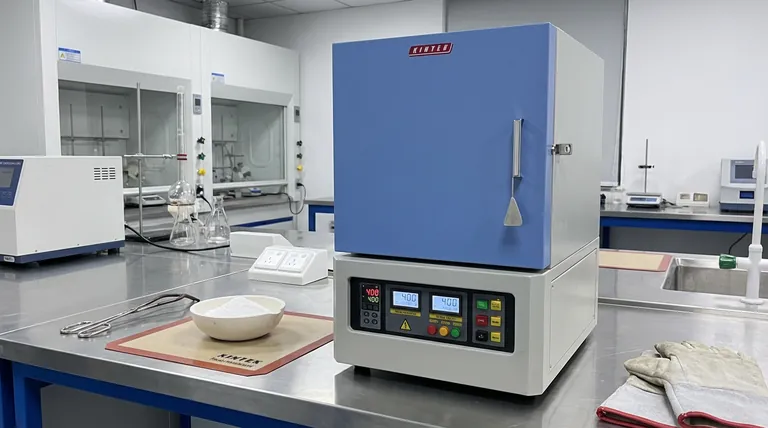
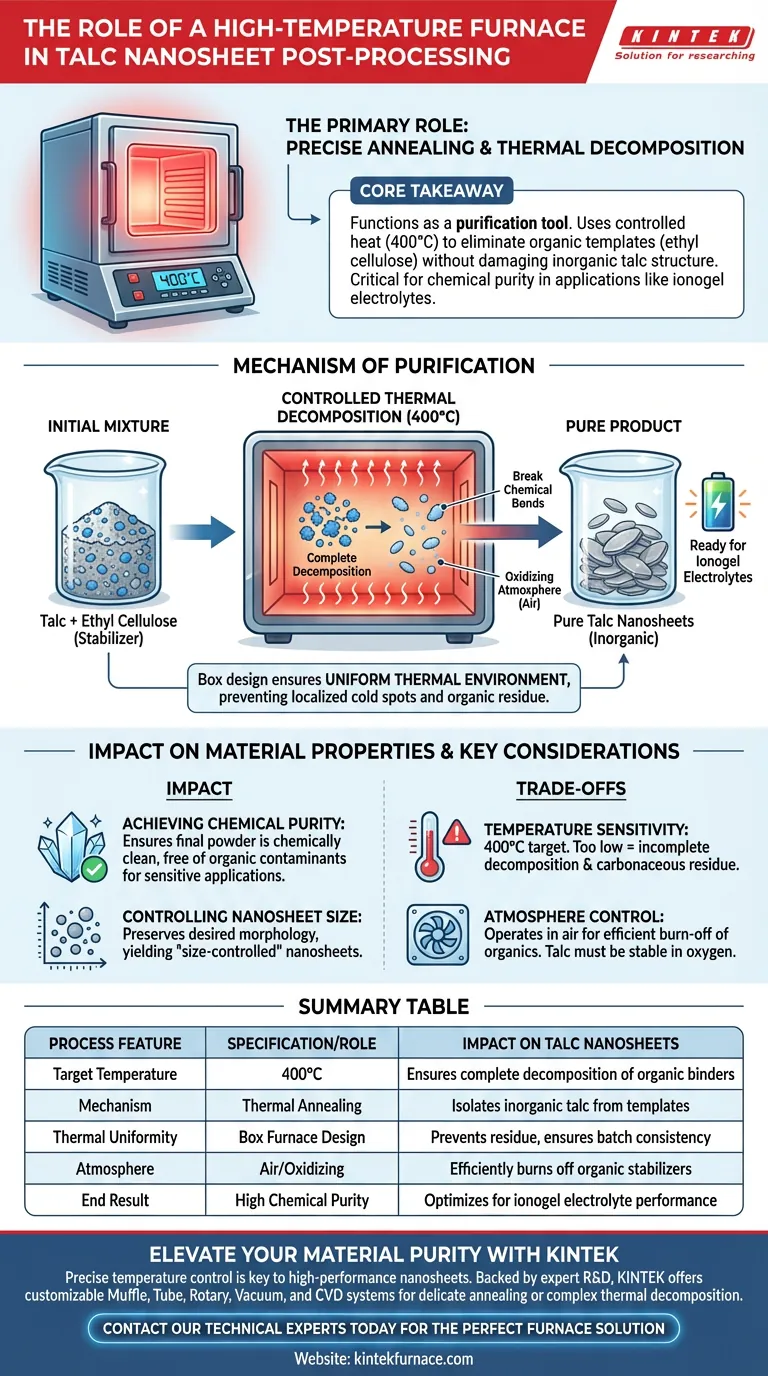
The primary role of a laboratory box high-temperature furnace in this context is to facilitate the precise annealing of talc and ethyl cellulose mixed powders. By maintaining a specific temperature of 400°C, the furnace drives the thermal decomposition of ethyl cellulose, which serves as a temporary stabilizer or template during the initial formation of the nanosheets. This thermal treatment is the decisive step that isolates the inorganic talc from the organic binders.
Core Takeaway: The furnace functions as a purification tool, utilizing controlled heat to eliminate organic templates without damaging the inorganic structure. This step is critical for achieving the chemical purity required for high-performance applications like ionogel electrolytes.
The Mechanism of Purification
Removing the Organic Template
In the initial processing stages, ethyl cellulose is mixed with talc to act as a stabilizer. While necessary for forming the nanosheets, this organic compound becomes an impurity in the final product.
The box furnace provides the thermal energy required to break down this chemical bond. It transitions the material from a composite mixture to a pure inorganic powder.
Controlled Thermal Decomposition
The furnace is set to a target temperature of 400°C. At this specific heat level, ethyl cellulose undergoes complete decomposition.
The "box" design of the furnace ensures a stable, uniform thermal environment. This uniformity is essential to ensure that the decomposition occurs evenly throughout the entire powder batch, preventing localized "cold spots" where organic residue might remain.
Impact on Material Properties
Achieving Chemical Purity
The ultimate goal of using the furnace is to produce pure talc nanosheet powders.
For sensitive applications, such as ionogel electrolytes, the presence of organic contaminants can severely hamper performance. The furnace ensures that the final powder is chemically clean and free of the ethyl cellulose precursor.
Controlling Nanosheet Size
Beyond simple purification, the annealing process helps define the physical characteristics of the powder.
The primary reference indicates that this heat treatment results in "size-controlled" nanosheets. By carefully removing the template at the correct rate and temperature, the furnace preserves the desired morphology of the talc.
Understanding the Trade-offs
Temperature Sensitivity
While 400°C is the target for this specific mixture, deviations can be problematic. If the temperature is too low, the ethyl cellulose will not decompose completely, leaving carbonaceous residue that contaminates the electrolyte.
Atmosphere Control
Laboratory box furnaces typically operate in air, which is effective for oxidizing and removing organics like ethyl cellulose.
However, unlike vacuum furnaces used for preventing oxidation in metals (such as bi-metal sintering), a standard box furnace allows for oxidation. This is beneficial here for burning off organics but requires that the talc itself remains stable in an oxygen-rich environment at that temperature.
Making the Right Choice for Your Goal
To maximize the effectiveness of your post-processing, focus on these operational priorities:
- If your primary focus is Chemical Purity: Ensure the furnace maintains 400°C for a sufficient duration to guarantee the total volatization of all ethyl cellulose content.
- If your primary focus is Electrolyte Performance: Verify that the "burn-off" process is complete, as even trace amounts of organic stabilizer can interfere with ionic conductivity in the final ionogel.
The box furnace is not just a heater; it is the final quality control gate that ensures your raw materials are chemically fit for advanced electronic applications.
Summary Table:
| Process Feature | Specification/Role | Impact on Talc Nanosheets |
|---|---|---|
| Target Temperature | 400°C | Ensures complete decomposition of organic binders |
| Mechanism | Thermal Annealing | Isolates inorganic talc from ethyl cellulose templates |
| Thermal Uniformity | Box Furnace Design | Prevents localized residue and ensures batch consistency |
| Atmosphere | Air/Oxidizing | Efficiently burns off organic stabilizers |
| End Result | High Chemical Purity | Optimizes nanosheets for ionogel electrolyte performance |
Elevate Your Material Purity with KINTEK
Precise temperature control is the difference between a contaminated sample and a high-performance nanosheet. Backed by expert R&D and world-class manufacturing, KINTEK offers a comprehensive range of Muffle, Tube, Rotary, Vacuum, and CVD systems. Whether you are performing delicate annealing or complex thermal decomposition, our laboratory high-temp furnaces are fully customizable to meet your unique research needs.
Ready to optimize your powder post-processing? Contact our technical experts today to find the perfect furnace solution for your lab.
Visual Guide
References
- Size‐Controlled Talc Nanosheet Ionogel Electrolytes for Dendrite Suppression in Solid‐State Sodium Metal Batteries. DOI: 10.1002/smsc.202500399
This article is also based on technical information from Kintek Furnace Knowledge Base .
Related Products
- 1400℃ High Temperature Laboratory Tube Furnace with Alumina Tube
- 1700℃ High Temperature Laboratory Tube Furnace with Alumina Tube
- 1800℃ High Temperature Muffle Oven Furnace for Laboratory
- 1700℃ High Temperature Muffle Oven Furnace for Laboratory
- 1200℃ Muffle Oven Furnace for Laboratory
People Also Ask
- How do high-temperature laboratory tube furnaces ensure environmental stability? Precision Thermal Reduction Tips
- How are high-temp tube furnaces used to measure diffusion coefficients per Fick's law? Master Precision Annealing
- How are high-temperature laboratory tube furnaces applied in long-term vacuum homogenization heat treatments for intermetallic samples?
- How are high-temperature tube furnaces applied in testing ceramic-supported alloy membranes? Insights
- What is the function of a furnace in CuAlMn alloy treatment? Achieve Perfect Microstructural Homogenization



















