
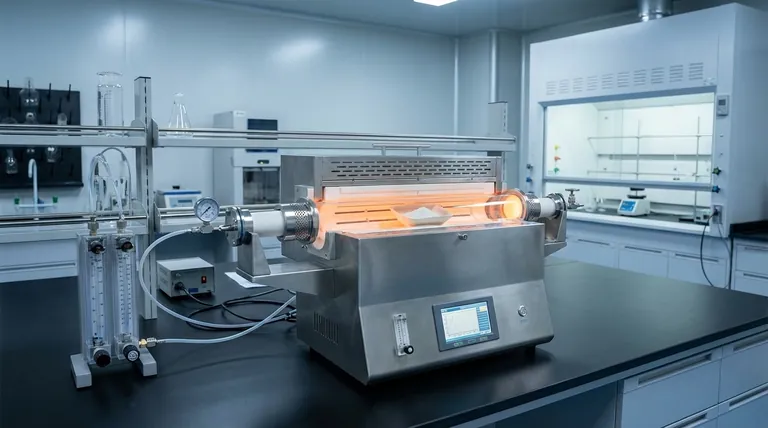
The primary purpose of using a tube or muffle furnace for the calcination of ZSM-5 zeolite catalysts is to provide a stable, high-temperature environment (typically 550 °C) required to activate the material. This thermal treatment is the critical step that transforms the synthesized raw material into a functional catalyst by removing organic residues.
By thermally decomposing the organic template agent, the furnace treatment clears blocked micro-pores and exposes the essential acid sites required for high catalytic activity and surface area.
The Mechanism of Template Removal
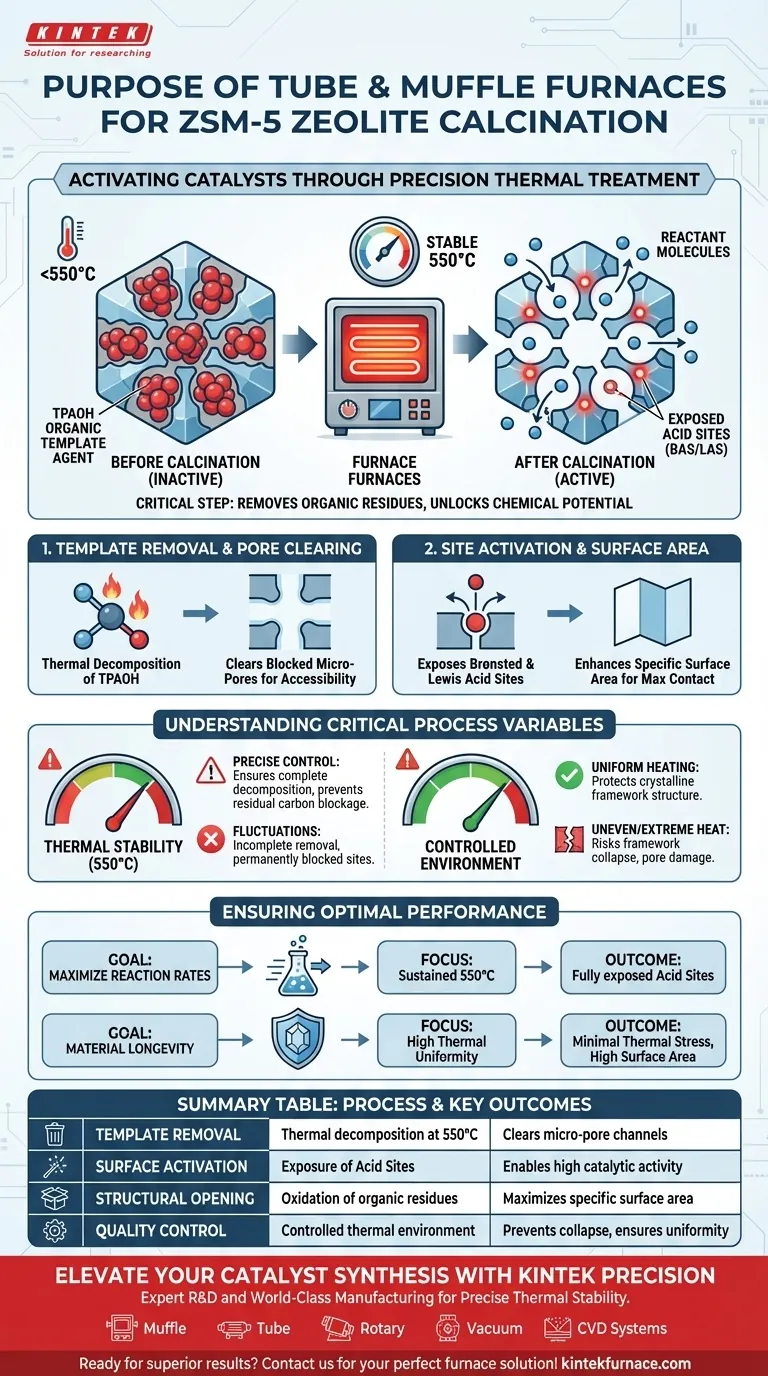
Thermal Decomposition of TPAOH
During the synthesis of ZSM-5, an organic template agent known as tetrapropylammonium hydroxide (TPAOH) is used to direct the structure. Once the structure is formed, this agent remains trapped inside the zeolite.
The furnace provides the necessary 550 °C heat to thermally decompose and oxidize this organic molecule. Without this high-temperature treatment, the template would remain, rendering the catalyst inert.
Clearing the Micro-Pore Channels
The physical removal of the TPAOH is essential for accessibility. The organic template acts as a plug, blocking the intricate network of channels within the zeolite.
Calcination burns these "plugs" away, effectively opening the micro-pores. This ensures that reactant molecules can freely enter and exit the catalyst's internal structure during future applications.
Activation of Catalytic Sites
Exposing Acid Sites
The true value of ZSM-5 lies in its chemical properties, specifically its acidity. The furnace treatment does more than just create empty space; it exposes active acid sites.
Specifically, the process reveals Brønsted and Lewis acid sites (BAS/LAS). These sites are the active centers where chemical reactions occur, making their exposure vital for the catalyst's performance.
Enhancing Specific Surface Area
A direct result of clearing the pores and exposing these sites is a dramatic increase in the material's specific surface area.
A large specific surface area allows for maximum contact between the catalyst and reactants. This is the defining characteristic of a high-efficiency ZSM-5 catalyst.
Understanding Critical Process Variables
The Importance of Thermal Stability
While the target temperature is 550 °C, the stability of the furnace environment is just as important as the temperature itself.
Fluctuations in temperature can lead to incomplete decomposition of the TPAOH. Residual carbon or organic matter left in the pores will permanently block active sites and reduce catalytic efficiency.
Preventing Structural Damage
The furnace must provide a controlled environment to ensure the zeolite framework remains intact.
If the temperature is not maintained precisely, or if the heating is uneven, there is a risk of damaging the crystalline structure. This would collapse the very pores you are attempting to clear, negating the benefits of the treatment.
Ensuring Optimal Catalyst Performance
To achieve the best results in ZSM-5 synthesis, align your furnace operation with your specific performance goals:
- If your primary focus is maximizing reaction rates: Ensure the furnace maintains a sustained 550 °C to guarantee the complete removal of TPAOH, fully exposing the Brønsted and Lewis acid sites.
- If your primary focus is material longevity: Prioritize a furnace with high thermal uniformity to clear micro-pores without inducing thermal stress that could degrade the specific surface area.
The furnace is not merely a heating device; it is the tool that unlocks the chemical potential of the ZSM-5 zeolite.
Summary Table:
| Process Objective | Mechanism | Key Outcome |
|---|---|---|
| Template Removal | Thermal decomposition of TPAOH at 550°C | Clears blocked micro-pore channels |
| Surface Activation | Exposure of Brønsted & Lewis acid sites | Enables high catalytic activity |
| Structural Opening | Oxidation of organic residues | Maximizes specific surface area |
| Quality Control | Controlled thermal environment | Prevents framework collapse & ensures uniformity |
Elevate Your Catalyst Synthesis with KINTEK Precision
Don't let temperature fluctuations compromise your ZSM-5 catalyst's activity. At KINTEK, we understand that precise thermal stability is the key to unlocking the full potential of your zeolite frameworks.
Backed by expert R&D and world-class manufacturing, we offer a comprehensive range of Muffle, Tube, Rotary, Vacuum, and CVD systems. Our lab high-temperature furnaces are fully customizable to meet your unique calcination protocols, ensuring uniform heating that protects your material's crystalline structure while maximizing specific surface area.
Ready to achieve superior catalytic results? Contact us today to find the perfect furnace solution for your lab!
Visual Guide
References
- Wei Xiong, Jun Zhao. Acidic Site-Controlled ZSM-5 Catalysts for Fast Molten-Phase Pyrolysis of Plastic Waste with Tunable Product Distribution. DOI: 10.1021/acs.energyfuels.5c02781
This article is also based on technical information from Kintek Furnace Knowledge Base .
Related Products
- Electric Rotary Kiln Pyrolysis Furnace Plant Machine Small Rotary Kiln Calciner
- Multi Zone Laboratory Quartz Tube Furnace Tubular Furnace
- Dental Porcelain Zirconia Sintering Ceramic Vacuum Press Furnace
- Chairside Dental Porcelain Zirconia Sintering Furnace with Transformer for Ceramic Restorations
People Also Ask
- What are the advantages of electric rotary kilns compared to fuel-fired ones? Boost Precision and Efficiency in Your Process
- What advantages do electric rotary kilns offer over fuel-based kilns? Boost Efficiency and Purity in Your Process
- What materials can be processed in an electric rotary kiln? Versatile Solutions for Advanced Materials
- What are the main applications of a rotary kiln electric furnace? Achieve Uniform Heat Treatment for Powders
- What are the key components of a rotary kiln electric furnace? Unlock Efficient Thermal Processing



