
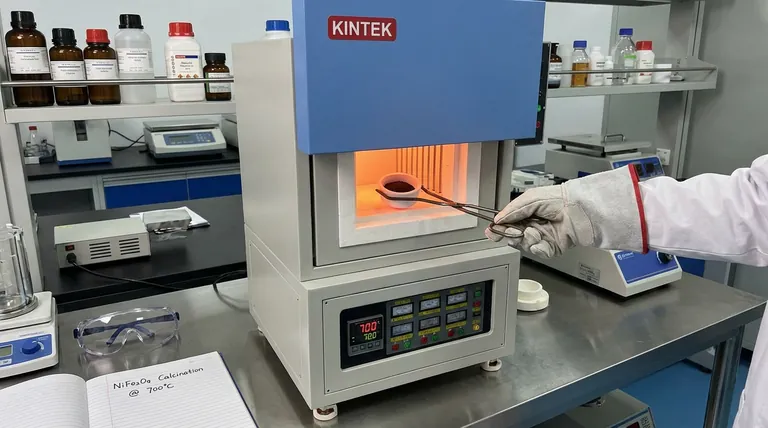
A high-temperature box resistance furnace is essential for the 700°C calcination of NiFe2O4 nanopowder because it provides the strictly controlled thermal environment needed to drive phase transformation. This specific equipment maintains a constant temperature field that converts the amorphous precursor into a stable crystalline structure while ensuring the total removal of chemical impurities left over from synthesis.
Core Insight The furnace functions as a precise reactor for atomic rearrangement, not just a heater. At 700°C, it supplies the thermal activation energy required to organize the material into a spinel phase, which is the defining characteristic that gives NiFe2O4 its specific magnetic and electrocatalytic utility.
The Mechanics of Phase Transformation
Transitioning from Amorphous to Crystalline
Before calcination, the NiFe2O4 precursor exists in an amorphous state, meaning its atomic structure is disordered.
The box resistance furnace provides a stable 700°C environment that forces these atoms to rearrange. This thermal input drives the material into a stable spinel crystalline structure, which is the thermodynamically preferred state for this compound.
Thermal Activation and Grain Development
The process relies heavily on thermal activation.
The heat supplied by the furnace energizes the atoms, allowing them to diffuse and bond correctly. This facilitates controlled grain development, ensuring the nanopowder achieves the physical structure necessary for its intended application.
Purification and Chemical Purity
Eliminating Sol-Gel Residues
The precursor material often originates from a sol-gel process, which leaves behind unwanted byproducts.
Specifically, the material contains residual organic matter and nitrate impurities. The 700°C calcination process effectively burns off these contaminants, ensuring the final powder is chemically pure.
Completing the Chemical Reaction
Without this high-temperature treatment, the material would remain a mixture of reactants rather than a pure compound.
The furnace ensures that the oxidation and decomposition of these residuals are complete. This prevents foreign substances from interfering with the material's final performance characteristics.
Defining Material Performance
Unlocking Magnetic Properties
The physical properties of NiFe2O4 are intrinsic to its crystal structure.
You cannot achieve the necessary magnetic properties without the spinel structure formed at 700°C. The furnace ensures the crystallinity is high enough to support the magnetic domains required for the material's function.
Enhancing Electrocatalytic Activity
Similarly, the material's ability to act as a catalyst depends on its surface and structural integrity.
By facilitating proper grain growth and phase purity, the calcination process directly imparts the electrocatalytic properties that make the nanopowder useful in advanced electrochemical applications.
Understanding the Trade-offs
The Risk of Temperature Instability
While 700°C is the target, the stability provided by a box resistance furnace is the critical variable.
If the temperature fluctuates significantly, the phase transformation may be incomplete, resulting in a material that is partially amorphous. Conversely, uncontrolled temperature spikes can lead to excessive grain growth, which may degrade the surface area and catalytic performance.
Time vs. Temperature Balance
The process is not instantaneous; it requires a sustained environment.
The furnace must maintain this temperature long enough to ensure the heat penetrates the entire batch and completes the reaction. Cutting this time short leads to impurities remaining in the core of the particles.
Making the Right Choice for Your Goal
If your primary focus is Magnetic Performance:
- Ensure the furnace maintains a tight temperature tolerance at 700°C to maximize crystallinity and magnetic domain formation.
If your primary focus is Chemical Purity:
- Prioritize a furnace with excellent airflow or venting capabilities to ensure oxidized organic volatiles and nitrates are fully evacuated from the chamber.
If your primary focus is Particle Size Control:
- Monitor the dwell time carefully; 700°C is necessary for phase formation, but excessive duration can lead to unwanted particle coarsening.
The high-temperature box resistance furnace is the critical tool that bridges the gap between a raw chemical mixture and a functional, high-performance nanomaterial.
Summary Table:
| Feature | Impact on NiFe2O4 Nanopowder |
|---|---|
| Phase Transformation | Converts amorphous precursors into a stable spinel crystalline structure. |
| Thermal Activation | Provides energy for atomic rearrangement and controlled grain development. |
| Impurity Removal | Eliminates organic matter and nitrate residues from the sol-gel process. |
| Property Optimization | Unlocks essential magnetic and electrocatalytic performance characteristics. |
| Temperature Stability | Prevents incomplete reactions or excessive grain coarsening during dwell time. |
Elevate Your Material Research with KINTEK
Precision calcination is the foundation of high-performance nanomaterials. Backed by expert R&D and manufacturing, KINTEK offers high-precision Muffle, Tube, Rotary, Vacuum, and CVD systems tailored for rigorous scientific requirements. Whether you are synthesizing NiFe2O4 or developing next-generation catalysts, our lab high-temp furnaces provide the thermal stability and atmospheric control you need.
Ready to optimize your thermal processes? Contact us today to discuss your custom furnace needs!
References
- Fowzia S. Alamro, Mahmoud A. Hefnawy. Modified NiFe2O4-Supported Graphene Oxide for Effective Urea Electrochemical Oxidation and Water Splitting Applications. DOI: 10.3390/molecules29061215
This article is also based on technical information from Kintek Furnace Knowledge Base .
Related Products
- 1700℃ High Temperature Laboratory Tube Furnace with Alumina Tube
- 1400℃ High Temperature Laboratory Tube Furnace with Alumina Tube
- 1700℃ Controlled Inert Nitrogen Atmosphere Furnace
- 1700℃ High Temperature Muffle Oven Furnace for Laboratory
- 1800℃ High Temperature Muffle Oven Furnace for Laboratory
People Also Ask
- How does zone-melting in tube furnaces synthesize bismuth micro-wires? Master Single-Crystal Thermoelectric Growth
- How are high-temperature laboratory tube furnaces applied in long-term vacuum homogenization heat treatments for intermetallic samples?
- How are high-temp tube furnaces used to measure diffusion coefficients per Fick's law? Master Precision Annealing
- How do high-temperature laboratory tube furnaces ensure environmental stability? Precision Thermal Reduction Tips
- How are high-temperature tube furnaces applied in testing ceramic-supported alloy membranes? Insights



















