
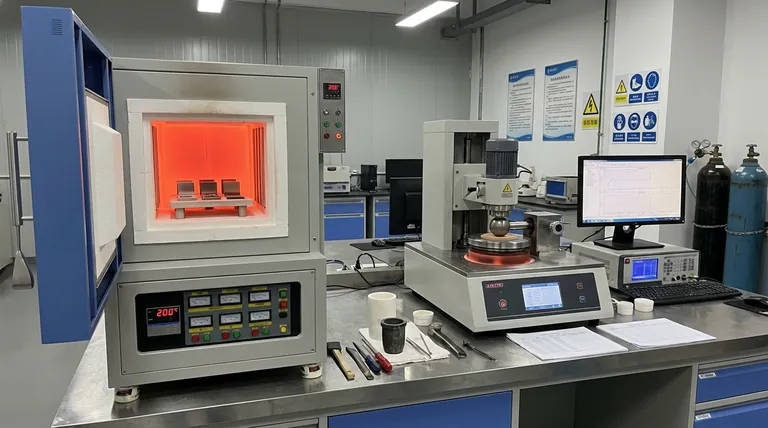
The Muffle Furnace serves as a thermal simulator, replicating the extreme heat generated by industrial tools during continuous, high-speed operations. By preheating and maintaining coating samples at specific temperatures—typically around 200 °C—it enables researchers to evaluate how protective layers perform under real-world stress rather than at ambient room temperature.
A Muffle Furnace bridges the gap between laboratory testing and industrial reality by exposing tool coatings to sustained thermal stress. This allows for the critical assessment of a coating's structural stability and its capacity to protect the underlying substrate from heat-induced failure.
Simulating Real-World Industrial Conditions
Replicating High-Speed Thermal Friction
Continuous industrial cutting, drilling, or grinding creates significant frictional heat. A Muffle Furnace maintains a constant temperature environment to mirror the thermal loads these tools face during operation.
Standardizing the Preheating Phase
For a wear test to be accurate, the sample must be thermally saturated. Holding a sample at a set temperature, such as 200 °C for 60 minutes, ensures that the wear data reflects the material's behavior in a steady-state heated environment.
Evaluating Coating Integrity and Substrate Protection
Verifying Structural Stability of DLC Layers
Specialized coatings, such as silicon-doped diamond-like carbon (DLC:Si), must remain chemically and physically intact under heat. The furnace allows researchers to observe if the coating’s atomic structure degrades or delaminates when exposed to sustained high temperatures.
Preventing Tool Steel Softening and Adhesive Wear
Excessive heat often causes the underlying tool steel to soften, leading to structural collapse. Testing in a heated state determines if the coating can effectively shield the substrate and prevent adhesive wear, where the tool and the workpiece bond together.
Understanding the Trade-offs
Static vs. Dynamic Heating
While a Muffle Furnace provides a stable thermal environment, it provides uniform heating to the entire sample. In actual industrial use, heat is often localized and fluctuates rapidly, which may produce different stress patterns than a controlled furnace environment.
Potential for Surface Oxidation
Sustained exposure to high heat within a furnace can lead to unintended oxidation of the sample surface if the atmosphere is not controlled. This can sometimes interfere with wear results by creating an oxide layer that would not exist in a vacuum or inert environment.
How to Apply This to Your Project
When integrating a Muffle Furnace into your coating validation process, consider the specific failure points of your tool.
- If your primary focus is substrate longevity: Use the furnace to determine the maximum temperature the coating can withstand before the underlying tool steel begins to lose its hardness.
- If your primary focus is coating adhesion: Use the furnace to perform "ball-on-disk" wear tests at peak operating temperatures to ensure the layer does not peel under thermal expansion.
By accurately simulating the thermal environment of the factory floor, you ensure your coating is prepared for the rigors of high-intensity industrial service.
Summary Table:
| Feature | Role in Friction/Wear Testing | Impact on Coating Validation |
|---|---|---|
| Thermal Simulation | Replicates high-speed frictional heat | Mirrors real-world industrial environments |
| Preheating/Saturation | Maintains steady-state temperatures (e.g., 200°C) | Ensures data accuracy under thermal equilibrium |
| Structural Assessment | Tests stability of DLC:Si and other layers | Identifies risk of delamination or chemical decay |
| Substrate Protection | Monitors tool steel hardness under heat | Prevents premature structural softening and failure |
Elevate Your Material Testing Precision with KINTEK
Don't settle for ambient testing when your tools operate in extreme heat. KINTEK provides industry-leading muffle furnaces designed to replicate the most rigorous industrial thermal loads. Backed by expert R&D and manufacturing, we offer highly customizable Muffle, Tube, Rotary, Vacuum, and CVD systems tailored to your specific friction and wear testing protocols.
Whether you are verifying the structural stability of DLC layers or protecting high-speed tool steel, our systems deliver the uniform heat control you need. Contact us today to discuss your unique testing requirements and see how KINTEK can enhance your lab's performance.
Visual Guide

References
- Sergey N. Grigoriev, Anna A. Okunkova. Increasing the Wear Resistance of Stamping Tools for Coordinate Punching of Sheet Steel Using CrAlSiN and DLC:Si Coatings. DOI: 10.3390/technologies13010030
This article is also based on technical information from Kintek Furnace Knowledge Base .
Related Products
- 1200℃ Muffle Oven Furnace for Laboratory
- Laboratory Muffle Oven Furnace with Bottom Lifting
- 1400℃ Muffle Oven Furnace for Laboratory
- High Temperature Muffle Oven Furnace for Laboratory Debinding and Pre Sintering
- 1700℃ High Temperature Muffle Oven Furnace for Laboratory
People Also Ask
- How does a high-temperature laboratory muffle furnace affect material properties? Transform Anodic Oxide Films Fast
- What is the primary function of a high-temperature laboratory muffle furnace in chemical synthesis? Achieve Precision.
- How is a laboratory muffle furnace used in 3D-printed PP-CF cross-linking? Achieve Thermal Stability at 150 °C
- How is a laboratory high-temperature muffle furnace used to evaluate porous Co-Al materials? Precision Thermal Analysis
- Why is a laboratory high-temperature muffle furnace used for BaTiO3? Achieve Optimal Tetragonal Crystalline Phases






