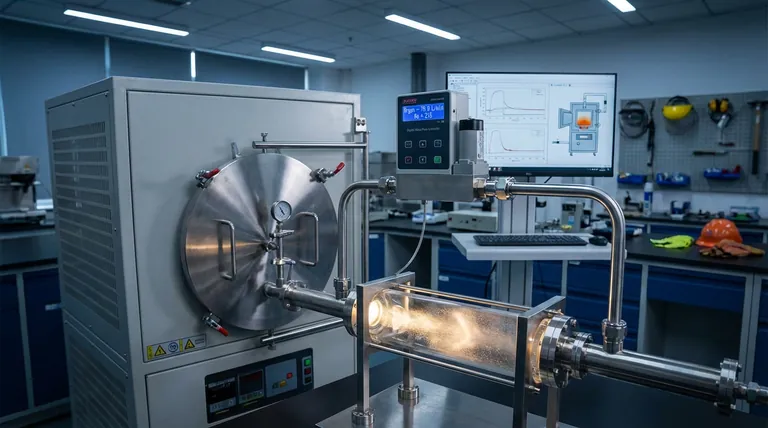
High-precision gas flow control is the critical variable for replicating industrial reality in a laboratory setting. It is used to maintain a strictly stable carrier gas flow—specifically 70 L/min of argon—to generate a Reynolds number (Re=215) that matches the actual flow field of a blast furnace.
By stabilizing the airflow to match a specific Reynolds number, the system ensures fluid dynamic similarity. This guarantees that the laboratory simulation of oil vapor, dust, and gas mixing accurately reflects what happens in a full-scale industrial purification process.
Achieving Fluid Dynamic Similarity
To understand why precision matters, you must look beyond the gas itself and focus on the physics of the flow.
Matching the Reynolds Number
The core challenge in simulation is scaling. You cannot simply shrink a blast furnace and expect fluids to behave the same way.
To bridge the gap between the lab and the factory, researchers must match the Reynolds number (Re).
The high-precision system locks the argon flow at exactly 70 L/min to achieve Re=215. This specific number ensures the flow characteristics in the test rig mirror those in the actual blast furnace.
Replicating the Flow Field
If the flow rate fluctuates, the flow field changes.
A precise control system creates a constant, predictable environment. This stability allows the simulation to mimic the exact aerodynamic forces present in the industrial equipment.
Ensuring Accurate Phase Interaction
The simulation is not just moving air; it is modeling a complex multiphase interaction involving oil, solid particles, and gas.
Consistent Mixing Environments
Oil migration involves the interaction of oil vapor, dust, and gas phases.
These elements must mix and distribute themselves exactly as they would in a real purification system.
High-precision control ensures the carrier gas (argon) transports these elements uniformly. This prevents artificial turbulence or stagnation points that would skew the mixing process.
Generating Valid Industrial Data
The ultimate goal of the simulation is to measure how oil distributes between dust, water, and gas.
If the airflow is not precise, the distribution data is meaningless.
By ensuring the flow environment is stable and similar to the real world, the resulting measurements provide a reliable industrial reference for optimizing purification processes.
Understanding the Trade-offs
While high-precision control is essential for accuracy, it introduces specific constraints that must be managed.
The Sensitivity of Simulation
The reliance on a specific Reynolds number creates a narrow operating window.
If the control system drifts or fails to maintain the 70 L/min setpoint, the fluid dynamic similarity is immediately broken.
Complexity vs. Necessity
Implementing high-precision mass flow controllers increases the complexity of the experimental setup compared to standard rotameters or manual valves.
However, this complexity is the "cost of entry" for valid data. Using lower-precision equipment would yield results that are scientifically valid for the tube but irrelevant to the blast furnace.
Making the Right Choice for Your Goal
When designing or evaluating a simulation for gas purification, focus on your end objective.
- If your primary focus is Simulation Fidelity: prioritize a flow control system capable of maintaining the exact Reynolds number (Re=215) without fluctuation.
- If your primary focus is Data Utility: ensure your flow parameters provide the fluid dynamic similarity required to make your oil distribution findings applicable to industrial scale-up.
Precision in flow control is not just about stability; it is the bridge that makes laboratory data actionable in the real world.
Summary Table:
| Parameter | Specification | Purpose in Simulation |
|---|---|---|
| Carrier Gas | Argon | Stable inert transport of oil vapor and dust |
| Flow Rate | 70 L/min | To achieve fluid dynamic similarity |
| Target Reynolds Number | Re = 215 | Matches laboratory flow field to industrial furnace |
| Phase Interaction | Multiphase | Modeling oil, dust, and gas mixing dynamics |
Optimize Your Industrial Simulations with KINTEK Precision
Bridge the gap between laboratory research and industrial reality. At KINTEK, we understand that precision is the foundation of actionable data. Backed by expert R&D and manufacturing, we provide high-performance Muffle, Tube, Rotary, Vacuum, and CVD systems, all of which can be customized with high-precision gas control to meet your unique simulation needs.
Whether you are modeling oil migration or complex gas purification, our specialized high-temperature lab furnaces ensure your research maintains the strict fluid dynamics required for valid results. Contact us today to discuss your custom furnace requirements!
References
- А. С. Харченко, E. O. Kharchenko. Modeling the distribution of components emitted from oiled scale between water, gas, and dust media in blast furnace dedusting plant. DOI: 10.17073/0368-0797-2025-4-332-338
This article is also based on technical information from Kintek Furnace Knowledge Base .
Related Products
- Ultra Vacuum Electrode Feedthrough Connector Flange Power Lead for High Precision Applications
- High Performance Vacuum Bellows for Efficient Connection and Stable Vacuum in Systems
- RF PECVD System Radio Frequency Plasma Enhanced Chemical Vapor Deposition
- Custom Made Versatile CVD Tube Furnace Chemical Vapor Deposition CVD Equipment Machine
- Cylindrical Resonator MPCVD Machine System for Lab Diamond Growth
People Also Ask
- Why is a high-precision vacuum sealing system necessary for CrSb? Ensure Pure Crystal Growth & Prevent Oxidation
- Why is an Ultra-High Vacuum (UHV) System Required for In2Se3? Achieving Atomic-Level Ferroelectric Clarity
- What is the function of quartz vacuum encapsulation in RhSeCl CVT? Mastering Pure Crystal Growth
- Why is vacuum sealing technology essential for K2In2As3 synthesis? Master High-Purity Solid-State Reactions
- What role do vacuum-sealed high-purity silica ampoules play in phase equilibrium experiments? Enhance Sample Integrity