
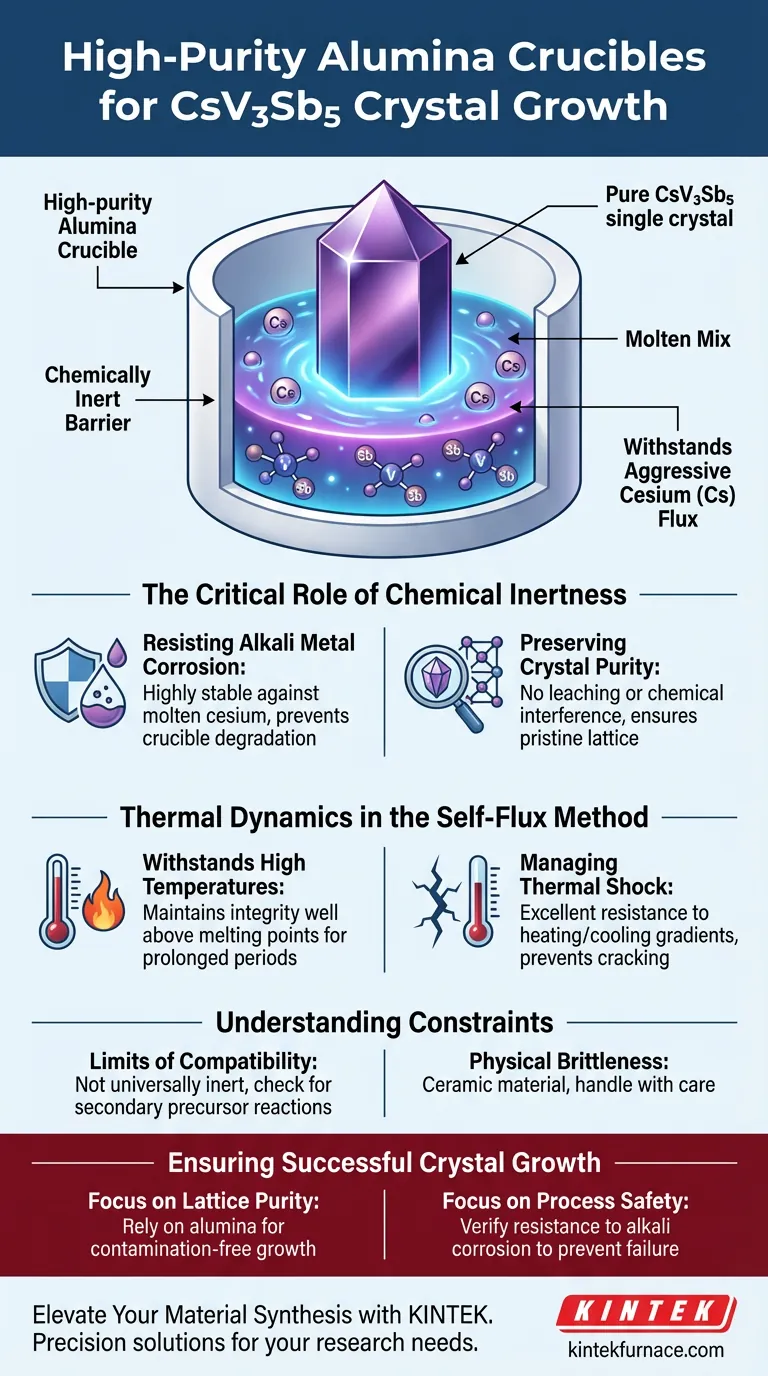
High-purity alumina crucibles are the preferred containment vessel for growing CsV3Sb5 single crystals because they provide a chemically inert barrier against aggressive reactants. Specifically, these crucibles withstand the corrosive nature of the alkali metal flux (cesium) at high temperatures, preventing the container from degrading or introducing impurities that would compromise the crystal lattice.
The success of the self-flux method hinges on the container's ability to remain invisible to the reaction. High-purity alumina is selected not just for its heat resistance, but because it refuses to chemically interact with the corrosive cesium flux, ensuring the final crystal remains pure.
The Critical Role of Chemical Inertness
Resisting Alkali Metal Corrosion
The growth of CsV3Sb5 involves the use of alkali metal fluxes, specifically cesium (Cs). These metals are highly reactive and chemically aggressive, particularly in a molten state.
Standard laboratory crucibles often degrade or react when exposed to these harsh conditions. High-purity alumina offers exceptional chemical stability, effectively acting as a shield against this corrosion.
Preserving Crystal Purity
The primary objective in single crystal growth is achieving a pristine lattice structure. Any reaction between the flux and the crucible wall can introduce foreign atoms into the melt.
Alumina’s stability ensures that the crucible material does not leach into the growth environment. This prevents chemical interference, allowing the CsV3Sb5 crystal to form without unintentional doping or defect formation.
Thermal Dynamics in the Self-Flux Method
Withstanding High Temperatures
The self-flux method requires prolonged periods of high heat to ensure the raw materials are fully dissolved.
High-purity alumina acts as a reliable carrier for these materials, maintaining its structural integrity at temperatures well above the melting points of the precursors.
Managing Thermal Shock
Crystal growth is rarely a static thermal process; it involves specific heating and cooling gradients to encourage nucleation.
Alumina possesses excellent thermal shock resistance. This property ensures the crucible does not crack or shatter during the temperature fluctuations required to precipitate the crystals from the flux.
Understanding the Constraints
The Limits of Compatibility
While alumina is exceptionally stable against alkali metals like cesium and potassium, it is not universally inert.
Researchers must ensure that no other secondary precursors in the mix have a specific affinity for reacting with aluminum oxide.
Physical Brittleness
Despite its thermal robustness, high-purity alumina remains a ceramic material.
It is inherently brittle and susceptible to mechanical failure if handled roughly, regardless of its chemical resistance.
Ensuring Successful Crystal Growth
To maximize the quality of your CsV3Sb5 samples, align your equipment choices with your experimental priorities:
- If your primary focus is Lattice Purity: Rely on high-purity alumina to prevent the leaching of contaminants that occurs with less stable crucible materials.
- If your primary focus is Process Safety: Ensure your crucible choice is specifically verified for resistance to alkali metal corrosion to prevent containment failure at high heat.
By matching the containment material to the chemical aggression of the flux, you ensure a controlled environment essential for high-quality materials synthesis.
Summary Table:
| Feature | Benefit for CsV3Sb5 Growth |
|---|---|
| Chemical Inertness | Resists corrosion from aggressive alkali metal (Cesium) flux. |
| High Purity | Prevents leaching of impurities into the crystal lattice structure. |
| Thermal Stability | Maintains structural integrity at high temperatures over long periods. |
| Thermal Shock Resistance | Withstands precise heating and cooling gradients without cracking. |
Elevate Your Material Synthesis with KINTEK
Precision in single crystal growth starts with the right containment. Backed by expert R&D and manufacturing, KINTEK provides high-performance high-purity alumina crucibles and lab high-temp furnaces—including Muffle, Tube, Rotary, Vacuum, and CVD systems—all customizable for your unique research needs. Ensure the purity of your CsV3Sb5 samples and prevent containment failure with our specialized laboratory solutions.
Ready to optimize your lab's efficiency? Contact us today to discuss your custom furnace and crucible requirements!
Visual Guide
References
- Yongqing Cai, Kai Chen. Emergence of quantum confinement in topological kagome superconductor CsV3Sb5. DOI: 10.1038/s43246-024-00461-z
This article is also based on technical information from Kintek Furnace Knowledge Base .
Related Products
People Also Ask
- What are the essential components of an MPCVD reactor system? Build a Pristine Environment for High-Purity Materials
- How does pressure affect the MPCVD growth process? Master Plasma Control for Superior Film Quality
- How do carbon-containing groups contribute to diamond growth in the MPCVD method? Unlock High-Quality Diamond Synthesis
- Why is temperature control important in the MPCVD growth process? Ensure High-Quality, Reliable Diamond Film Deposition
- What are the key components of an MPCVD system? Unlock High-Purity Crystal Growth
