
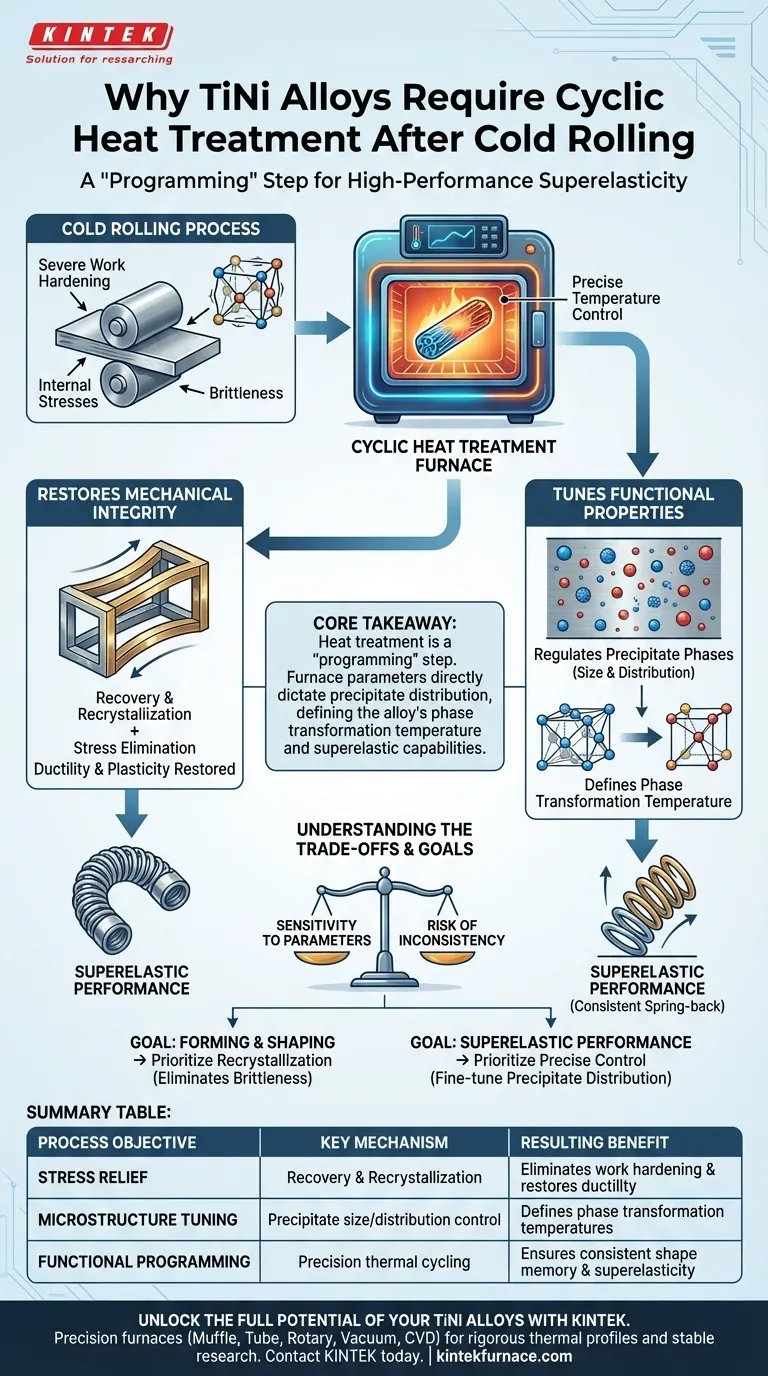
A cyclic heat treatment furnace is required to reverse the severe work hardening and internal stresses that TiNi (Titanium-Nickel) alloys accumulate during cold rolling. This specific equipment provides the precise temperature control necessary to trigger recovery and recrystallization, effectively eliminating stress and restoring the material's plasticity.
Core Takeaway Heat treatment for TiNi alloys is not merely about softening the metal; it is a "programming" step. The furnace parameters directly dictate the size and distribution of precipitates, which defines the alloy's phase transformation temperature and its resulting superelastic capabilities.
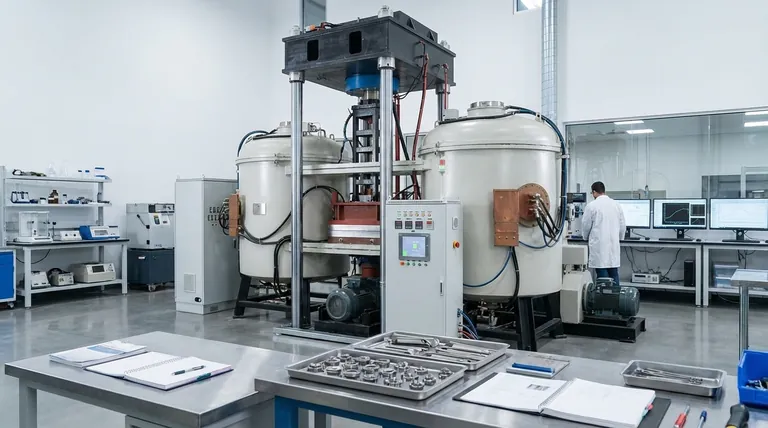
The Dual Role of Heat Treatment
Processing TiNi alloys involves more than just shaping the metal; it involves managing its internal microstructure to ensure it functions correctly.
Restoring Mechanical Integrity
Cold rolling significantly alters the physical state of the alloy, leading to work hardening. This process makes the material brittle and introduces high levels of internal residual stress.
The cyclic heat treatment furnace creates the environment needed for recovery and recrystallization. By carefully controlling the heat, the internal structure relaxes, eliminating the residual stress and restoring the ductility (plasticity) needed for further use.
Tuning Functional Properties
TiNi is valued for its functional properties, specifically shape memory and superelasticity. These properties are not inherent to the raw shape but are engineered during heat treatment.
The furnace allows for the precise regulation of temperature and time parameters. These parameters determine the size and distribution of precipitate phases within the alloy's matrix.
Regulating Phase Transformation
The behavior of these precipitates is critical. They directly regulate the phase transformation temperature—the specific point at which the alloy changes from one crystal structure to another.
This structural change is the mechanism behind the alloy's superelastic performance. Without precise control in the furnace, the alloy would not exhibit the consistent spring-back (superelasticity) required for advanced applications.
Understanding the Trade-offs
While the primary goal is restoring plasticity and tuning performance, the process requires a delicate balance.
Sensitivity to Parameters
TiNi alloys are highly sensitive to thermal history. If the temperature or duration in the furnace deviates even slightly, the precipitate distribution changes.
The Risk of Inconsistency
Incorrect parameters can lead to an alloy that is either too soft (loss of functional strength) or one that transforms at the wrong temperature. This renders the superelastic effect useless for its intended operating environment.
Making the Right Choice for Your Goal
The settings you choose within the cyclic heat treatment furnace depend heavily on the final application of the alloy.
- If your primary focus is Forming and Shaping: Prioritize parameters that maximize recrystallization to fully restore plasticity and eliminate brittleness.
- If your primary focus is Superelastic Performance: Prioritize precise control over time and temperature to fine-tune precipitate distribution, ensuring the correct phase transformation temperature.
Summary: The cyclic heat treatment furnace is the bridge between a work-hardened piece of metal and a functional, superelastic component tailored to specific engineering needs.
Summary Table:
| Process Objective | Key Mechanism | Resulting Benefit |
|---|---|---|
| Stress Relief | Recovery & Recrystallization | Eliminates work hardening & restores ductility |
| Microstructure Tuning | Precipitate size/distribution control | Defines phase transformation temperatures |
| Functional Programming | Precision thermal cycling | Ensures consistent shape memory & superelasticity |
Unlock the Full Potential of Your TiNi Alloys with KINTEK
Precision is the difference between a brittle metal and a high-performance superelastic component. Backed by expert R&D and world-class manufacturing, KINTEK offers a comprehensive range of Muffle, Tube, Rotary, Vacuum, and CVD systems, all of which can be customized to meet the rigorous thermal profiles required for TiNi processing.
Whether you are focusing on deep recrystallization for forming or fine-tuning precipitate phases for medical-grade superelasticity, our lab high-temp furnaces provide the stability and control your research demands.
Ready to elevate your material science? Contact KINTEK today to find the perfect furnace solution for your unique needs.
Visual Guide
References
- Jiajing Sun. Development of TiNi Alloy Superelastic Guidewire Needle for New Type of Medical Arthroscopic Surgery. DOI: 10.54097/mcmv2h54
This article is also based on technical information from Kintek Furnace Knowledge Base .
Related Products
- Vacuum Heat Treat Furnace with Ceramic Fiber Liner
- 2200 ℃ Graphite Vacuum Heat Treat Furnace
- Vacuum Heat Treat Sintering and Brazing Furnace
- Vacuum Heat Treat Sintering Furnace with Pressure for Vacuum Sintering
- Vacuum Heat Treat Sintering Furnace Molybdenum Wire Vacuum Sintering Furnace
People Also Ask
- How does vacuum heat treating affect the grain structure of metal alloys? Achieve Precise Microstructure Control
- What are the benefits of using vacuum heat treating furnaces for metal alloys? Achieve Superior Metal Properties and Performance
- What is one of the most important uses of vacuum heat treating furnaces in aerospace? Achieve Superior Strength in Aircraft Alloys
- How does a vacuum heat treat furnace work? Achieve Pristine, High-Performance Results
- What is the difference between heat treat and vacuum heat treat? Achieve Superior Metal Properties with Pristine Finishes



















