
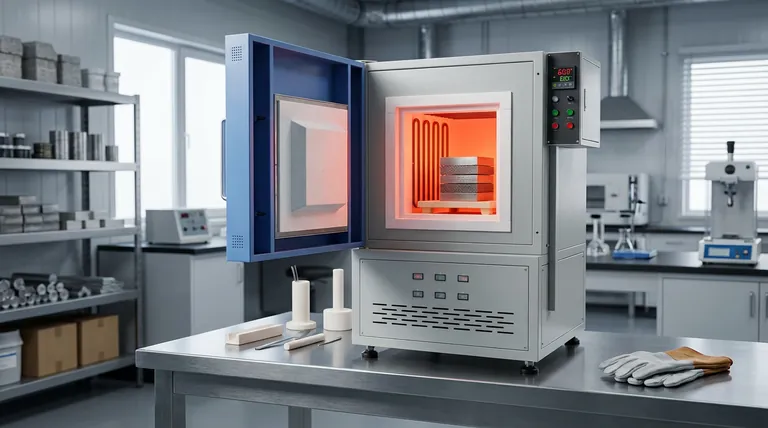
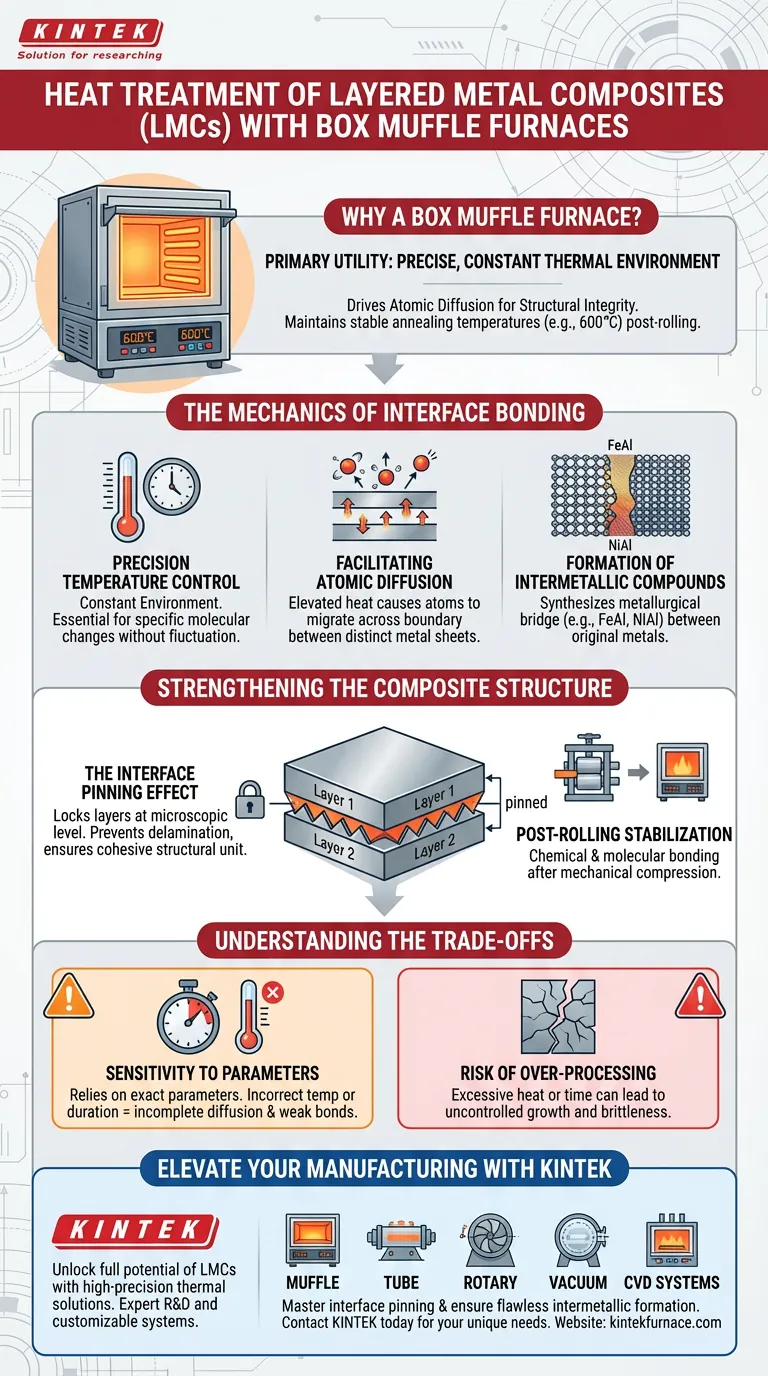
The primary utility of a box muffle furnace in the processing of Layered Metal Composites (LMCs) is to create a precise, constant thermal environment that drives atomic diffusion. By maintaining stable annealing temperatures—typically around 600°C—after the rolling process, the furnace enables the formation of critical intermetallic compound layers that are essential for structural integrity.
By facilitating controlled atomic diffusion, the box muffle furnace promotes the "interface pinning effect." This mechanism transforms weak boundaries into robust mechanical bonds through the synthesis of compounds like FeAl or NiAl.
The Mechanics of Interface Bonding
Precision Temperature Control
The fundamental requirement for treating LMCs is a constant temperature environment. A box muffle furnace provides the stability necessary to hold materials at exact specifications, such as 600°C, without significant fluctuation. This consistency is vital for initiating specific molecular changes across the entire workpiece.
Facilitating Atomic Diffusion
At these elevated temperatures, the furnace facilitates atomic diffusion at the interface between the metal layers. The heat energy excites atoms, causing them to migrate across the boundary separating the distinct metal sheets. This movement is the precursor to creating a unified composite rather than just two sheets pressed together.
Formation of Intermetallic Compounds
The goal of this diffusion is the creation of intermetallic compound layers. Depending on the materials used, compounds such as Iron-Aluminum (FeAl) or Nickel-Aluminum (NiAl) are synthesized. These new layers act as a metallurgical bridge between the original constituent metals.
Strengthening the Composite Structure
The Interface Pinning Effect
The formation of these intermetallic layers triggers the interface pinning effect. This phenomenon effectively locks the layers together at a microscopic level. It prevents delamination and ensures the composite behaves as a single, cohesive structural unit.
Post-Rolling Stabilization
This heat treatment is specifically utilized after the rolling process. While rolling mechanically compresses the layers, the furnace treatment provides the chemical and molecular bonding required for true interlaminar strength.
Understanding the Trade-offs
Sensitivity to Duration and Temperature
While the furnace enables strengthening, the process relies heavily on exact parameters. If the temperature deviates from the target (e.g., 600°C) or the duration is incorrect, the diffusion process may remain incomplete, leading to weak bonds.
Risk of Over-Processing
Conversely, excessive heat or time can alter the material structure unpredictably. The formation of intermetallic compounds must be controlled; uncontrolled growth can sometimes lead to brittleness rather than strength. The muffle furnace is a tool of precision, and its effectiveness is entirely dependent on the operator's adherence to the specific recipe required for the alloy.
Optimizing Your Heat Treatment Process
To maximize the performance of your Layered Metal Composites, consider your specific structural goals:
- If your primary focus is Bonding Strength: Ensure your furnace is calibrated to maintain the exact temperature required (e.g., 600°C) to maximize atomic diffusion and the interface pinning effect.
- If your primary focus is Material Consistency: Utilize the constant temperature capabilities of the box muffle furnace to ensure uniform intermetallic compound formation across the entire surface area.
Success in LMC fabrication ultimately relies on leveraging the furnace's stability to precisely engineer the molecular interface between metal layers.
Summary Table:
| Feature | Role in LMC Heat Treatment | Outcome |
|---|---|---|
| Temperature Stability | Maintains constant heat (e.g., 600°C) | Ensures uniform atomic diffusion |
| Atomic Diffusion | Facilitates molecular migration across layers | Precursor to metallurgical bonding |
| Compound Synthesis | Forms intermetallic layers (FeAl, NiAl) | Creates a robust chemical bridge |
| Interface Pinning | Locks layers at a microscopic level | Prevents delamination and increases strength |
Elevate Your Composite Manufacturing with KINTEK
Unlock the full potential of your Layered Metal Composites with KINTEK’s high-precision thermal solutions. Backed by expert R&D and manufacturing, we offer industry-leading Muffle, Tube, Rotary, Vacuum, and CVD systems—all fully customizable to meet your specific annealing and diffusion requirements.
Whether you need to master the interface pinning effect or ensure flawless intermetallic compound formation, our lab high-temp furnaces provide the thermal stability essential for your success. Contact KINTEK today to discuss your unique needs and let our experts help you engineer the perfect thermal environment for your materials.
Visual Guide
References
- The Influence of Interface Morphology on the Mechanical Properties of Binary Laminated Metal Composites Fabricated by Hierarchical Roll-Bonding. DOI: 10.3390/met15060580
This article is also based on technical information from Kintek Furnace Knowledge Base .
Related Products
- Laboratory Muffle Oven Furnace with Bottom Lifting
- 1400℃ Muffle Oven Furnace for Laboratory
- 1200℃ Muffle Oven Furnace for Laboratory
- 1700℃ High Temperature Muffle Oven Furnace for Laboratory
- High Temperature Muffle Oven Furnace for Laboratory Debinding and Pre Sintering
People Also Ask
- Why is a high-temperature muffle furnace required for FeOx-MOx/TiO2? Engineering High-Performance Nanocomposites
- What function does a muffle furnace perform in Ba0.75Ca0.25TiO3 calcination? Ensure Phase Purity & Synthesis
- Why is a high-temperature laboratory muffle furnace essential for the alkali fusion process in zeolite synthesis?
- What is the importance of the calcination process? Master High-Purity Calcium Phosphate Nanopowder Production
- What are the primary functions of a high-temperature laboratory muffle furnace in the preparation of biosorbent materials?



















