
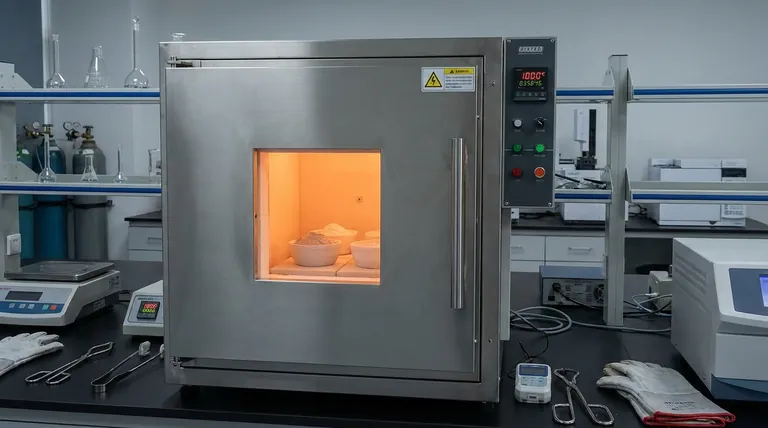
The industrial-grade box-type high-temperature furnace acts as the critical catalyst for synthesizing NaY(WO4)2 crystals. It provides the sustained thermal environment—specifically around 1000°C for extended periods like 4 hours—required to drive solid-state reactions. This precise application of heat forces the precursor components to diffuse and reorganize, effectively locking them into a specific tetragonal crystalline structure.
Achieving the correct crystal phase is not merely about reaching a high temperature; it is about sustaining a stable thermal environment. The furnace ensures that atomic diffusion occurs uniformly throughout the sample, transforming raw powder into a consistent NaY(WO4)2 phase.
Driving the Solid-State Reaction
To understand the furnace's role, you must look beyond simple heating and understand the physics of the reaction occurring inside the chamber.
Facilitating Atomic Diffusion
In the solid state, atoms are tightly bound and resistant to movement. The furnace creates a high-energy environment that overcomes this resistance.
By holding the temperature at 1000°C, the furnace provides the kinetic energy necessary for atoms within the precursor powder to migrate. This diffusion is the fundamental mechanism that allows chemically distinct powders to react and bond.
The Importance of Holding Time
Reaching the target temperature is only the first step; maintaining it is where the phase formation happens.
The process requires a controlled holding time, typically 4 hours. This duration allows the slow process of diffusion to reach completion, ensuring the reaction fully converts the precursors rather than leaving unreacted material behind.
Establishing Structural Integrity
The ultimate goal of this thermal treatment is not just chemical bonding, but specific crystallographic arrangement.
Forming the Tetragonal Structure
The thermal treatment dictates the final geometry of the crystal lattice. Under these specific conditions, the material adopts a tetragonal structure.
This structure is specific to the NaY(WO4)2 phase. Deviations in temperature or time could result in intermediate phases or incomplete crystallization, failing to achieve the desired material properties.
Ensuring Consistency Across Samples
For industrial applications, the "box-type" design of the furnace is significant.
It creates a large, thermally uniform chamber. This thermal uniformity is critical for large-scale samples, ensuring that the crystal quality at the center of the batch is identical to the quality at the edges.
Understanding Process Trade-offs
While high-temperature furnaces are essential, they introduce specific variables that must be managed to avoid processing errors.
The Risk of Thermal Gradients
If the furnace does not maintain absolute uniformity, thermal gradients can occur within the chamber.
This leads to inconsistent phase formation, where parts of the sample may be fully crystallized while others remain under-reacted. Relying on industrial-grade equipment mitigates this, but proper sample loading is still required to ensure even airflow and heat distribution.
Balancing Reaction vs. Agglomeration
While heat drives the necessary diffusion, excessive heat or uncontrolled ramp rates can have side effects.
Extended thermal treatment facilitates the reaction but must be carefully controlled to prevent excessive grain growth or agglomeration. The precise control offered by these furnaces allows you to find the sweet spot between full phase formation and maintaining a usable particle size.
Making the Right Choice for Your Goal
Selecting the right thermal profile depends heavily on what you value most in your final material.
- If your primary focus is Phase Purity: Ensure your furnace can maintain the 1000°C setpoint within tight tolerances to guarantee the complete formation of the tetragonal structure.
- If your primary focus is Batch Consistency: Prioritize a box-type furnace with verified thermal uniformity to prevent gradients across larger powder volumes.
Success in synthesizing NaY(WO4)2 relies on treating the furnace not just as a heater, but as a precision instrument for controlling atomic organization.
Summary Table:
| Parameter | Influence on NaY(WO4)2 Formation | Key Benefit |
|---|---|---|
| Temperature (1000°C) | Facilitates kinetic energy for atomic diffusion | Overcomes solid-state resistance |
| Holding Time (4h) | Allows complete precursor conversion | Eliminates unreacted material |
| Thermal Uniformity | Prevents temperature gradients | Ensures consistent batch crystallization |
| Controlled Environment | Dictates crystallographic arrangement | Formation of stable tetragonal structure |
Optimize Your Crystal Synthesis with KINTEK
Precision thermal processing is the difference between a pure crystal phase and a failed reaction. KINTEK provides industry-leading Muffle, Tube, Rotary, Vacuum, and CVD systems designed to maintain the rigorous stability required for NaY(WO4)2 synthesis.
Backed by expert R&D and precision manufacturing, our lab high-temperature furnaces are fully customizable to meet your specific temperature profiles and uniformity requirements. Ensure your material research reaches its full potential with equipment built for accuracy.
Ready to elevate your material properties? Contact our technical experts today to find the perfect furnace solution for your laboratory needs.
References
- Duan Gao, Lihong Cheng. Near infrared emissions from both high efficient quantum cutting (173%) and nearly-pure-color upconversion in NaY(WO4)2:Er3+/Yb3+ with thermal management capability for silicon-based solar cells. DOI: 10.1038/s41377-023-01365-2
This article is also based on technical information from Kintek Furnace Knowledge Base .
Related Products
- 1400℃ High Temperature Laboratory Tube Furnace with Alumina Tube
- 1700℃ High Temperature Laboratory Tube Furnace with Alumina Tube
- 1700℃ High Temperature Muffle Oven Furnace for Laboratory
- 1800℃ High Temperature Muffle Oven Furnace for Laboratory
- 1200℃ Split Tube Furnace Laboratory Quartz Tube Furnace with Quartz Tube
People Also Ask
- How does zone-melting in tube furnaces synthesize bismuth micro-wires? Master Single-Crystal Thermoelectric Growth
- How are high-temp tube furnaces used to measure diffusion coefficients per Fick's law? Master Precision Annealing
- How do high-temperature laboratory tube furnaces ensure environmental stability? Precision Thermal Reduction Tips
- How are high-temperature laboratory tube furnaces applied in long-term vacuum homogenization heat treatments for intermetallic samples?
- How are high-temperature tube furnaces applied in testing ceramic-supported alloy membranes? Insights



















