Precision and safety are the twin pillars of successful Chemical Vapor Deposition (CVD). In a two-step MoS2 synthesis process, Mass Flow Controllers (MFCs) are strictly required to maintain a constant Argon carrier gas flow rate to ensure uniform crystal growth, while KOH bubblers function as essential downstream filtration units to neutralize hazardous sulfur by-products and protect the vacuum infrastructure.
The MFC guarantees the stable thermodynamic environment necessary for high-quality monolayer formation, whereas the KOH bubbler acts as a critical safety barrier, preventing sulfur contamination of equipment and ensuring laboratory compliance.
The Role of Mass Flow Controllers (MFC)
Regulating Carrier Gas Flow
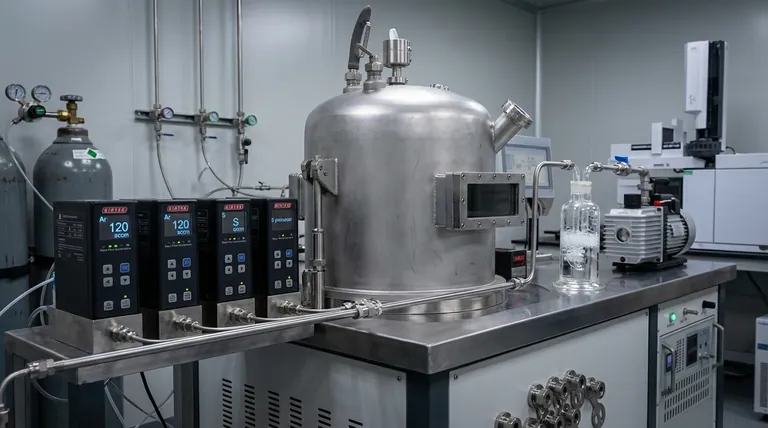
The primary function of the MFC is to deliver the carrier gas (typically Argon) at a precise, unvarying rate, such as 120 cm³/min.
Without this automation, manual adjustments would lead to fluctuations that disrupt the synthesis process.
Maintaining Stable Reaction Pressure
A constant flow rate is the prerequisite for maintaining stable reaction pressure inside the CVD furnace.
Pressure stability is essential because even minor deviations can alter the vapor concentration in the chamber, leading to inconsistent material deposition.
Ensuring Uniform Monolayer Growth
The ultimate goal of the MFC is to facilitate uniform monolayer growth of the MoS2 crystals.
By strictly regulating the flow ratio, the MFC controls the supersaturation levels and reactant supply, ensuring the synthesized material maintains consistent morphological characteristics rather than growing irregularly.
The Critical Function of KOH Bubblers
Tail Gas Treatment
The KOH (Potassium Hydroxide) bubbler is installed at the end of the system to act as a tail gas treatment unit.
Its chemical role is to absorb and neutralize residual sulfur vapor and other acidic reaction by-products that exit the furnace.
Protecting the Vacuum System
Beyond chemical neutralization, the bubbler serves as a physical barrier that protects the vacuum system.
By trapping corrosive vapors before they reach the pump, it prevents damage to the CVD equipment's delicate internal components.
Ensuring Laboratory Safety
The use of a KOH bubbler ensures that operations comply with strict laboratory safety standards.
It prevents hazardous sulfur compounds from being vented into the laboratory environment, protecting the health of the researchers.
Understanding the Operational Trade-offs
Equipment Sensitivity vs. Process Control
While MFCs provide high precision, they introduce sensitivity to calibration errors; an improperly calibrated MFC will consistently deliver the wrong stoichiometry, ruining the entire batch.
You must view the MFC not as a "set and forget" tool, but as a precision instrument requiring regular verification.
Maintenance of Filtration Units
The KOH bubbler is highly effective, but it has a finite saturation limit.
If the solution is not refreshed regularly, its neutralizing capacity drops, leading to "breakthrough" where corrosive sulfur vapors can bypass the trap and damage the vacuum pump or exhaust system.
Optimizing Your Setup for MoS2 Synthesis
To achieve the best results in your CVD process, align your equipment usage with your specific operational goals:
- If your primary focus is Crystal Quality: Prioritize the calibration of your MFC to ensure the Argon flow rate remains perfectly constant at 120 cm³/min for uniform monolayers.
- If your primary focus is Equipment Longevity: rigorous monitoring of the KOH bubbler solution is required to prevent corrosive sulfur vapors from degrading your vacuum pumps.
By balancing precise flow control with robust exhaust treatment, you ensure both the integrity of your MoS2 samples and the safety of your laboratory.
Summary Table:
| Component | Primary Function | Impact on MoS2 Synthesis |
|---|---|---|
| Mass Flow Controller (MFC) | Regulates Argon carrier gas flow | Ensures stable reaction pressure & uniform monolayer growth |
| KOH Bubbler | Neutralizes sulfur tail gas | Protects vacuum pumps from corrosion & ensures lab safety |
| Argon (Carrier Gas) | Transports reactants | Maintains necessary thermodynamic environment for deposition |
| Vacuum System | Maintains low-pressure environment | Facilitates high-purity crystal growth and contamination control |
Elevate Your Material Synthesis with KINTEK
Precision is the foundation of high-quality MoS2 growth. KINTEK provides industry-leading Muffle, Tube, Rotary, Vacuum, and CVD systems designed to meet the rigorous demands of modern research. Backed by expert R&D and manufacturing, our systems are fully customizable to your specific gas flow and safety requirements, ensuring uniform results and equipment longevity.
Ready to optimize your lab's CVD capabilities? Contact our specialists today for a custom solution
Visual Guide

References
- Vaibhav Varade, Jana Vejpravová. Sulfur isotope engineering in heterostructures of transition metal dichalcogenides. DOI: 10.1039/d4na00897a
This article is also based on technical information from Kintek Furnace Knowledge Base .
Related Products
- RF PECVD System Radio Frequency Plasma Enhanced Chemical Vapor Deposition
- HFCVD Machine System Equipment for Drawing Die Nano Diamond Coating
- Custom Made Versatile CVD Tube Furnace Chemical Vapor Deposition CVD Equipment Machine
- Cylindrical Resonator MPCVD Machine System for Lab Diamond Growth
- 915MHz MPCVD Diamond Machine Microwave Plasma Chemical Vapor Deposition System Reactor
People Also Ask
- What is RF in PECVD? A Critical Control for Plasma Deposition
- What is the role of RF power in PECVD and how does the RF-PECVD process work? Master Thin Film Deposition Control
- What are the applications of plasma enhanced chemical vapor deposition? Key Uses in Electronics, Optics & Materials
- What are the key advantages of PECVD technology? Achieve Low-Temperature, High-Quality Thin Film Deposition
- How are deposition rates and film properties controlled in PECVD? Master Key Parameters for Optimal Thin Films