
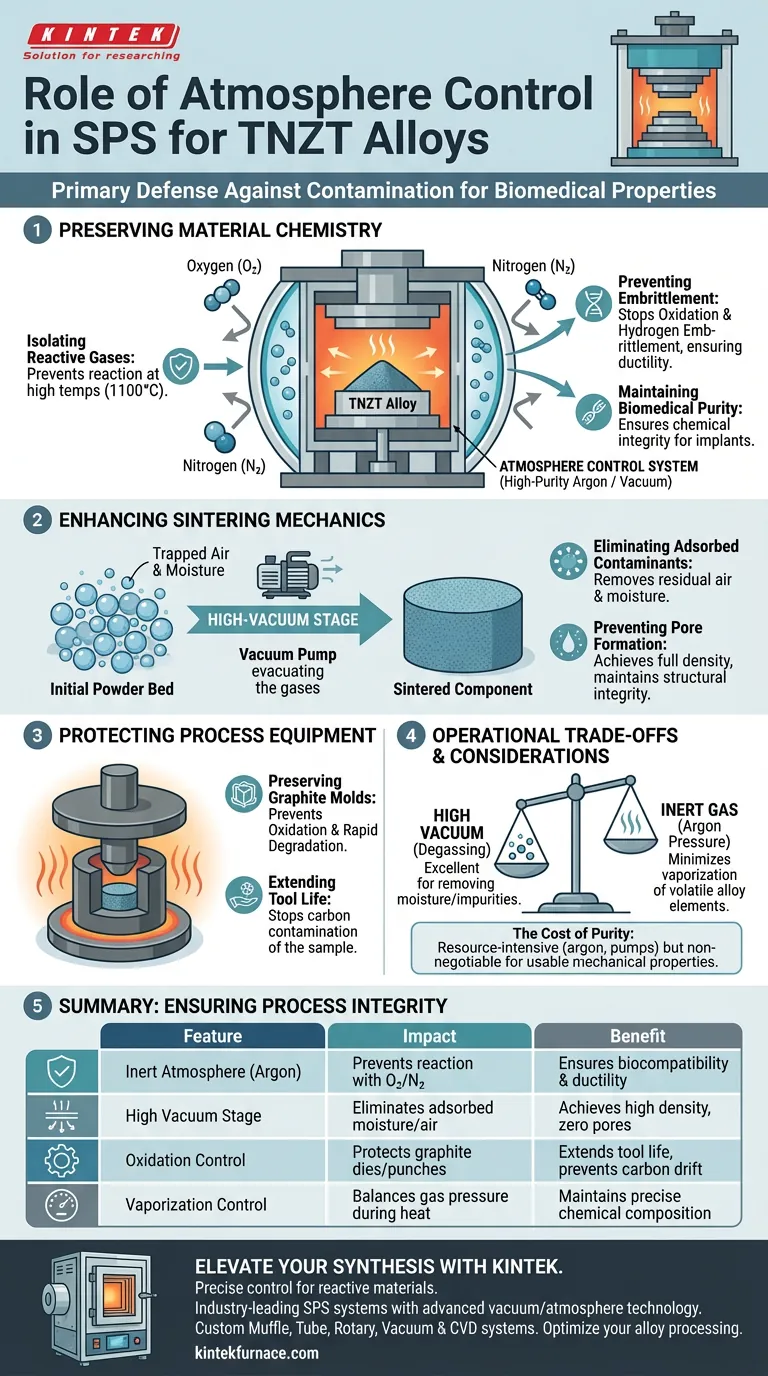
The vacuum or atmosphere control system serves as the primary defense against contamination during the Spark Plasma Sintering (SPS) of TNZT alloys. It functions by establishing and maintaining a pristine environment—often high-purity argon—to isolate the highly reactive titanium powder from atmospheric gases like oxygen and nitrogen while processing at temperatures as high as 1100°C.
Core Takeaway Processing titanium-based alloys requires strict environmental isolation to prevent chemical degradation during heating. The atmosphere control system safeguards the material’s biomedical properties by eliminating reactive gases that would otherwise cause oxidation, hydrogen embrittlement, and reduced mechanical performance.
Preserving Material Chemistry
Processing TNZT (Titanium-Niobium-Zirconium-Tantalum) alloys requires navigating the material's extreme sensitivity to interstitial elements.
Isolating Reactive Gases
The primary function of the system is to create a barrier between the sample and the ambient atmosphere.
Titanium alloys are highly reactive at elevated temperatures. Without this control, the alloy would rapidly absorb oxygen and nitrogen from the air.
Preventing Embrittlement
Exposure to these gases leads to disastrous consequences for biomedical materials.
The control system prevents oxidation and hydrogen embrittlement, ensuring the alloy retains the ductility and fatigue strength required for structural implants.
Maintaining Biomedical Purity
For TNZT composites, the chemical composition determines biocompatibility.
By maintaining a high-purity argon environment, the system ensures the final sintered product remains chemically pure and safe for use in the human body.
Enhancing Sintering Mechanics
Beyond chemistry, the atmosphere control system plays a physical role in the densification of the powder.
Eliminating Adsorbed Contaminants
Before backfilling with argon, a high-vacuum stage is often used to evacuate the chamber.
This effectively eliminates residual air and adsorbed moisture trapped in the gaps between powder particles.
Preventing Pore Formation
Removing these gases is critical for achieving full density.
If left in the powder bed, trapped gases can form closed pores during rapid sintering, compromising the structural integrity of the component.
Protecting Process Equipment
The atmosphere control system protects more than just the TNZT alloy; it is vital for the SPS tooling itself.
Preserving Graphite Molds
SPS utilizes graphite dies and punches, which degrade rapidly in the presence of oxygen.
A vacuum or inert atmosphere prevents the oxidation of graphite at high temperatures, extending the life of the molds and preventing carbon contamination of the sample.
Operational Trade-offs and Considerations
While atmosphere control is essential, it introduces specific challenges that must be managed.
Vacuum vs. Inert Gas Pressure
There is a balance between degassing and suppression.
While high vacuum is excellent for removing volatile impurities and moisture, inert gas (argon) is generally preferred for TNZT at peak temperatures to minimize the vaporization of volatile alloy elements.
The Cost of Purity
Achieving the necessary environmental quality is resource-intensive.
High-purity argon and high-vacuum pumps increase operational costs, but for titanium alloys, this is a non-negotiable requirement to achieve usable mechanical properties.
Ensuring Process Integrity for TNZT Applications
To maximize the quality of your TNZT components, your atmosphere strategy should align with your specific quality metrics.
- If your primary focus is Biomedical Safety: Prioritize a high-purity argon flow to strictly prevent oxidation and embrittlement, ensuring the material remains chemically inert.
- If your primary focus is Mechanical Density: Ensure a rigorous initial vacuum stage to fully degas powder gaps and remove moisture before heating begins.
Success in sintering TNZT relies not just on heat and pressure, but on the absolute purity of the environment in which they are applied.
Summary Table:
| Feature | Impact on TNZT Alloy Processing | Benefit to Final Product |
|---|---|---|
| Inert Atmosphere (Argon) | Prevents reaction with Oxygen/Nitrogen | Ensures biocompatibility and ductility |
| High Vacuum Stage | Eliminates adsorbed moisture and air | Achieves high density with zero pores |
| Oxidation Control | Protects graphite dies and punches | Extends tool life and prevents carbon drift |
| Vaporization Control | Balances gas pressure during peak heat | Maintains precise chemical composition |
Elevate Your Advanced Material Synthesis with KINTEK
Precise control over your sintering environment is non-negotiable for reactive materials like TNZT alloys. KINTEK provides industry-leading Spark Plasma Sintering (SPS) systems integrated with sophisticated vacuum and atmosphere control technology.
Backed by expert R&D and manufacturing, we offer customizable Muffle, Tube, Rotary, Vacuum, and CVD systems designed to eliminate contamination and ensure maximum material density. Whether you are developing medical implants or high-performance aerospace components, our high-temp lab furnaces are engineered for your unique needs.
Ready to optimize your alloy processing? Contact us today to speak with a specialist.
Visual Guide
References
- Satyavan Digole, Tushar Borkar. Improved Tribological Performance of Nitride-Reinforced Biocompatible Titanium–Niobium–Zirconium–Tantalum (TNZT) Alloys for Advanced Orthopedic Applications. DOI: 10.3390/met14010122
This article is also based on technical information from Kintek Furnace Knowledge Base .
Related Products
- Spark Plasma Sintering SPS Furnace
- 9MPa Air Pressure Vacuum Heat Treat and Sintering Furnace
- Vacuum Heat Treat Sintering Furnace with Pressure for Vacuum Sintering
- 600T Vacuum Induction Hot Press Vacuum Heat Treat and Sintering Furnace
- Small Vacuum Heat Treat and Tungsten Wire Sintering Furnace
People Also Ask
- How does the heating mechanism of Spark Plasma Sintering (SPS) function? Enhance TiC/SiC Composite Fabrication
- Why is it necessary to maintain a high vacuum environment during the SPS of SiC? Key to High-Density Ceramics
- What are the technical advantages of using an SPS sintering furnace? Elevate Al2O3-TiC Material Performance
- What are the steps in the discharge plasma sintering process? Master Fast, High-Density Material Consolidation
- What are the advantages of spark plasma sintering (SPS) over traditional forging? Precision Microstructural Control



















