
The high-temperature vacuum tube furnace serves as the foundational reactor for converting liquid precursors into solid ceramics. In the context of SiC/SiC composite manufacturing, this equipment drives the pyrolysis stage by sustaining temperatures exceeding 1000°C. Its primary function is to facilitate the inorganic transformation of the precursor while utilizing a vacuum or inert atmosphere to protect the material integrity.
The furnace solves the critical dual challenge of high-temperature processing: it forces the chemical conversion of the precursor into a silicon carbide matrix while simultaneously establishing an oxygen-free environment that prevents the catastrophic degradation of the reinforcing fibers.
The Mechanism of Inorganic Transformation
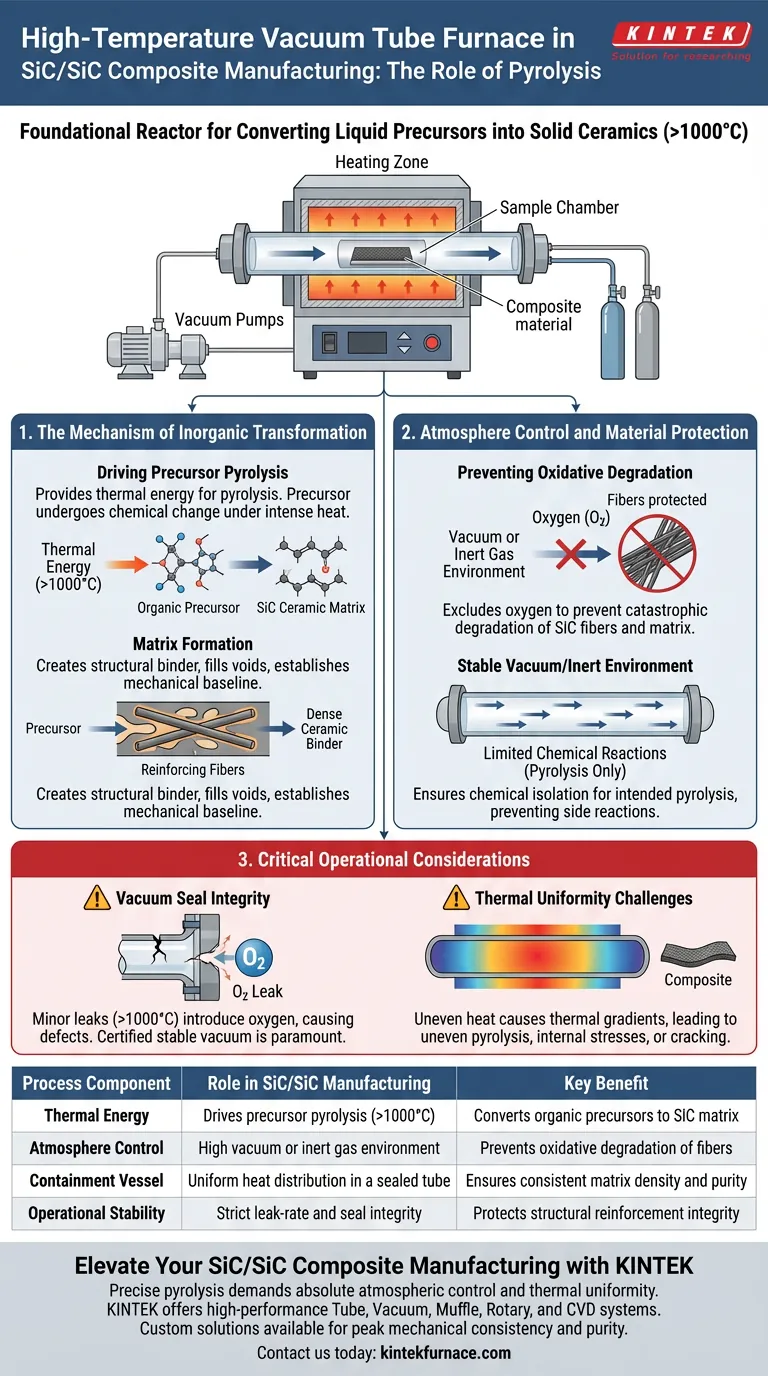
Driving Precursor Pyrolysis
The central role of the furnace is to provide the thermal energy required for pyrolysis.
The system must reach and maintain temperatures exceeding 1000°C.
Under this intense heat, the solidified precursor undergoes a chemical change, transitioning from an organic state into the desired silicon carbide ceramic matrix.
Matrix Formation
This thermal treatment creates the structural binder of the composite.
The furnace ensures the precursor effectively fills the voids between fibers and hardens into a dense ceramic.
This process establishes the mechanical baseline for the final composite material.
Atmosphere Control and Material Protection
Preventing Oxidative Degradation
The most specific value of using a vacuum tube furnace is its ability to exclude oxygen.
At elevated temperatures, silicon carbide fibers and the newly forming matrix are highly susceptible to oxidation.
Without strict atmosphere control, oxygen would attack the fibers, destroying the composite's structural reinforcement before it is fully formed.
Stable Vacuum or Inert Environment
The furnace creates a "protection environment" using either a high vacuum or an inert gas flow.
This isolation is not merely a feature; it is a chemical necessity for the survival of the material.
It ensures that the chemical reactions occurring inside the tube are strictly limited to the intended pyrolysis, without side reactions caused by air contaminants.
Critical Operational Considerations
The Risk of Atmosphere Compromise
While these furnaces are designed for protection, the integrity of the vacuum seal is paramount.
Even a minor leak during the >1000°C ramp phase can introduce oxygen, leading to surface defects or fiber embrittlement.
Operators must ensure the vacuum levels are certified stable before initiating the heating cycle.
Thermal Uniformity Challenges
A high temperature alone is insufficient; the heat must be applied uniformly across the composite.
Although the primary reference highlights the temperature magnitude, general furnace physics dictates that thermal gradients can cause uneven pyrolysis.
If the tube does not maintain a uniform temperature field, the matrix may density unevenly, leading to internal stresses or cracking within the composite.
Ensuring Process Success
To maximize the effectiveness of the pyrolysis stage, align your furnace operation with your specific manufacturing metrics:
- If your primary focus is Material Purity: Prioritize the vacuum pump capability and leak rate integrity to ensure absolute exclusion of oxygen and contaminants.
- If your primary focus is Mechanical Consistency: Focus on the furnace’s heating zone length and thermal uniformity to guarantee the precursor transforms evenly across the entire part.
The high-temperature vacuum tube furnace is not just a heater; it is the containment vessel that makes the chemistry of SiC/SiC composites possible.
Summary Table:
| Process Component | Role in SiC/SiC Manufacturing | Key Benefit |
|---|---|---|
| Thermal Energy | Drives precursor pyrolysis (>1000°C) | Converts organic precursors to SiC matrix |
| Atmosphere Control | High vacuum or inert gas environment | Prevents oxidative degradation of fibers |
| Containment Vessel | Uniform heat distribution in a sealed tube | Ensures consistent matrix density and purity |
| Operational Stability | Strict leak-rate and seal integrity | Protects structural reinforcement integrity |
Elevate Your SiC/SiC Composite Manufacturing with KINTEK
Precise pyrolysis requires more than just heat—it demands absolute atmospheric control and thermal uniformity. Backed by expert R&D and manufacturing, KINTEK offers high-performance Tube, Vacuum, Muffle, Rotary, and CVD systems tailored for the rigorous demands of advanced ceramic processing. Whether you need a standard setup or a fully customizable high-temperature furnace for unique research needs, our technology ensures your materials achieve peak mechanical consistency and purity.
Ready to optimize your lab's thermal processing? Contact us today to find your solution!
Visual Guide
References
- Surface Processing and Characterization of Stoichiometry-Varied BaZrS<sub>3</sub> Thin Films. DOI: 10.1021/acsaem.5c01766
This article is also based on technical information from Kintek Furnace Knowledge Base .
Related Products
- 1400℃ High Temperature Laboratory Tube Furnace with Alumina Tube
- 1700℃ High Temperature Laboratory Tube Furnace with Alumina Tube
- 2200 ℃ Tungsten Vacuum Heat Treat and Sintering Furnace
- 1200℃ Split Tube Furnace Laboratory Quartz Tube Furnace with Quartz Tube
- Molybdenum Vacuum Heat Treat Furnace
People Also Ask
- How does zone-melting in tube furnaces synthesize bismuth micro-wires? Master Single-Crystal Thermoelectric Growth
- How are high-temp tube furnaces used to measure diffusion coefficients per Fick's law? Master Precision Annealing
- How are high-temperature laboratory tube furnaces applied in long-term vacuum homogenization heat treatments for intermetallic samples?
- How do high-temperature laboratory tube furnaces ensure environmental stability? Precision Thermal Reduction Tips
- How are high-temperature tube furnaces applied in testing ceramic-supported alloy membranes? Insights



















