
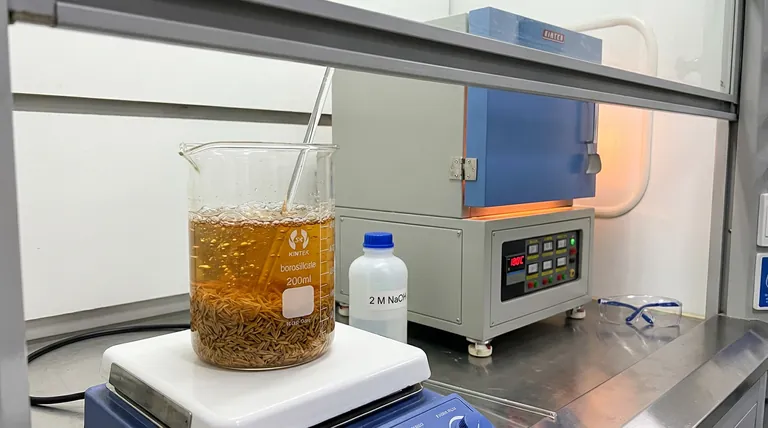
The high-temperature boiling step acts as the critical chemical trigger for extracting silica from rice husks. By heating the husks in a 2 M sodium hydroxide solution, you initiate a reaction that dissolves the solid silica components, converting them into a soluble sodium silicate solution.
The combination of heat and high alkalinity serves a dual purpose: it strips away the organic lignin barriers and drives the chemical conversion of agricultural waste into a usable industrial liquid.
The Mechanics of Extraction
Breaking Down the Protective Layer
Rice husks are naturally resilient structures. To access the silica within, you must first bypass their outer defenses.
The high-temperature boiling process creates a strong alkaline environment. This environment aggressively degrades the protective lignin layer that binds the husk structure together.
By breaking this organic seal, the solution exposes the underlying silica to the chemical reactants.
The Chemical Transformation
Once the lignin barrier is compromised, the core chemical reaction begins.
The silica components in the husk react directly with the alkali (sodium hydroxide). This reaction transforms the silica from a solid, insoluble state into soluble sodium silicate.
This phase is the defining moment where the material transitions from solid agricultural waste to a liquid industrial precursor.
Understanding the Trade-offs
Time and Energy Requirements
The primary reference notes that this process requires heating for an "extended period."
While effective, this indicates that the process is energy-intensive. You cannot rush the dissolution; the solution must be maintained at temperature long enough for the lignin to fully break down and the silica to dissolve completely.
Concentration Sensitivity
The process relies specifically on a 2 M sodium hydroxide solution.
If the concentration is too low, the solution may fail to penetrate the lignin layer effectively. This would leave silica trapped in the solid husk, resulting in a low yield of sodium silicate.
Making the Right Choice for Your Goal
To maximize the efficiency of your extraction process, consider the following key drivers:
- If your primary focus is yield: Ensure the boiling duration is sufficient to completely degrade the lignin layer, as partially processed husks will retain valuable silica.
- If your primary focus is process consistency: Strictly monitor the sodium hydroxide concentration at 2 M, as fluctuations here will directly alter the solvency power of the solution.
Mastering the variable of time against alkalinity is the key to efficient sodium silicate production.
Summary Table:
| Process Variable | Role / Function | Key Impact |
|---|---|---|
| High-Temp Boiling | Chemical Trigger | Accelerates lignin breakdown and silica dissolution |
| 2 M Sodium Hydroxide | Alkaline Reactant | Transforms solid silica into soluble sodium silicate |
| Extended Duration | Kinetic Requirement | Ensures complete penetration of resilient husk structures |
| Lignin Degradation | Barrier Removal | Exposes underlying silica to the chemical solution |
Precision Solutions for Your Extraction Research
Consistency in agricultural waste conversion requires absolute control over temperature and chemical kinetics. KINTEK provides the high-performance laboratory equipment necessary to master these variables.
Backed by expert R&D and manufacturing, KINTEK offers Muffle, Tube, Rotary, Vacuum, and CVD systems, all customizable for your unique lab high-temp needs. Whether you are scaling up sodium silicate production or refining lignin degradation protocols, our furnaces deliver the uniform heating essential for high-yield results.
Contact KINTEK today to optimize your extraction workflow!
References
- Shengwang Yuan, Yunhai Ma. A Comparative Study on Rice Husk, as Agricultural Waste, in the Production of Silica Nanoparticles via Different Methods. DOI: 10.3390/ma17061271
This article is also based on technical information from Kintek Furnace Knowledge Base .
Related Products
- Custom Made Versatile CVD Tube Furnace Chemical Vapor Deposition CVD Equipment Machine
- 1400℃ Muffle Oven Furnace for Laboratory
- 1400℃ High Temperature Laboratory Tube Furnace with Alumina Tube
- 1700℃ High Temperature Laboratory Tube Furnace with Alumina Tube
- Vertical Laboratory Quartz Tube Furnace Tubular Furnace
People Also Ask
- Why are CVD tube furnace sintering systems indispensable for 2D material research and production? Unlock Atomic-Scale Precision
- What is a CVD tube furnace and what is its primary function? Discover Precision Thin-Film Deposition
- Which industries and research fields benefit from CVD tube furnace sintering systems for 2D materials? Unlock Next-Gen Tech Innovations
- How does CVD tube furnace sintering enhance graphene growth? Achieve Superior Crystallinity and High Electron Mobility
- What improvements can be made to the bonding force of gate dielectric films using a CVD tube furnace? Enhance Adhesion for Reliable Devices


















