
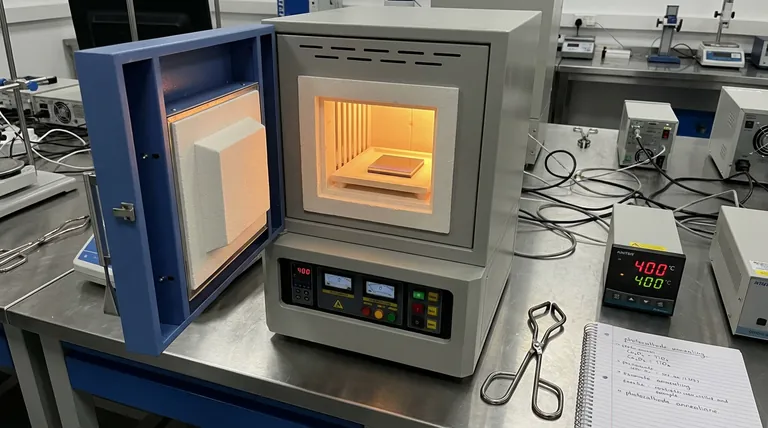
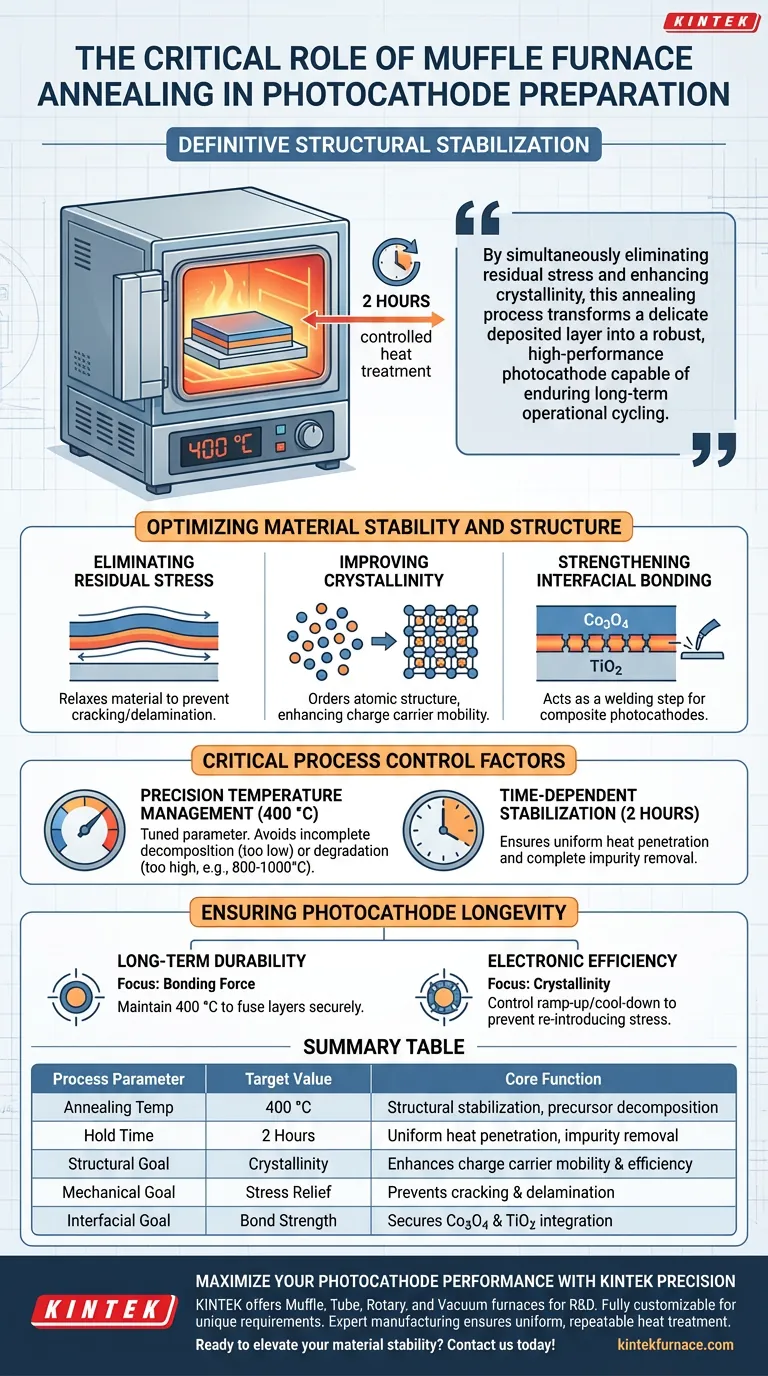
Annealing in a Muffle furnace serves as the definitive structural stabilization step in the final preparation of photocathodes. Specifically, this process involves subjecting the material to a controlled heat treatment at 400 °C for 2 hours. This thermal stage is essential for relieving internal mechanical stresses and solidifying the interface between deposited layers, directly dictating the component's future reliability.
By simultaneous eliminating residual stress and enhancing crystallinity, this annealing process transforms a delicate deposited layer into a robust, high-performance photocathode capable of enduring long-term operational cycling.
Optimizing Material Stability and Structure
The primary function of the Muffle furnace in this context is to transition the material from a raw deposited state to a stable, crystalline structure. This heat treatment addresses three specific physical requirements.
Eliminating Residual Stress
During the initial deposition of material layers, significant residual stress can accumulate within the structure.
If left untreated, this internal tension creates weak points that lead to mechanical failure. The annealing process relaxes the material, effectively removing these stresses to prevent future cracking or delamination.
Improving Crystallinity
Heat treatment is the primary driver for ordering the atomic structure of the active substances.
Holding the temperature at 400 °C allows atoms to settle into a more regular, crystalline lattice. High crystallinity is vital for semiconductor performance, as it typically correlates with improved charge carrier mobility and overall efficiency.
Strengthening Interfacial Bonding
For composite photocathodes, such as those combining Co3O4 and TiO2, the interface between materials is a common failure point.
Annealing acts as a welding step, significantly strengthening the bonding force between these distinct layers. This ensures the structural integrity of the device, preventing the layers from separating during the stress of chemical reactions.
Critical Process Control Factors
While annealing is beneficial, it requires strict adherence to specific parameters to avoid diminishing returns or material damage.
Precision Temperature Management
The specific protocol of 400 °C is not arbitrary; it is a tuned parameter for this specific material set.
Temperatures that are too low may fail to fully decompose precursors or achieve the necessary crystalline phase. Conversely, excessive temperatures (common in other furnace applications like sintering at 800°C or silicon annealing at 1000°C) could degrade the active oxides or damage the substrate.
Time-Dependent Stabilization
The duration of 2 hours is critical for ensuring the heat permeates the entire mass uniformly.
This duration allows sufficient time for the complete removal of any remaining volatile impurities and ensures that the structural changes are uniform throughout the depth of the photocathode, not just on the surface.
Ensuring Photocathode Longevity
To maximize the utility of your Muffle furnace annealing process, you must align your thermal profile with your specific performance goals.
- If your primary focus is Long-Term Durability: Prioritize the bonding force by strictly maintaining the 400 °C setpoint to ensure the Co3O4 and TiO2 layers fuse securely without degradation.
- If your primary focus is Electronic Efficiency: Focus on the crystallinity aspect by ensuring the ramp-up and cool-down rates are controlled to prevent re-introducing stress into the lattice.
Precision in this final thermal step is what ultimately separates a functioning experimental sample from a viable, robust component.
Summary Table:
| Process Parameter | Target Value | Core Function |
|---|---|---|
| Annealing Temp | 400 °C | Structural stabilization and precursor decomposition |
| Hold Time | 2 Hours | Uniform heat penetration and impurity removal |
| Structural Goal | Crystallinity | Enhances charge carrier mobility and efficiency |
| Mechanical Goal | Stress Relief | Prevents cracking and delamination of layers |
| Interfacial Goal | Bond Strength | Secures Co3O4 and TiO2 layer integration |
Maximize Your Photocathode Performance with KINTEK Precision
Achieving the perfect 400 °C annealing profile requires the thermal accuracy that only professional-grade equipment can provide. KINTEK offers a comprehensive range of Muffle, Tube, Rotary, and Vacuum furnaces, specifically engineered for materials science and R&D applications.
Whether you are refining composite layers like Co3O4/TiO2 or developing next-generation semiconductors, our systems are fully customizable to meet your unique temperature and atmospheric requirements. Backed by expert manufacturing, KINTEK ensures your heat treatment is uniform, repeatable, and optimized for structural integrity.
Ready to elevate your material stability? Contact us today to discuss your laboratory needs!
Visual Guide
References
- Solar Trap‐Adsorption Photocathode for Highly Stable 2.4 V Dual‐Ion Solid‐State Iodine Batteries. DOI: 10.1002/adma.202504492
This article is also based on technical information from Kintek Furnace Knowledge Base .
Related Products
- Laboratory Muffle Oven Furnace with Bottom Lifting
- High Temperature Muffle Oven Furnace for Laboratory Debinding and Pre Sintering
- 1400℃ Muffle Oven Furnace for Laboratory
- 1200℃ Muffle Oven Furnace for Laboratory
- 1700℃ High Temperature Muffle Oven Furnace for Laboratory
People Also Ask
- Why is a high-temperature muffle furnace required for FeOx-MOx/TiO2? Engineering High-Performance Nanocomposites
- What is the importance of the calcination process? Master High-Purity Calcium Phosphate Nanopowder Production
- What function does a muffle furnace perform in Ba0.75Ca0.25TiO3 calcination? Ensure Phase Purity & Synthesis
- Why is a high-temperature laboratory muffle furnace essential for the alkali fusion process in zeolite synthesis?
- What are the primary functions of a high-temperature laboratory muffle furnace in the preparation of biosorbent materials?














