
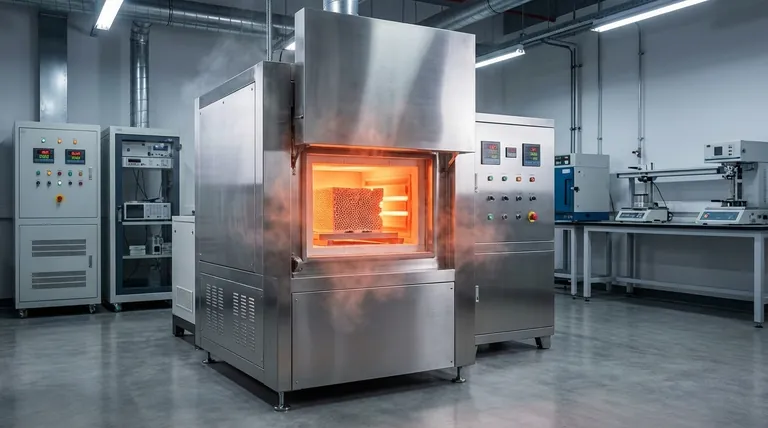
The industrial microwave muffle furnace functions as the primary reaction chamber for converting raw materials—specifically coal gangue and alumina—into porous mullite ceramic skeletons. It accomplishes this through a specialized, multi-stage thermal treatment that rigorously controls thermochemical reactions to ensure structural integrity and proper crystal formation.
Core Takeaway The effectiveness of this furnace lies in its execution of a complex three-stage heating curve. By precisely synchronizing the decomposition of pore-forming agents with the kinetics of mullite crystallization, the equipment ensures the growth of high-quality mullite whiskers without compromising the porous architecture of the ceramic.
The Three-Stage Heating Strategy
The defining characteristic of this sintering process is not merely reaching a high temperature, but how that temperature is applied. The furnace utilizes a programmed thermal profile to manage different phases of material transformation.
Stage 1: The Slow Heating Phase
The initial stage focuses on gradual temperature elevation. This controlled pace is critical for managing the decomposition rate of pore-forming agents added to the raw mix.
If heating is too rapid during this phase, volatile components may escape violently, causing cracks or structural collapse. The slow ramp allows these agents to decompose and exit the material in a stable manner, leaving behind the desired porous "skeleton."
Stage 2: The Rapid Heating Phase
Once the volatile components have been safely evacuated, the furnace shifts to a rapid heating mode.
This stage accelerates the thermal energy input to bring the remaining coal gangue and alumina precursors up to reaction temperatures quickly. This efficiency minimizes unnecessary energy consumption while preparing the reactants for the final phase transition.
Stage 3: The High-Temperature Constant Phase
The final stage involves maintaining a stable peak temperature.
This "soaking" period is where the actual synthesis of mullite occurs. The constant temperature provides the necessary thermodynamic environment for the solid-phase reactions to complete, ensuring the material achieves full conversion and stability.
Impact on Microstructure and Quality
The role of the microwave muffle furnace extends beyond simple heating; it acts as a tool for microstructural engineering.
Facilitating Mullite Whisker Growth
The primary goal of this process is the development of mullite whiskers—needle-like crystal structures that reinforce the ceramic.
The furnace’s ability to maintain a precise high-temperature thermal field controls the dynamics of this crystal growth. A uniform thermal environment ensures that grains and whiskers grow synchronously, preventing defects associated with uneven heat distribution.
Optimizing the Porous Architecture
For porous ceramics, the void space is just as important as the solid material.
By strictly controlling the burn-off of pore-forming agents (during the slow heating stage) and the subsequent densification (during the constant stage), the furnace ensures the final product retains its intended porosity. This precise balance prevents the ceramic from shrinking too much or becoming too dense, which would defeat the purpose of a "porous skeleton."
Understanding the Trade-offs
While the microwave muffle furnace offers superior control for this specific application, it requires careful operational management.
Complexity of Process Control
Unlike simple firing, this process relies heavily on the accuracy of the heating curve. Any deviation in the transition between the slow, rapid, and constant stages can lead to incomplete reactions or structural defects. The operator must strictly adhere to the programmed profile.
Material Specificity
This thermal treatment is highly specialized for the coal gangue and alumina reaction system. The parameters used here specifically target the decomposition temperatures of selected pore formers and the crystallization temperature of mullite. Applying this exact curve to different ceramic materials (like zirconia or silicon nitride) without adjustment would likely yield poor results.
Making the Right Choice for Your Goal
To maximize the utility of an industrial microwave muffle furnace for mullite ceramics, align your process parameters with your specific quality targets.
- If your primary focus is Structural Integrity: Prioritize the Slow Heating Stage to ensure pore-forming agents escape gently, preventing internal stress and micro-cracking.
- If your primary focus is Material Strength: Optimize the High-Temperature Constant Stage to maximize the growth of mullite whiskers, which act as reinforcement within the ceramic matrix.
The microwave muffle furnace is not just a heater; it is a precision instrument that dictates the final density, strength, and porosity of your ceramic skeleton through rigorous thermal management.
Summary Table:
| Heating Stage | Temperature Control | Primary Function |
|---|---|---|
| Stage 1: Slow Heating | Gradual Elevation | Controlled decomposition of pore-forming agents to prevent cracks. |
| Stage 2: Rapid Heating | Accelerated Input | Quickly reaches reaction temperature to maximize energy efficiency. |
| Stage 3: Constant Phase | Stable Peak Heat | Facilitates mullite crystallization and solid-phase reaction completion. |
Elevate Your Ceramic Sintering Precision with KINTEK
Achieving the perfect balance of porosity and structural strength requires more than just heat—it requires precise thermal engineering. Backed by expert R&D and manufacturing, KINTEK offers a wide range of advanced Muffle, Tube, Rotary, Vacuum, and CVD systems, all fully customizable to meet the unique demands of your high-temperature lab processes.
Whether you are synthesizing mullite whiskers or developing next-generation porous materials, our equipment ensures the rigorous control your research deserves. Contact our experts today to find the ideal furnace solution for your specific application.
References
- Chunxia Xu, Wenbin Han. Research on preparation and related properties of macro–micro porous mullite ceramic skeletons <i>via</i> twice pore-forming technology. DOI: 10.1039/d4ra01277a
This article is also based on technical information from Kintek Furnace Knowledge Base .
Related Products
- 1400℃ Muffle Oven Furnace for Laboratory
- 1700℃ High Temperature Muffle Oven Furnace for Laboratory
- 1200℃ Muffle Oven Furnace for Laboratory
- 1800℃ High Temperature Muffle Oven Furnace for Laboratory
- High Temperature Muffle Oven Furnace for Laboratory Debinding and Pre Sintering
People Also Ask
- How does a high-temperature laboratory muffle furnace affect material properties? Transform Anodic Oxide Films Fast
- What is the primary function of a high-temperature laboratory muffle furnace in chemical synthesis? Achieve Precision.
- What is the function of a muffle furnace in MOF-derived zirconia conversion? Optimize Phase & Pore Engineering
- How does a laboratory high-temperature muffle furnace contribute to the final formation of Bismuth Oxide nanosheets?
- How is a laboratory high-temperature muffle furnace used in agloporite preparation? Optimize Material Synthesis



















