
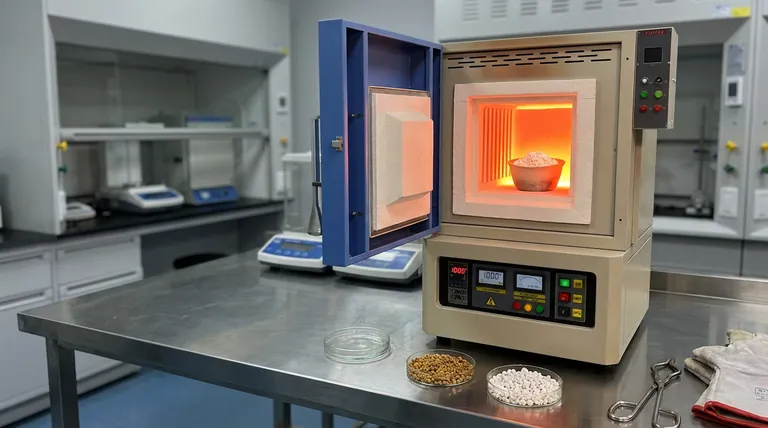
A laboratory high-temperature muffle furnace acts as the central reaction vessel, providing a stable 1000 °C environment to process calcified pollen for a continuous two-hour duration. This precise thermal treatment is the specific mechanism that converts raw biological material into functional, high-purity bioceramic particles.
Core Takeaway The furnace performs a simultaneous dual function: it eliminates organic impurities via pyrolysis and drives a phase change in minerals to create high-crystallinity hydroxyapatite and beta-tricalcium phosphate—essential components for biomimetic bone repair.
The Mechanics of Transformation
Pyrolysis of Organic Templates
The primary function of the furnace is to subject the material to high-temperature pyrolysis. This extreme heat targets the sporopollenin biological template and any residual organic components within the pollen. The result is the complete removal of organic matter, leaving behind only the inorganic structure.
Mineral Phase Transformation
Before entering the furnace, the calcium phosphate minerals on the pollen are in an amorphous or low-crystalline state. The 1000 °C environment provides the energy required to reorganize these atomic structures. This transforms the material into a highly crystalline state, which is necessary for its stability and biological function.
Formation of Biphasic Bioceramics
The calcination process specifically engineers the material into a biphasic bioceramic. It promotes the formation of two distinct calcium phosphate phases: hydroxyapatite (HAp) and beta-tricalcium phosphate (beta-TCP). This specific composition is critical for creating effective bone repair materials.
Achieving Biomimetic Architecture
Creating Hollow Structures
While the heat removes organic material, the process is tuned to preserve the overall geometry of the pollen. The result is a biomimetic material that retains a hollow structure. This architecture is highly advantageous for applications in bone tissue engineering.
Thermal Stability and Uniformity
A muffle furnace is chosen specifically for its ability to provide a stable and uniform thermal environment. This ensures that the entire batch of calcified pollen receives the same heat exposure. Uniformity prevents inconsistent crystallization, ensuring the final product has reliable mechanical and chemical properties.
Critical Variables and Trade-offs
Temperature Precision Risks
The target temperature of 1000 °C is a precise operational requirement. Failing to reach this temperature may result in incomplete pyrolysis, leaving toxic organic residues in the material. Conversely, excessive temperatures could damage the delicate hollow structure required for the biomimetic application.
The Necessity of Duration
The continuous two-hour calcination window is non-negotiable for achieving high crystallinity. Reducing this time can result in a material that is still largely amorphous. Amorphous materials lack the structural integrity and biological response required for high-quality bone repair bioceramics.
Making the Right Choice for Your Goal
When configuring your thermal processing parameters, consider the specific requirements of your end application:
- If your primary focus is biological safety: Prioritize maintaining the full 1000 °C temperature to guarantee the complete removal of sporopollenin and organic residues.
- If your primary focus is structural strength: Ensure strictly uniform heat distribution and full duration to maximize the conversion to high-crystallinity HAp and beta-TCP phases.
Precise thermal control is the defining factor that turns raw calcified pollen into a viable, clinical-grade bone repair material.
Summary Table:
| Process Step | Mechanism | Resulting Benefit |
|---|---|---|
| Organic Pyrolysis | Removal of sporopollenin at 1000°C | Eliminates toxins & creates hollow architecture |
| Phase Transformation | Atomic reorganization of minerals | Forms high-crystallinity HAp and beta-TCP |
| Thermal Uniformity | Stable heat distribution | Ensures consistent mechanical & chemical properties |
| Sustained Calcination | 2-hour continuous treatment | Maximizes structural integrity for bone repair |
Elevate Your Material Research with KINTEK Precision
Achieving the perfect biphasic bioceramic requires absolute thermal accuracy. Backed by expert R&D and world-class manufacturing, KINTEK offers a comprehensive range of Muffle, Tube, Rotary, Vacuum, and CVD systems. Our lab high-temp furnaces are fully customizable to meet the unique demands of your biomimetic tissue engineering projects.
Ready to optimize your calcination process? Contact our specialists today to find your custom furnace solution.
References
- Arianna De Mori, Marta Roldo. Sporopollenin Capsules as Biomimetic Templates for the Synthesis of Hydroxyapatite and β-TCP. DOI: 10.3390/biomimetics9030159
This article is also based on technical information from Kintek Furnace Knowledge Base .
Related Products
- 1700℃ High Temperature Muffle Oven Furnace for Laboratory
- 1800℃ High Temperature Muffle Oven Furnace for Laboratory
- 1400℃ Muffle Oven Furnace for Laboratory
- 1200℃ Muffle Oven Furnace for Laboratory
- High Temperature Muffle Oven Furnace for Laboratory Debinding and Pre Sintering
People Also Ask
- What is the primary function of a high-temperature laboratory muffle furnace in chemical synthesis? Achieve Precision.
- How does a high-temperature laboratory muffle furnace affect material properties? Transform Anodic Oxide Films Fast
- What role does a muffle furnace play in BCZY712 electrolyte powder production? Achieve Perfect Phase Purity
- What is the role of a high-temperature muffle furnace in guava leaf carbonization? Master Precise Pyrolysis Control
- What role does a muffle furnace play in sintering photocathodes? Enhance Electrode Conductivity & Catalytic Activity



















