
In short, modern muffle furnaces have evolved far beyond simple heating boxes, incorporating advancements in materials, digital control, and energy efficiency. Key upgrades include advanced heating elements like silicon carbide for higher temperatures and longer life, sophisticated programmable controllers for precise thermal cycling, and eco-friendly designs that significantly reduce energy consumption.
The central advancement in muffle furnace technology is the shift from a manually operated heat source to a fully automated, precise, and repeatable thermal processing instrument. This gives operators unprecedented control over their processes, leading to higher quality results and improved efficiency.
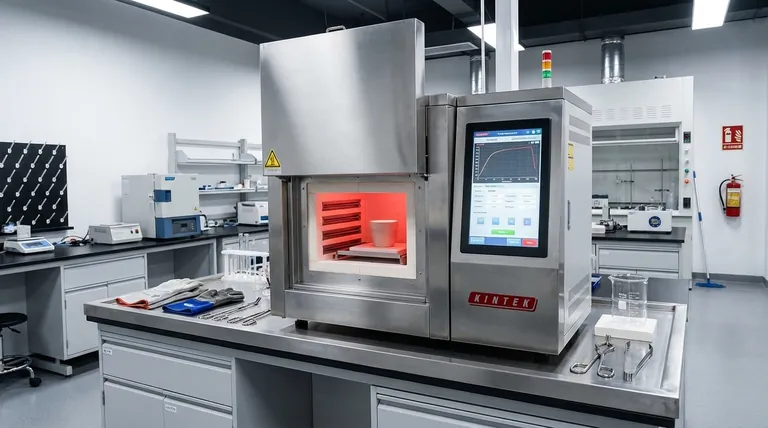
From 'Hot Box' to Precision Instrument
Historically, a muffle furnace was a simple insulated chamber with a heating element. Its primary function was to get hot. Modern furnaces, however, are sophisticated instruments designed for precision, repeatability, and efficiency, driven by advancements in core components.
Advanced Heating Elements and Materials
The heart of the furnace, the heating element, has seen significant upgrades. While older models used basic resistance wire, modern units often employ superior materials.
Silicon carbide (SiC) and molybdenum disilicide (MoSi2) are now common. These materials offer higher maximum operating temperatures, faster heat-up rates, and much greater durability, which translates to longer service life and reduced downtime.
Superior Insulation and Energy Efficiency
Driven by both cost and environmental concerns, insulation technology has improved dramatically. Modern furnaces use advanced ceramic fiber and refractory materials that minimize heat loss.
This leads directly to eco-friendly models with lower energy consumption. A more efficient furnace not only reduces operational costs but also contributes to a lower carbon footprint and less waste heat in the laboratory or production environment.
Unprecedented Control and Automation
The most transformative advancements are in the realm of digital control. Modern furnaces provide a level of process management that was previously unattainable, moving beyond simple temperature settings to full-cycle automation.
Programmable Thermal Cycles
Operators are no longer limited to a single setpoint. Modern controllers allow for multi-stage programming, where temperature ramp rates, soak times, and cooling rates can all be precisely defined.
This is critical for preventing thermal shock in sensitive materials, such as advanced ceramics or glass, and for executing complex material synthesis or treatment protocols.
Multi-Zone Heating for Uniformity
For applications where temperature uniformity across the entire chamber is critical, high-end furnaces now offer multi-zone heating.
By using multiple heating elements and sensors, the controller can independently manage the temperature in different parts of the chamber. This eliminates hot and cold spots, ensuring that every part of the sample experiences the exact same thermal conditions.
Advanced User Interfaces and Connectivity
The user experience has been completely redesigned. Clunky dials and basic readouts have been replaced with touchscreen controls and clear digital displays.
Many furnaces now include pre-set programs for common applications, like firing specific dental porcelains. Internet connectivity is an emerging feature, allowing for remote monitoring, data logging, and automatic shut-off, which enhances both safety and convenience.
Understanding the Trade-offs
While these advancements offer powerful capabilities, they require careful consideration. More features often mean more complexity and higher cost, and it's essential to match the technology to the actual need.
Performance Specifications vs. Real-World Need
Technical specifications can be misleading if not properly understood. For example, a furnace may list a temperature resolution of 1°C but an accuracy of ±5°C.
This means that while you can set the temperature in one-degree increments, the actual temperature in the chamber could be off by several degrees. For most heat-treating or ashing, this is perfectly acceptable. For highly sensitive material science, it may not be.
The Cost of Customization
Modern furnaces are highly customizable, with options for different chamber sizes, temperature ranges, and control features. This is a significant advantage, allowing you to procure a furnace perfectly suited to your task.
However, this flexibility places the burden on you to precisely define your requirements. Over-specifying a furnace with unneeded features leads to unnecessary cost, while under-specifying can render it useless for your most critical tasks.
Automation and Safety
Automation features like programmable cycles and automatic shut-off are significant safety enhancements. They reduce the chance of operator error and ensure processes complete safely without constant supervision. However, they are not a substitute for proper training and safety protocols.
Making the Right Choice for Your Goal
Selecting the right furnace means aligning its capabilities with your primary objective.
- If your primary focus is general laboratory work like ashing or simple heat-treating: A reliable furnace with a basic programmable controller, robust heating elements, and good safety features is your best choice.
- If your primary focus is advanced materials research: Prioritize furnaces with precise multi-stage programming, options for multi-zone heating, and potentially gas management systems.
- If your primary focus is high-throughput industrial production: Emphasize energy efficiency, automation for repeatability, and the durability of components like SiC heating elements to maximize uptime.
- If your primary focus is a specialized application like dental ceramics: Seek out furnaces with pre-set, validated programs for your specific materials to ensure consistent, high-quality results.
Ultimately, understanding these technological advancements empowers you to select not just a furnace, but the right instrument for achieving precise and repeatable thermal processing.
Summary Table:
| Advancement | Key Features | Benefits |
|---|---|---|
| Advanced Heating Elements | Silicon carbide, molybdenum disilicide | Higher temperatures, faster heat-up, longer life |
| Digital Control | Programmable thermal cycles, multi-zone heating | Precise temperature control, uniformity, repeatability |
| Energy Efficiency | Advanced insulation materials | Lower energy consumption, reduced costs, eco-friendly |
| Automation and Safety | Touchscreen interfaces, remote connectivity | Enhanced safety, ease of use, reduced operator error |
Ready to elevate your thermal processing with cutting-edge muffle furnaces? At KINTEK, we leverage exceptional R&D and in-house manufacturing to provide diverse laboratories with advanced high-temperature furnace solutions. Our product line, including Muffle, Tube, Rotary Furnaces, Vacuum & Atmosphere Furnaces, and CVD/PECVD Systems, is complemented by strong deep customization capabilities to precisely meet your unique experimental requirements. Whether you're in general lab work, advanced materials research, or industrial production, we can help you achieve higher quality results and improved efficiency. Contact us today to discuss how our tailored solutions can benefit your specific applications!
Visual Guide

Related Products
- 1400℃ Muffle Oven Furnace for Laboratory
- 1700℃ High Temperature Muffle Oven Furnace for Laboratory
- 1800℃ High Temperature Muffle Oven Furnace for Laboratory
- 1200℃ Muffle Oven Furnace for Laboratory
- High Temperature Muffle Oven Furnace for Laboratory Debinding and Pre Sintering
People Also Ask
- What is the primary function of a high-temperature laboratory muffle furnace in chemical synthesis? Achieve Precision.
- How does a high-temperature laboratory muffle furnace affect material properties? Transform Anodic Oxide Films Fast
- What role does a muffle furnace play in refractory bricks? Enhance Performance and Durability Testing
- How does a laboratory high-temperature muffle furnace contribute to the final formation of Bismuth Oxide nanosheets?
- How does a laboratory high-temperature muffle furnace facilitate the homogenization of borosilicate glass samples? Expert Insights



















