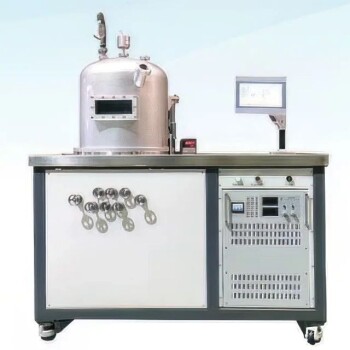
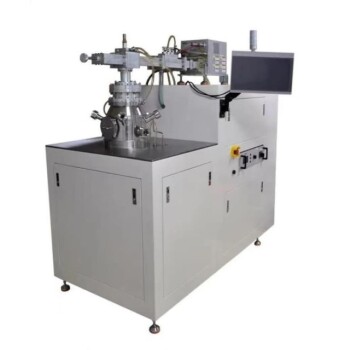
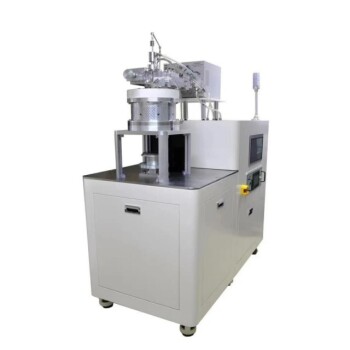
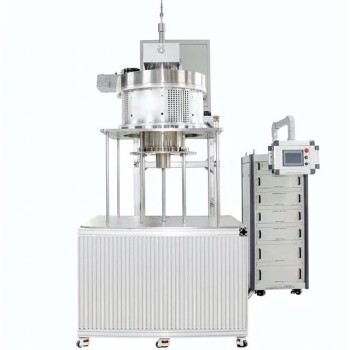
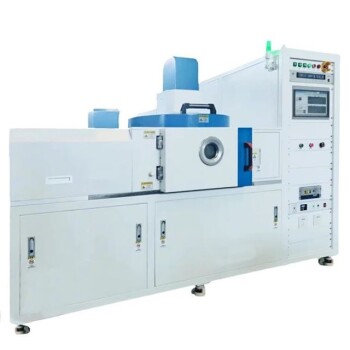
The Vertical Cold Wall MOCVD system serves as the foundational platform for synthesizing epitaxial Tungsten Diselenide (WSe2) by creating a rigorous, thermally controlled reaction environment. It functions by injecting specific vapor-phase precursors—tungsten hexacarbonyl and diethyl selenium—into a chamber heated to 600 °C, facilitating the precise thermal decomposition required to form the material.
Core Takeaway: This system is the key to transitioning WSe2 from theoretical potential to practical application, enabling the growth of large-area, high-quality monolayers directly on silicon substrates through controlled chemical reactions rather than physical transport.
The Mechanics of the MOCVD Process
Precise Precursor Injection
The system operates by introducing metalorganic precursors in a vapor phase.
Specifically, it utilizes tungsten hexacarbonyl and diethyl selenium as the source materials.
Controlled Thermal Decomposition
Once injected, these precursors undergo thermal decomposition reactions.
This occurs within a reaction chamber maintained at a specific temperature of 600 °C, ensuring the chemical breakdown occurs at a rate that favors epitaxial growth.
Achieving High-Quality Material Outcomes
Large-Area Uniformity
Unlike methods that produce small, isolated flakes, this MOCVD system facilitates large-area growth.
This capability is essential for creating continuous films necessary for scalable device fabrication.
Structural Integrity on Silicon
The system is capable of growing WSe2 directly on silicon substrates.
The resulting films exhibit high crystallinity and structural uniformity, producing a high-quality two-dimensional monolayer suitable for advanced electronic applications.
Distinguishing MOCVD from Alternative Methods
It is critical to distinguish this MOCVD process from other synthesis methods, such as those using a horizontal dual-zone tube furnace.
Temperature Differences
While the MOCVD system operates at a moderate 600 °C, tube furnaces often utilize much higher gradients (e.g., 1050 °C at the source and 800 °C at the growth zone).
Growth Mechanism
The tube furnace relies on chemical vapor transport (CVT) driven by temperature gradients to recrystallize material.
In contrast, the Vertical Cold Wall MOCVD relies on chemical vapor deposition via precursor decomposition to deposit films.
Output Type
Tube furnaces are typically used to grow single crystals, whereas the MOCVD system described is optimized for large-area monolayer films.
Making the Right Choice for Your Goal
Selecting the correct synthesis tool depends entirely on the desired form factor of the Tungsten Diselenide.
- If your primary focus is Scalable Device Fabrication: Utilize the Vertical Cold Wall MOCVD system to generate large, uniform monolayers directly on silicon at 600 °C.
- If your primary focus is Fundamental Crystal Research: Consider a horizontal dual-zone tube furnace to grow high-quality discrete single crystals using high-temperature chemical vapor transport.
The Vertical Cold Wall MOCVD system is the definitive choice when structural uniformity across a large surface area is the priority.
Summary Table:
| Feature | Vertical Cold Wall MOCVD | Dual-Zone Tube Furnace |
|---|---|---|
| Mechanism | Chemical Vapor Deposition (CVD) | Chemical Vapor Transport (CVT) |
| Precursors | Tungsten hexacarbonyl & Diethyl selenium | Solid sources/powders |
| Growth Temp | 600 °C (Controlled decomposition) | 800 °C - 1050 °C (Thermal gradient) |
| Output Type | Large-area uniform monolayers | High-quality discrete single crystals |
| Application | Scalable device fabrication | Fundamental material research |
Elevate Your Thin Film Research with KINTEK Precision
Ready to achieve superior uniformity in your 2D material synthesis? At KINTEK, we understand that high-performance semiconductors like WSe2 require uncompromising thermal control. Backed by expert R&D and world-class manufacturing, we provide advanced Muffle, Tube, Rotary, Vacuum, and CVD/MOCVD systems tailored to your laboratory’s unique specifications.
Whether you are scaling monolayer production or conducting fundamental crystal research, our customizable high-temperature solutions deliver the precision you need. Contact KINTEK today to discuss your project requirements and see how our expertise can drive your innovation forward.
References
- Theresa M. Kucinski, Michael T. Pettes. Direct Measurement of the Thermal Expansion Coefficient of Epitaxial WSe<sub>2</sub> by Four-Dimensional Scanning Transmission Electron Microscopy. DOI: 10.1021/acsnano.4c02996
This article is also based on technical information from Kintek Furnace Knowledge Base .
Related Products
- HFCVD Machine System Equipment for Drawing Die Nano Diamond Coating
- Custom Made Versatile CVD Tube Furnace Chemical Vapor Deposition CVD Equipment Machine
- Cylindrical Resonator MPCVD Machine System for Lab Diamond Growth
- MPCVD Machine System Reactor Bell-jar Resonator for Lab and Diamond Growth
- Multi Heating Zones CVD Tube Furnace Machine for Chemical Vapor Deposition Equipment
People Also Ask
- What is Hot-filament Chemical Vapor Deposition (HFCVD)? Achieve High-Quality Thin Films with Precision Control
- What are the equipment for chemical vapor deposition? A Guide to the 5 Essential Components
- What is the significance of the vacuum pressure control system in the CVD coating process for powders?
- What is the function of high-purity Argon (Ar) gas during CVD? Optimize Your Thin Film Uniformity and Purity
- What are the advantages of using Chemical Vapor Deposition (CVD) for coating turbine blades? Enhance Life & Performance