
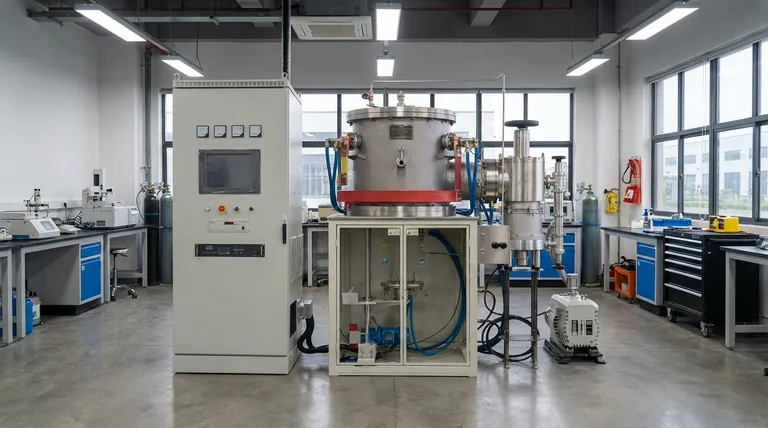
The Vacuum Induction Melting (VIM) Furnace serves as the absolute baseline for the development of high-performance carbide-free bainitic steel. Its primary function is to produce experimental steel ingots with exceptional purity and rigorous chemical precision, eliminating variables that would otherwise compromise research into microstructural transformations.
Core Takeaway The VIM furnace creates a controlled vacuum environment that minimizes impurity elements like oxygen and nitrogen while preventing the oxidative loss of critical alloying agents. This ensures the experimental steel possesses the exact chemical composition required to validate subsequent heat treatment and microstructural studies.
Establishing Material Purity
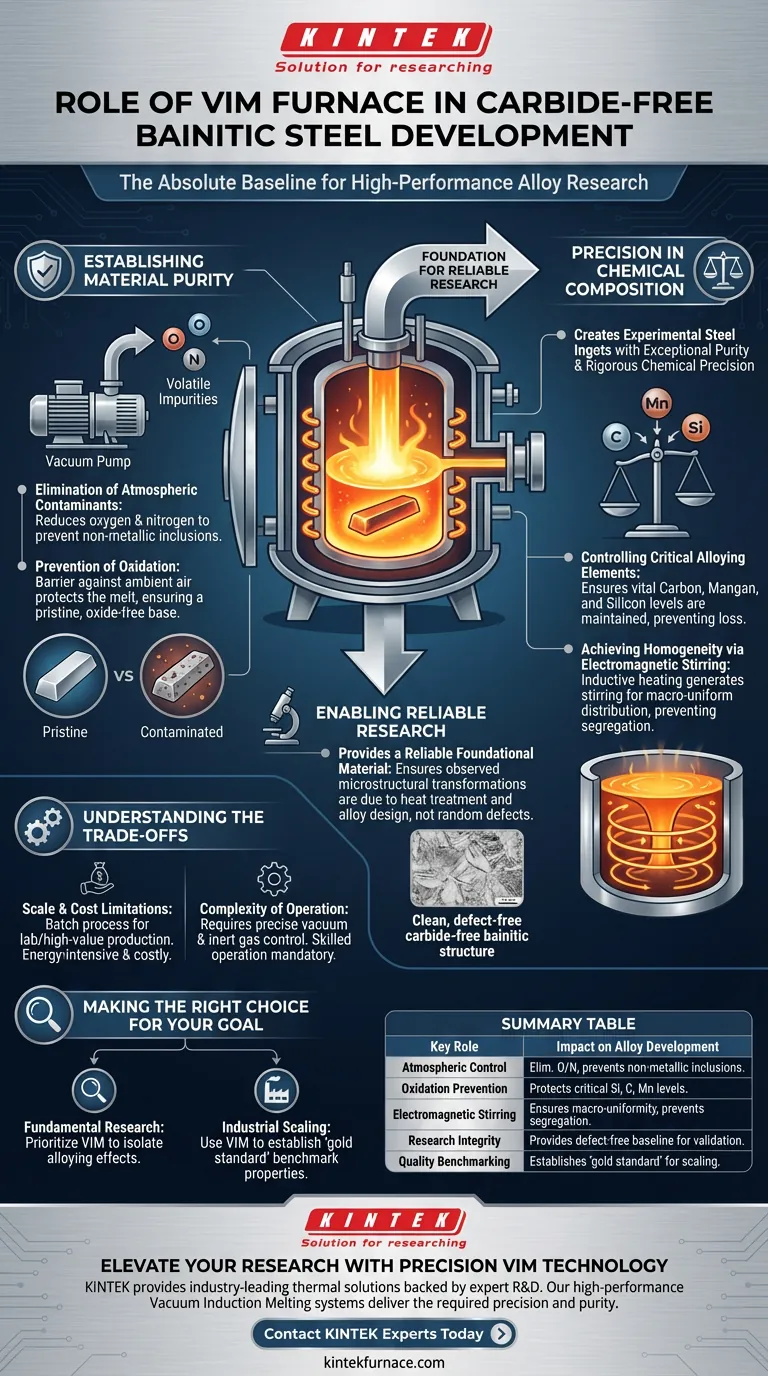
Elimination of Atmospheric Contaminants
The most immediate role of the VIM furnace is the removal of volatile impurities. By operating in a vacuum, the system effectively reduces the presence of oxygen and nitrogen in the molten steel.
High levels of these gaseous elements can lead to the formation of non-metallic inclusions. These inclusions act as stress concentrators, which can obscure the true mechanical properties of the bainitic structure being studied.
Prevention of Oxidation
In open-air melting, molten steel reacts with the atmosphere. The VIM furnace provides a barrier against oxidation, protecting the melt from ambient air.
This is critical because oxidation introduces slag and impurities that degrade the steel's quality. A pristine, oxide-free base material is non-negotiable for high-stakes alloy development.
Precision in Chemical Composition
Controlling Critical Alloying Elements
Carbide-free bainitic steel relies on a delicate balance of alloying elements, specifically carbon, manganese, and silicon.
Silicon is particularly vital in this alloy class to suppress carbide precipitation. The VIM furnace ensures these elements are not lost to oxidation or evaporation, guaranteeing the final ingot matches the theoretical design.
Achieving Homogeneity via Electromagnetic Stirring
A distinct advantage of induction heating is the generation of electromagnetic stirring within the melt pool.
This natural agitation promotes a macro-uniform distribution of all additives. It ensures that the chemical composition is consistent throughout the entire ingot, preventing segregation that could lead to inconsistent experimental data.
Enabling Reliable Research
The Foundation for Microstructural Study
The ultimate goal of this phase is to study microstructural transformations. If the base material is chemically inaccurate or "dirty," the resulting microstructure will be flawed.
The VIM furnace provides a reliable foundational material. It ensures that any observed changes in properties are due to the heat treatment and alloy design, not random defects or impurities introduced during melting.
Understanding the Trade-offs
Scale and Cost Limitations
While VIM offers superior quality, it is generally a batch process used for laboratory or high-value production.
It is significantly more energy-intensive and costly than conventional melting methods. For mass production of lower-grade steels, this level of precision may yield diminishing returns, but for developmental research, the cost is justified by the data reliability.
Complexity of Operation
The equipment requires precise control of vacuum levels and inert gas backfilling (often Argon).
Any breach in the vacuum seal or failure in the pumping system can ruin the heat. This necessitates skilled operation and rigorous maintenance compared to standard induction furnaces.
Making the Right Choice for Your Goal
If your primary focus is Fundamental Research:
- Prioritize the VIM furnace to eliminate variables; the high purity is essential to isolate the effects of specific alloying elements on bainite formation.
If your primary focus is Industrial Scaling:
- Use VIM to establish the "gold standard" benchmark properties, but prepare to investigate secondary refining methods (like ladle furnaces) to approximate this quality at a lower cost for volume production.
The reliability of your alloy development data is directly proportional to the purity of your initial melt.
Summary Table:
| Key Role | Impact on Alloy Development |
|---|---|
| Atmospheric Control | Eliminates oxygen/nitrogen to prevent non-metallic inclusions. |
| Oxidation Prevention | Protects critical silicon, carbon, and manganese levels. |
| Electromagnetic Stirring | Ensures macro-uniformity and prevents chemical segregation. |
| Research Integrity | Provides a defect-free baseline for microstructural validation. |
| Quality Benchmarking | Establishes the "gold standard" for industrial scaling. |
Elevate Your Research with Precision VIM Technology
Don't let impurities compromise your next breakthrough in metallurgy. KINTEK provides industry-leading thermal solutions backed by expert R&D and manufacturing. Our high-performance Vacuum Induction Melting systems are designed to deliver the chemical precision and material purity required for advanced alloy development.
Whether you need Muffle, Tube, Rotary, Vacuum, or CVD systems, KINTEK offers customizable lab high-temp furnaces tailored to your unique research specifications.
Ready to ensure the reliability of your experimental data? Contact KINTEK Experts Today
Visual Guide
References
- Radhakanta Rana, Carlos García-Mateo. Design of carbide free bainitic steels for hot rolling practices. DOI: 10.1080/09500839.2024.2322552
This article is also based on technical information from Kintek Furnace Knowledge Base .
Related Products
- Vacuum Induction Melting Furnace
- 600T Vacuum Induction Hot Press Vacuum Heat Treat and Sintering Furnace
- Small Vacuum Heat Treat and Tungsten Wire Sintering Furnace
- Vacuum Heat Treat Sintering and Brazing Furnace
- Vacuum Heat Treat Sintering Furnace Molybdenum Wire Vacuum Sintering Furnace
People Also Ask
- What are the core functions of the High Vacuum Induction Melting (VIM) furnace? Optimize DD5 Superalloy Purification
- What are the technical advantages of using a Vacuum Induction Melting furnace in the development of advanced packaging steel?
- What is the role of VIM and directional solidification in aero-engine blade substrates? Engineering Extreme Durability
- What role does a Vacuum Induction Melting furnace play in the production of high-aluminum nickel-based superalloys?
- What are the advantages of using a VIM furnace to control residual oxygen pressure? Achieve Superior Metal Uniformity



















