
Vacuum induction melting is the critical foundation for producing high-performance Fe-Mn-Si shape memory alloys.
A vacuum induction furnace (VIM) provides a controlled, oxygen-free environment that prevents the oxidative loss of reactive elements like Manganese and Silicon at high temperatures. Furthermore, the furnace utilizes electromagnetic induction to stir the molten metal, ensuring a high level of chemical homogeneity that is essential for the alloy's specialized shape-shifting properties.
The vacuum induction furnace serves as both a protective shield and a precision mixer. It enables the creation of alloys with exact elemental ratios and high purity by eliminating atmospheric contamination and ensuring the melt is uniform throughout.
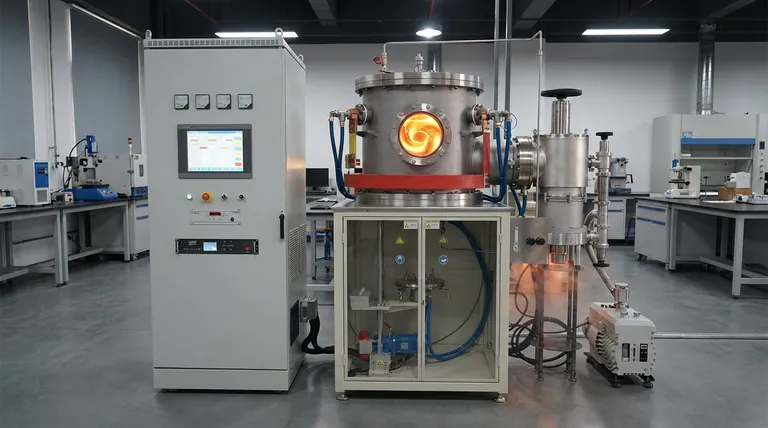
Maintaining Elemental Integrity through Vacuum Control
Preventing High-Temperature Oxidation
Fe-Mn-Si alloys contain highly reactive elements, particularly Manganese (Mn) and Silicon (Si), which easily react with oxygen and nitrogen at melting temperatures. The vacuum environment effectively isolates these elements, preventing the formation of unwanted oxides and nitrides that would otherwise degrade the material's properties.
Ensuring Precise Chemical Composition
Because the vacuum prevents the "burn-off" of active elements, engineers can maintain a precise elemental ratio. This precision is vital for shape memory alloys, where even a minor deviation in the percentage of Manganese or Silicon can significantly alter the phase transformation temperatures.
Degassing and Purity
The high-vacuum environment facilitates the removal of dissolved gaseous impurities from the liquid metal. By extracting these gases during the melt, the furnace produces a high-purity ingot that is free from internal defects and inclusions.
Achieving Homogeneity via Induction Stirring
The Role of Electromagnetic Eddy Currents
A VIM furnace uses medium-frequency induction to generate eddy currents within the melt. These currents create a natural stirring effect that continuously circulates the liquid metal, preventing the heavier elements from settling at the bottom.
Uniformity of the Shape Memory Effect
Chemical homogeneity is the "solid material foundation" for high performance. If the Manganese distribution is uneven, different parts of the alloy will react differently to thermal stress, ruining the shape memory consistency across the finished component.
Efficiency and Process Streamlining
The induction stirring effect ensures such high uniformity that it often eliminates the need for multiple remelting steps. Unlike traditional arc furnaces, which may require several passes to achieve a consistent master alloy, the VIM process reaches the desired homogeneity in a single melting cycle.
Understanding the Trade-offs
Equipment Complexity and Cost
Operating a vacuum induction furnace requires sophisticated vacuum pumping systems and high-power induction coils. This results in higher initial capital investment and operational costs compared to open-air induction or traditional casting methods.
Refractory Interaction
While the vacuum protects the melt from the air, the high temperatures can sometimes cause the molten metal to react with the refractory lining of the crucible. This interaction must be carefully managed to avoid introducing ceramic impurities into the Fe-Mn-Si alloy.
Element Volatility
At very high vacuum levels, elements with high vapor pressure—such as Manganese—can actually begin to evaporate. Operators must strike a careful balance between a deep vacuum for purity and a partial pressure of inert gas to suppress the evaporation of critical alloying elements.
How to Apply VIM to Your Alloy Production
The success of an Fe-Mn-Si alloy depends entirely on the control parameters used during the melting phase.
- If your primary focus is maximum shape memory recovery: Prioritize the induction stirring duration to ensure the Manganese and Silicon are perfectly distributed at the atomic level.
- If your primary focus is material purity for sensitive applications: Utilize the highest possible vacuum levels during the initial melting stage to maximize the degassing of impurities.
- If your primary focus is cost-effective mass production: Use the VIM’s ability to produce a homogenous melt in a single step to reduce the total energy expenditure associated with multiple remelting cycles.
By mastering the vacuum environment and the induction stirring effect, you ensure that every ingot produced meets the rigorous standards required for advanced shape memory applications.
Summary Table:
| Feature | Role in Fe-Mn-Si Alloy Melting | Key Benefit |
|---|---|---|
| Vacuum Environment | Prevents oxidation and nitridation of Mn and Si | Maintains precise chemical composition |
| Induction Stirring | Uses eddy currents to circulate molten metal | Ensures uniform shape memory properties |
| Degassing | Removes dissolved gaseous impurities | Produces high-purity, defect-free ingots |
| Thermal Control | Regulates high-temperature melt stability | Optimizes phase transformation temperatures |
Elevate Your Alloy Precision with KINTEK
Manufacturing high-performance Fe-Mn-Si shape memory alloys requires absolute control over purity and homogeneity. Backed by expert R&D and world-class manufacturing, KINTEK provides advanced Vacuum Induction (VIM), CVD, Muffle, and Tube furnace systems specifically designed to meet the rigorous demands of material science. Whether you need a standard setup or a fully customizable system for unique metallurgical challenges, we deliver the precision you need.
Ready to optimize your smelting process? Contact KINTEK today for a custom solution!
References
- Haojie Niu, Chengxin Lin. Study on the Effect of Solid Solution Treatment on the Bending Fatigue Property of Fe-Mn-Si Shape Memory Alloys. DOI: 10.3390/met14040441
This article is also based on technical information from Kintek Furnace Knowledge Base .
Related Products
- 600T Vacuum Induction Hot Press Vacuum Heat Treat and Sintering Furnace
- Vacuum Induction Melting Furnace
- Small Vacuum Heat Treat and Tungsten Wire Sintering Furnace
- High Pressure Laboratory Vacuum Tube Furnace
- Vacuum Hot Press Furnace Machine Heated Vacuum Press Tube Furnace
People Also Ask
- Why use Vacuum Hot Press (VHP) for ZnS Ceramics? Achieve Superior IR Transparency and Mechanical Strength
- How does a vacuum hot press sintering furnace mitigate copper sintering swelling? Solve Fe-Cu Expansion Issues
- How does the vacuum environment in a vacuum hot press sintering furnace protect chromium-containing ceramics? Find out.
- What are the key advantages of vacuum hot press sintering furnaces? Achieve Superior Density and Purity in Materials
- What is the core function of a vacuum hot press sintering furnace in the preparation of high-density RuTi alloys? Achieve Maximum Density and Purity



















