
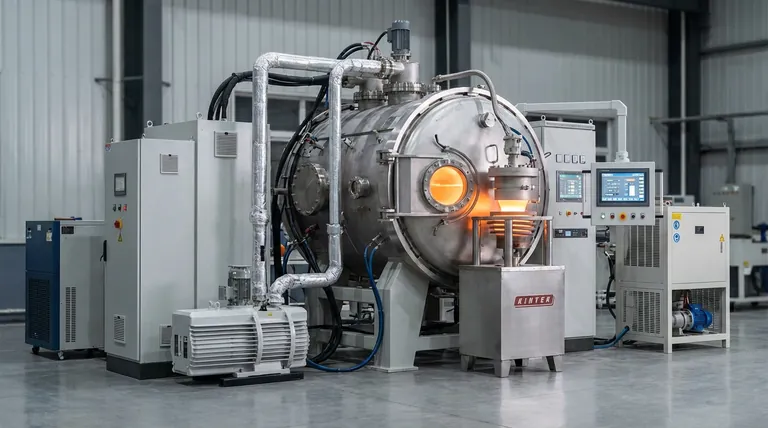
The Vacuum Induction Melting (VIM) furnace is the foundational tool for preparing Ni30 superalloys, serving primarily to melt raw materials within a highly controlled, high-vacuum environment. Its critical functions are to eliminate large non-metallic inclusions, prevent the oxidation of reactive elements, and precisely control chemical composition to refine the alloy's grain structure for subsequent processing.
Core Takeaway VIM is not simply a melting method; it is a purification and homogenization process essential for superalloy integrity. By isolating the melt from atmospheric contamination and utilizing electromagnetic forces, it transforms raw feedstocks into ingots with the dense, uniform crystalline structure required for high-performance applications.
Achieving High-Purity Melts
The primary challenge in creating Ni30 superalloys is maintaining purity at extreme temperatures. The VIM furnace addresses this through two distinct mechanisms.
Removal of Impurities
The furnace operates under a high vacuum (typically between 1.4 and 5.3 Pa). This environment facilitates the degassing of the melt, effectively removing volatile impurities and gaseous elements that would otherwise compromise the material's strength.
According to the primary technical data, this vacuum environment is specifically effective at removing large non-metallic inclusions. Eliminating these defects is mandatory to ensure the alloy possesses the structural integrity required for high-stress environments.
Prevention of Elemental Loss
Nickel-based superalloys rely on active elements like aluminum (Al), titanium (Ti), and niobium (Nb) for their superior properties. These elements are highly reactive and prone to rapid oxidation in open air.
The VIM furnace creates a protective barrier against oxidation. By preventing these active elements from burning off, the system ensures the final chemical composition matches the precise engineering specifications.
Ensuring Compositional Uniformity
Beyond purity, the physical distribution of elements within the alloy must be consistent. VIM utilizes the physics of induction to achieve this.
Electromagnetic Stirring
The induction heating mechanism does more than melt the metal; it generates strong electromagnetic stirring forces within the liquid pool.
This natural agitation is critical for mixing the complex nickel matrix. It ensures that trace elements, such as boron (B) and zirconium (Zr), are distributed evenly throughout the melt rather than segregating, which prevents weak points in the final material.
Grain Structure Refinement
The ultimate goal of the VIM process is to produce a sound ingot. The combination of precise composition control and vacuum processing facilitates the refinement of the alloy grain structure.
The result is an ingot with dense, uniform crystalline quality. This quality provides the necessary foundation for any subsequent processing steps, such as forging or casting.
Operational Criticality and Trade-offs
While VIM is indispensable for superalloys, understanding its operational context is vital for process planning.
Vacuum Dependency
The quality of the alloy is entirely dependent on the integrity of the vacuum system. Maintaining pressures as low as 0.01 hPa requires robust pumping systems and rigorous leak prevention. Any breach in the vacuum envelope immediately risks the oxidative loss of active elements like aluminum.
Process Complexity
The system requires the synchronization of multiple sub-systems, including medium frequency power supplies, tilting mechanisms, and cooling loops. The electromagnetic stirring must be carefully managed; while it ensures homogeneity, it must be balanced to avoid eroding the crucible lining, which could re-introduce inclusions into the melt.
Making the Right Choice for Your Goal
The specific application of VIM depends on which material characteristic is most critical for your final component.
- If your primary focus is Material Cleanliness: Prioritize the vacuum system's capability to reach and maintain low pressures (e.g., 1.4 Pa or lower) to maximize the removal of volatile impurities and non-metallic inclusions.
- If your primary focus is Mechanical Consistency: Focus on the induction frequency and stirring protocols to ensure the absolute homogenization of trace elements like boron and zirconium within the matrix.
Summary: The VIM furnace serves as the gatekeeper of quality for Ni30 superalloys, converting raw inputs into a chemically precise and structurally uniform foundation necessary for high-temperature performance.
Summary Table:
| Feature | Primary Function | Impact on Ni30 Superalloy |
|---|---|---|
| High Vacuum (1.4-5.3 Pa) | Degassing & Impurity Removal | Eliminates non-metallic inclusions and gaseous defects. |
| Controlled Environment | Prevention of Oxidation | Protects reactive elements like Al, Ti, and Nb from burning off. |
| Electromagnetic Stirring | Homogenization | Ensures uniform distribution of trace elements (B, Zr). |
| Induction Melting | Grain Structure Refinement | Produces dense, uniform crystalline ingots for high-stress use. |
Elevate Your Superalloy Production with KINTEK
Precise control over chemical composition and material purity is non-negotiable for high-performance superalloys. KINTEK provides industry-leading thermal solutions backed by expert R&D and world-class manufacturing. Whether you need Vacuum, CVD, Muffle, Tube, or Rotary systems, our high-temperature furnaces are fully customizable to meet your unique metallurgical requirements.
Ready to refine your melting process? Contact us today to consult with our experts and discover how our advanced furnace technology can bring absolute consistency to your laboratory or production line.
References
- Microstructural Evolution and Oxidation Resistance of Fe-30Ni-15Cr Alloy for Internal Combustion Engine Valves Under Long-Term High-Temperature Exposure and Heat Treatment. DOI: 10.3390/met15010061
This article is also based on technical information from Kintek Furnace Knowledge Base .
Related Products
- Vacuum Induction Melting Furnace
- 600T Vacuum Induction Hot Press Vacuum Heat Treat and Sintering Furnace
- Vacuum Heat Treat Sintering Furnace with Pressure for Vacuum Sintering
- 1400℃ Controlled Inert Nitrogen Atmosphere Furnace
- Vacuum Heat Treat Sintering Furnace Molybdenum Wire Vacuum Sintering Furnace
People Also Ask
- What are the core functions of the High Vacuum Induction Melting (VIM) furnace? Optimize DD5 Superalloy Purification
- Why is a Vacuum Induction Melting furnace (VIM) used for Cu-Zn-Al-Sn alloys? Achieve Precision Composition Control
- What are the technical advantages of using a Vacuum Induction Melting furnace in the development of advanced packaging steel?
- What is the role of VIM and directional solidification in aero-engine blade substrates? Engineering Extreme Durability
- What role does a Vacuum Induction Melting furnace play in the production of high-aluminum nickel-based superalloys?



















