
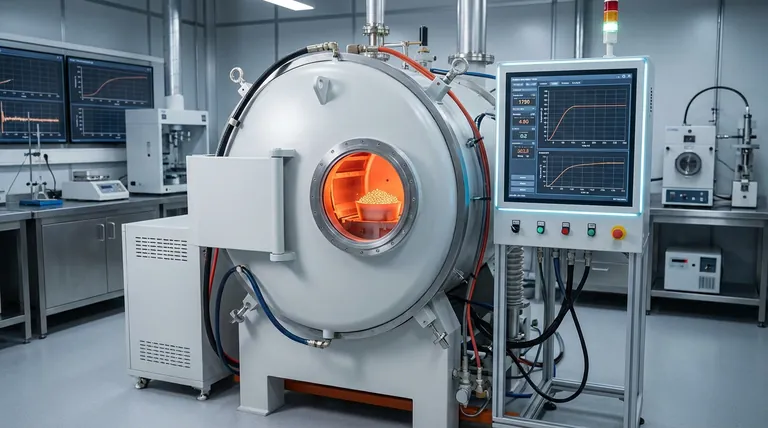
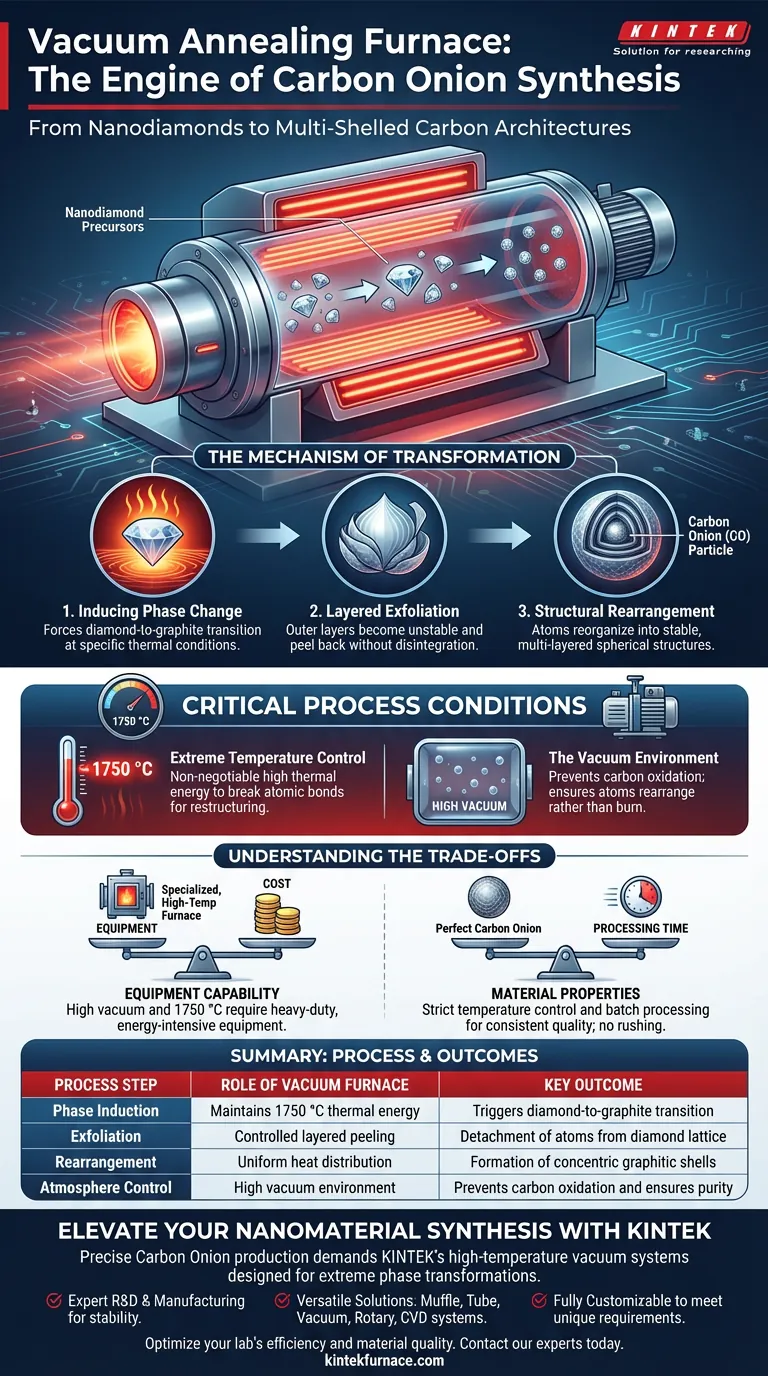
The vacuum annealing furnace serves as the critical reaction vessel for transforming nanodiamonds into Carbon Onion (CO) structures. By maintaining a strictly controlled vacuum environment at extreme temperatures of 1750 °C, the furnace drives a phase transformation that exfoliates the particle layers and rearranges them into multi-shelled, spherical carbon formations.
Core Takeaway While standard annealing is often used to soften metals, in Carbon Onion synthesis, the furnace acts as a high-precision phase reactor. It facilitates the atomic reorganization of nanodiamonds into concentric graphitic shells, unlocking unique properties like high hardness combined with exceptional lubricity.
The Mechanism of Transformation
Inducing Phase Change
The primary role of the furnace is to force a phase transformation.
It takes raw nanodiamond precursors and subjects them to specific thermal conditions. This environment causes the outer layers of the diamond structure to become unstable and shift.
Layered Exfoliation
Under these precise conditions, the particles undergo layered exfoliation.
The atomic structure essentially "peels" back. The furnace's controlled heat allows these atoms to detach from their rigid diamond lattice without disintegrating the material entirely.
Structural Rearrangement
Once exfoliated, the carbon atoms require a stable environment to settle into a new form.
The furnace facilitates the rearrangement of these particles into concentric spheres. This results in the "onion-like" multi-layered structure that defines Carbon Onion particles.
Critical Process Conditions
Extreme Temperature Control
The synthesis requires temperatures significantly higher than standard metal treatments.
The furnace must maintain a stable temperature of 1750 °C. This high thermal energy is non-negotiable for breaking the specific atomic bonds in nanodiamonds to allow for restructuring.
The Vacuum Environment
Conducting this process in a vacuum is essential for purity.
While the furnace provides uniform heating—a general characteristic of annealing equipment—the vacuum prevents oxidation. At 1750 °C, carbon would instantly burn up in the presence of oxygen; the vacuum ensures the carbon atoms rearrange rather than react.
Understanding the Trade-offs
Equipment Capability vs. Cost
Achieving 1750 °C in a high vacuum requires specialized, heavy-duty equipment.
Standard annealing furnaces used for metals (often operating at lower temperatures for stress relief) are insufficient. This makes the synthesis of Carbon Onions an energy-intensive and equipment-dependent process.
Material Properties vs. Processing Time
The process utilizes a strict temperature control program.
This implies a batch-style processing timeline. You cannot rush the heating or cooling cycles without risking thermal shock or incomplete phase transformation, which can lead to inconsistent particle sizes or structural defects.
Making the Right Choice for Your Goal
Application-Specific Recommendations
The properties of your final Carbon Onion material depend heavily on the precision of your furnace operations.
- If your primary focus is Lubrication: Ensure your furnace program prioritizes a long, stable hold time at peak temperature to ensure perfectly spherical, multi-layered shells that roll easily.
- If your primary focus is Hardness: Focus on the cooling rate control to lock in the structural integrity of the newly formed carbon layers without re-inducing stress.
The vacuum annealing furnace is not just a heater; it is the precise instrument that dictates the structural integrity and performance of the final Carbon Onion nanomaterial.
Summary Table:
| Process Step | Role of Vacuum Furnace | Key Outcome |
|---|---|---|
| Phase Induction | Maintains 1750 °C thermal energy | Triggers diamond-to-graphite transition |
| Exfoliation | Controlled layered peeling | Detachment of atoms from diamond lattice |
| Rearrangement | Uniform heat distribution | Formation of concentric graphitic shells |
| Atmosphere Control | High vacuum environment | Prevents carbon oxidation and ensures purity |
Elevate Your Nanomaterial Synthesis with KINTEK
Precise Carbon Onion production demands equipment that can withstand extreme 1750 °C environments without compromising structural integrity. KINTEK provides industry-leading high-temperature vacuum systems designed specifically for advanced phase transformations.
Why choose KINTEK?
- Expert R&D & Manufacturing: Our furnaces are built for stability and extreme thermal precision.
- Versatile Solutions: From Muffle and Tube furnaces to specialized Vacuum, Rotary, and CVD systems.
- Fully Customizable: We tailor our lab high-temp equipment to meet your unique nanotech or metallurgical requirements.
Ready to optimize your lab’s efficiency and material quality? Contact our experts today to find the perfect furnace for your research.
Visual Guide
References
- Timothy MacLucas, Frank Mücklich. Combining Carbon Nanoparticle Coatings and Laser Surface Texturing for Enhanced Lubricity Under High Loads. DOI: 10.1007/s11249-024-01837-5
This article is also based on technical information from Kintek Furnace Knowledge Base .
Related Products
- Vacuum Heat Treat Sintering Furnace with Pressure for Vacuum Sintering
- 1400℃ Controlled Inert Nitrogen Atmosphere Furnace
- Vacuum Heat Treat Sintering and Brazing Furnace
- Vacuum Heat Treat Sintering Furnace Molybdenum Wire Vacuum Sintering Furnace
- Small Vacuum Heat Treat and Tungsten Wire Sintering Furnace
People Also Ask
- How does vacuum heat treating affect the grain structure of metal alloys? Achieve Precise Microstructure Control
- What are the benefits of using vacuum heat treating furnaces for metal alloys? Achieve Superior Metal Properties and Performance
- What is one of the most important uses of vacuum heat treating furnaces in aerospace? Achieve Superior Strength in Aircraft Alloys
- What are the key components of a vacuum sintering furnace? Essential Parts for Precision Material Processing
- What is the purpose of setting a mid-temperature dwell stage? Eliminate Defects in Vacuum Sintering



















