
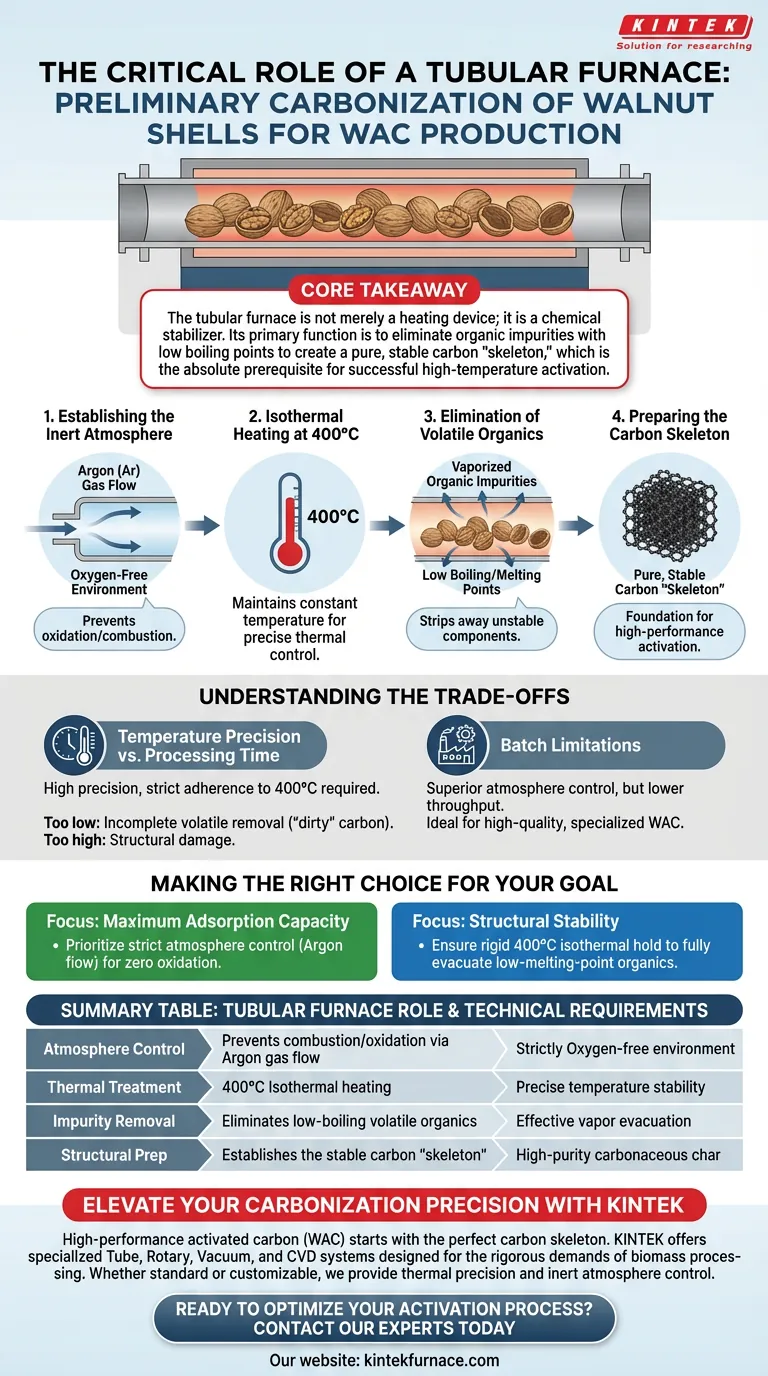
A tubular furnace serves as the critical stabilization vessel during the preliminary carbonization of walnut shells. It provides a strictly controlled, inert environment—typically using Argon gas—to heat the biomass isothermally at 400°C, stripping away volatile organic compounds without incinerating the carbon structure.
Core Takeaway The tubular furnace is not merely a heating device; it is a chemical stabilizer. Its primary function is to eliminate organic impurities with low boiling points to create a pure, stable carbon "skeleton," which is the absolute prerequisite for successful high-temperature activation.
The Mechanics of Preliminary Carbonization
Establishing the Inert Atmosphere
The most immediate role of the tubular furnace is to prevent oxidation. By maintaining a continuous flow of inert gas, such as Argon (Ar), the furnace ensures the environment is strictly oxygen-free.
Without this inert shield, heating walnut shells to hundreds of degrees would result in combustion (burning) rather than carbonization. The furnace allows thermal decomposition to occur while preserving the carbon mass.
Isothermal Heating at 400°C
According to the primary technical data, the specific target temperature for walnut shell preliminary carbonization is 400°C.
The tubular furnace maintains this specific temperature isothermally (constant temperature). This precise thermal control is necessary to target specific chemical bonds within the walnut shell biomass.
Elimination of Volatile Organics
The 400°C thermal field is calibrated to remove specific impurities. It targets organic compounds with low boiling and melting points.
As the furnace applies heat, these unstable components vaporize and are carried away by the gas flow. This leaves behind a carbonaceous char that is chemically more stable than the raw shell.
Preparing the Carbon Skeleton
This process establishes the foundation for the final product. By removing volatiles now, the furnace ensures the material has a stable structure for the subsequent, more aggressive activation phase.
If these organics were left in the shell, they would interfere with the development of micropores during later high-temperature processing.
Understanding the Trade-offs
Temperature Precision vs. Processing Time
The tubular furnace offers high precision, but it requires strict adherence to the 400°C set point.
If the temperature is too low, volatile removal is incomplete, leading to "dirty" carbon that performs poorly during activation. If the temperature spikes significantly higher during this preliminary phase, you risk damaging the structural skeleton before it is fully formed.
Batch Limitations
Tubular furnaces are generally batch or semi-continuous processing units. While they offer superior atmosphere control compared to open kilns, their throughput is often lower.
This makes them ideal for high-quality, specialized Activated Carbon production (like WAC) where purity is paramount, rather than bulk, low-grade charcoal production.
Making the Right Choice for Your Goal
To maximize the efficiency of your walnut shell carbonization, consider your specific production targets:
- If your primary focus is maximum adsorption capacity: Prioritize strict atmosphere control (Argon flow) to ensure zero oxidation of the pore structure.
- If your primary focus is structural stability: Ensure the furnace maintains a rigid 400°C isothermal hold to fully evacuate low-melting-point organics without thermal shock.
The tubular furnace transforms raw biomass into a predictable engineering material, acting as the gatekeeper between variable organic waste and high-performance activated carbon.
Summary Table:
| Stage | Key Role of Tubular Furnace | Technical Requirement |
|---|---|---|
| Atmosphere Control | Prevents combustion/oxidation via Argon gas flow | Strictly Oxygen-free environment |
| Thermal Treatment | 400°C Isothermal heating | Precise temperature stability |
| Impurity Removal | Eliminates low-boiling volatile organics | Effective vapor evacuation |
| Structural Prep | Establishes the stable carbon "skeleton" | High-purity carbonaceous char |
Elevate Your Carbonization Precision with KINTEK
High-performance activated carbon (WAC) starts with the perfect carbon skeleton. Backed by expert R&D and world-class manufacturing, KINTEK offers specialized Tube, Rotary, Vacuum, and CVD systems designed for the rigorous demands of biomass processing. Whether you need a standard lab unit or a customizable high-temperature furnace for unique walnut shell carbonization protocols, we provide the thermal precision and inert atmosphere control necessary to maximize adsorption capacity.
Ready to optimize your activation process? Contact our technical experts today to find the ideal system for your research or production needs.
Visual Guide
References
- Daniel Arenas Esteban, David Ávila‐Brande. Enhancing Electrochemical Properties of Walnut Shell Activated Carbon with Embedded MnO Clusters for Supercapacitor Applications. DOI: 10.1002/batt.202400101
This article is also based on technical information from Kintek Furnace Knowledge Base .
Related Products
- Electric Rotary Kiln Small Rotary Furnace for Activated Carbon Regeneration
- Vertical Laboratory Quartz Tube Furnace Tubular Furnace
- Multi Zone Laboratory Quartz Tube Furnace Tubular Furnace
- Laboratory Quartz Tube Furnace RTP Heating Tubular Furnace
- Custom Made Versatile CVD Tube Furnace Chemical Vapor Deposition CVD Equipment Machine
People Also Ask
- What are the main applications of a rotary kiln electric furnace? Achieve Uniform Heat Treatment for Powders
- What are the key components of a rotary kiln electric furnace? Unlock Efficient Thermal Processing
- What is the significance of the refractory lining in a rotary kiln electric furnace? Unlock Efficiency and Longevity
- What advantages do electric rotary kilns offer over fuel-based kilns? Boost Efficiency and Purity in Your Process
- What materials can be processed in an electric rotary kiln? Versatile Solutions for Advanced Materials

















