
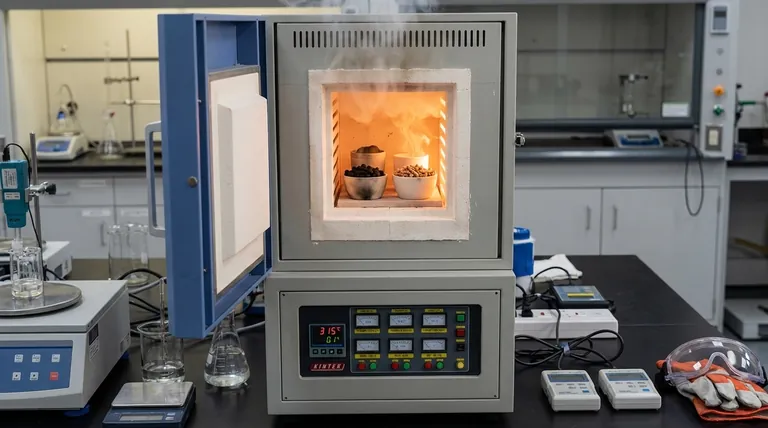
A Muffle Furnace acts as the central precision heating chamber in the high-temperature torrefaction of biomass pellets. It provides a strictly controlled, isolated environment that allows for the thermal degradation of wood pellets at specific temperatures between 285°C and 340°C, without the interference of direct flame or oxygen.
Core Insight: The primary value of a Muffle Furnace in this context is process isolation and thermal precision. It separates the biomass from fuel combustion byproducts, enabling an oxygen-free environment and exact heating rates that are essential for converting raw biomass into high-quality bio-reductants.
Precision Control of Thermal Parameters
Defining the Temperature Window
The effectiveness of torrefaction relies on maintaining a specific thermal window. The Muffle Furnace is used to sustain temperatures strictly within the 285°C to 340°C range.
This range is critical because it represents the "sweet spot" for high-temperature torrefaction. Below this range, the biomass creates standard torrefied wood; above it, the material begins to carbonize too heavily, moving toward charcoal production.
Regulating Heating Rates
Success in torrefaction is not just about the final temperature, but how you get there. The furnace allows operators to set specific heating rates, typically kept below 10 K/min.
By controlling the ramp-up speed, the furnace ensures that the thermal degradation of the biomass happens gradually. This prevents thermal shock and ensures the chemical changes within the pellet are uniform throughout its structure.
Environmental Control and Isolation
Creating an Oxygen-Free Zone
One of the defining features of a Muffle Furnace is its ability to isolate the sample from the heating elements. In this process, the furnace facilitates an oxygen-free condition.
Torrefaction is a mild form of pyrolysis, which requires the absence of oxygen to prevent combustion. The furnace design allows the biomass to "cook" rather than burn, altering its chemical structure without consuming the material in flames.
Managing Residence Time
The furnace provides the stability needed to hold biomass at peak temperature for a defined duration, known as residence time.
Precise control over residence time allows for the complete volatilization of moisture and specific volatile organic compounds. This is necessary to achieve the desired energy density and grindability in the final product.
Understanding the Trade-offs
Batch vs. Continuous Processing
Muffle furnaces are typically batch-processing units. While they offer superior control for research and small-scale production, they may limit throughput compared to continuous flow reactors used in industrial settings.
Thermal Lag
Because the heating is indirect (the "muffle" separates the heat source from the chamber), there can be a slight delay in temperature response. Operators must account for this lag when programming heating curves to ensure the internal pellet temperature matches the chamber setpoint.
Making the Right Choice for Your Goal
When utilizing a Muffle Furnace for biomass torrefaction, your operational parameters should change based on your desired output.
- If your primary focus is maximizing energy density: Target the upper temperature limit (340°C) with a longer residence time to remove the maximum amount of volatiles.
- If your primary focus is preserving mass yield: Keep the temperature closer to the lower bound (285°C) and utilize a slower heating rate (<10 K/min) to minimize material loss.
Summary: The Muffle Furnace is the tool of choice for converting raw biomass into engineered bio-reductants through rigorous control of heat, time, and atmosphere.
Summary Table:
| Parameter | Range/Requirement | Purpose in Torrefaction |
|---|---|---|
| Temperature Range | 285°C to 340°C | Ensures thermal degradation without full carbonization |
| Heating Rate | < 10 K/min | Prevents thermal shock and ensures uniform chemical change |
| Atmosphere | Oxygen-Free | Enables mild pyrolysis while preventing combustion |
| Residence Time | Precision Holding | Controls energy density and moisture volatilization |
Elevate Your Biomass Research with KINTEK Precision
To achieve consistent bio-reductant quality, you need equipment that masters the balance of temperature, atmosphere, and time. KINTEK provides industry-leading Muffle, Tube, Rotary, Vacuum, and CVD systems engineered for rigorous laboratory and industrial standards.
Backed by expert R&D and advanced manufacturing, our high-temperature furnaces are fully customizable to meet your specific biomass processing needs. Ensure your thermal degradation processes are precise and repeatable—Contact us today to discuss your custom furnace solution!
Visual Guide

References
- Richard Deutsch, Gernot Krammer. Characteristics of High-Temperature Torrefied Wood Pellets for Use in a Blast Furnace Injection System. DOI: 10.3390/en18030458
This article is also based on technical information from Kintek Furnace Knowledge Base .
Related Products
- 1400℃ Muffle Oven Furnace for Laboratory
- 1700℃ High Temperature Muffle Oven Furnace for Laboratory
- 1800℃ High Temperature Muffle Oven Furnace for Laboratory
- 1200℃ Muffle Oven Furnace for Laboratory
- High Temperature Muffle Oven Furnace for Laboratory Debinding and Pre Sintering
People Also Ask
- What is the primary function of a high-temperature laboratory muffle furnace in chemical synthesis? Achieve Precision.
- How does a high-temperature laboratory muffle furnace affect material properties? Transform Anodic Oxide Films Fast
- What is the muffle furnace function in ilmenite oxidative roasting? Enhance Phase Change & Magnetic Separation
- What is the function of a muffle furnace in MOF-derived zirconia conversion? Optimize Phase & Pore Engineering
- How is a laboratory high-temperature muffle furnace utilized to achieve the specific crystalline structure of LaFeO3 catalysts?



















