
In a muffle furnace, the atmosphere's primary role is twofold: it acts as a medium to transfer heat uniformly to the sample and provides a controlled chemical environment, protecting the material from direct contact with heating elements and unwanted contaminants. This ensures both thermal consistency and chemical purity during high-temperature processing.
The atmosphere inside a muffle furnace is not merely empty space; it is an active and critical component. Its function is to guarantee that the sample is heated evenly from all sides while simultaneously dictating the chemical reactions—or lack thereof—that can occur at high temperatures.
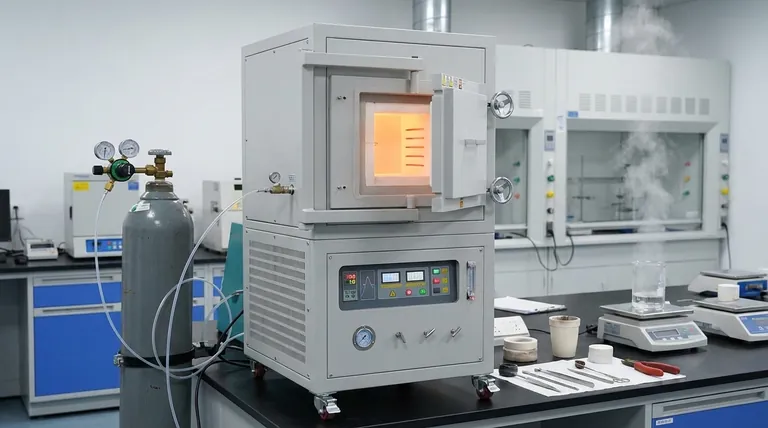
The Principle of Indirect Heating
To understand the atmosphere's role, you must first understand how a muffle furnace works. It is fundamentally an indirect heating system.
Separating the Heat Source from the Sample
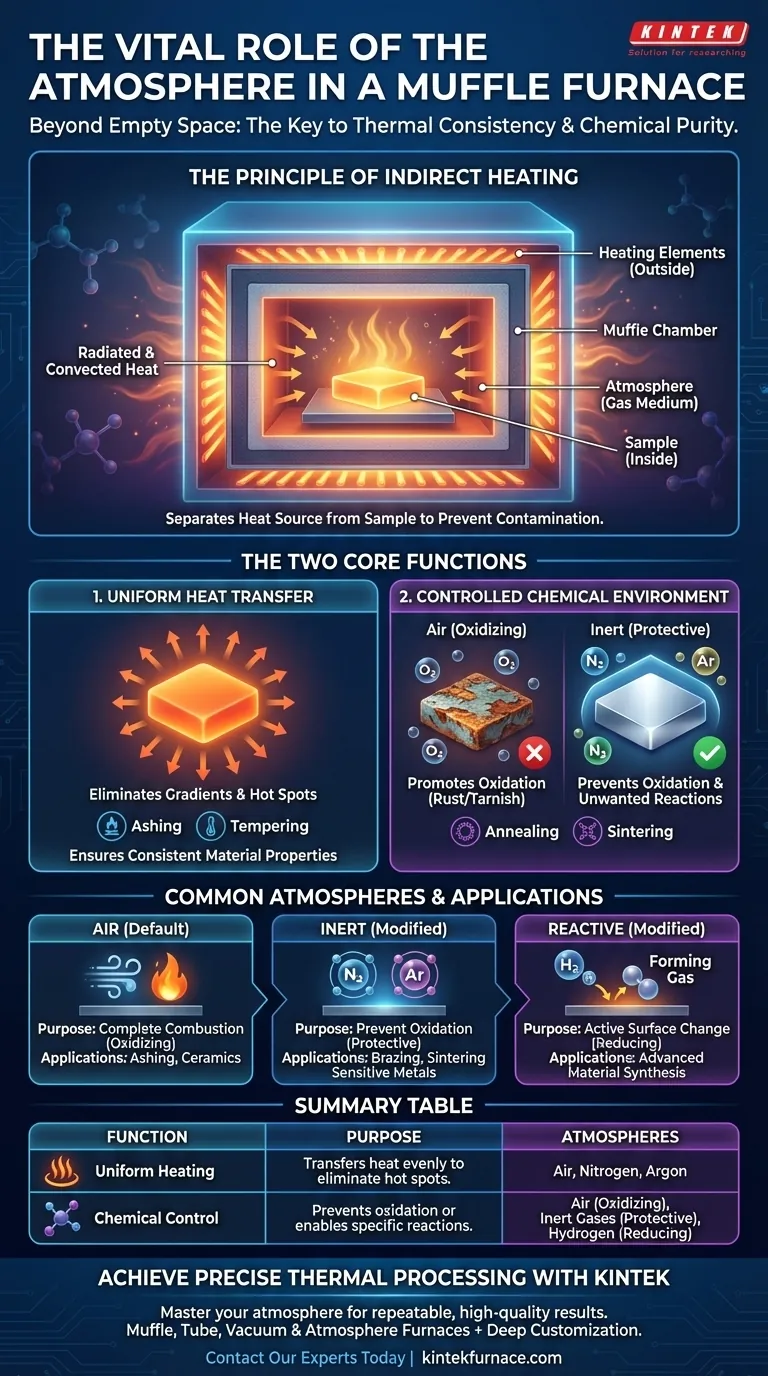
A muffle furnace contains a chamber, or "muffle," made of a heat-resistant material. The heating elements, which generate the high temperatures, are located outside of this chamber.
This design intentionally separates the heat source from the material being processed. This prevents contamination from combustion by-products (in fuel-fired furnaces) or direct radiation hot-spots from electrical elements.
The Atmosphere as a Heat Transfer Medium
The heating elements heat the walls of the muffle. The muffle then radiates and convects this heat into the atmosphere—typically air or a specific gas—sealed inside the chamber.
This heated atmosphere then envelops the sample, transferring thermal energy to it evenly from all directions.
The Two Core Functions of the Furnace Atmosphere
The atmosphere inside the muffle chamber serves two distinct but equally important purposes.
Function 1: Ensuring Uniform Heating
A static, contained atmosphere is excellent at distributing heat. By heating the sample from all sides simultaneously, it eliminates the temperature gradients and hot spots common with direct heating methods.
This uniformity is critical for processes like annealing, tempering, and ashing, where consistent material properties are the primary goal.
Function 2: Providing a Controlled Chemical Environment
The atmosphere also dictates the chemical interactions that take place. By managing the gas inside the muffle, you can either prevent or encourage specific reactions.
The most common goal is to prevent oxidation. Many materials, especially metals, will rapidly oxidize (rust or tarnish) at high temperatures when exposed to oxygen. The muffle allows for the air to be replaced with an inert gas to prevent this.
Common Atmospheres and Their Applications
The "right" atmosphere depends entirely on the process goal. The choice is a deliberate one that directly impacts the outcome of the thermal processing.
The Default Atmosphere: Air
For many common applications like determining the ash content of a sample or certain ceramics processing, a standard air atmosphere is sufficient and often necessary. The oxygen in the air is required to facilitate complete combustion of the organic material.
Modified Atmospheres for Sensitive Materials
For processing sensitive metals or advanced materials, oxygen is a contaminant. In these cases, the chamber is purged of air and filled with a specific gas.
- Inert Atmospheres (Nitrogen, Argon): These gases are non-reactive. They are used to create a protective environment that prevents oxidation and other unwanted chemical changes during processes like brazing or sintering.
- Reactive Atmospheres (Hydrogen, Forming Gas): In some advanced applications, a reactive gas is introduced to actively change the surface of the material, such as reducing surface oxides.
Making the Right Choice for Your Process
Understanding the role of the atmosphere allows you to select the correct conditions for your specific application.
- If your primary focus is ashing or simple drying: A standard air atmosphere is all you need, as its main role is to provide uniform heat.
- If your primary focus is annealing or brazing metals: You require an inert atmosphere (like nitrogen or argon) to prevent destructive oxidation at high temperatures.
- If your primary focus is advanced material synthesis: You may need a specific reactive gas atmosphere to control the chemical transformation of your sample.
Ultimately, mastering the furnace atmosphere is fundamental to achieving precise, repeatable results in high-temperature material processing.
Summary Table:
| Function | Purpose | Common Atmospheres |
|---|---|---|
| Uniform Heating | Transfers heat evenly to eliminate hot spots and temperature gradients. | Air, Nitrogen, Argon |
| Chemical Control | Prevents oxidation or enables specific reactions by managing the gas composition. | Air (Oxidizing), Inert Gases (Protective), Hydrogen (Reducing) |
Achieve Precise Thermal Processing with KINTEK's Advanced Furnace Solutions
Mastering your furnace atmosphere is key to repeatable, high-quality results. Whether your application requires simple ashing in air or complex material synthesis under a controlled gas, KINTEK has the expertise and technology to meet your exact needs.
Leveraging exceptional R&D and in-house manufacturing, we provide diverse laboratories with advanced high-temperature furnace solutions. Our product line, including Muffle, Tube, and Vacuum & Atmosphere Furnaces, is complemented by our strong deep customization capability to precisely meet unique experimental requirements.
Ready to optimize your high-temperature processes? Contact our experts today to discuss how a KINTEK furnace can deliver the perfect atmosphere for your application.
Visual Guide
Related Products
- Mesh Belt Controlled Atmosphere Furnace Inert Nitrogen Atmosphere Furnace
- 1200℃ Controlled Inert Nitrogen Atmosphere Furnace
- 1700℃ Controlled Inert Nitrogen Atmosphere Furnace
- Controlled Inert Nitrogen Hydrogen Atmosphere Furnace
- 1400℃ Controlled Inert Nitrogen Atmosphere Furnace
People Also Ask
- What are the two main purposes of controlled atmosphere conditions in furnaces? Protect or Transform Materials for Peak Performance
- How is a controlled atmosphere furnace used in material research? Achieve Precise Material Synthesis and Heat Treatment
- What types of gases can a controlled atmosphere furnace handle? Master Inert and Reactive Gases for Your Lab
- How does a controlled atmosphere furnace improve product quality and consistency? Master Precise Heat Treatment for Superior Results
- What types of furnaces have controlled atmosphere furnaces largely replaced? Boost Metallurgical Precision & Safety










