
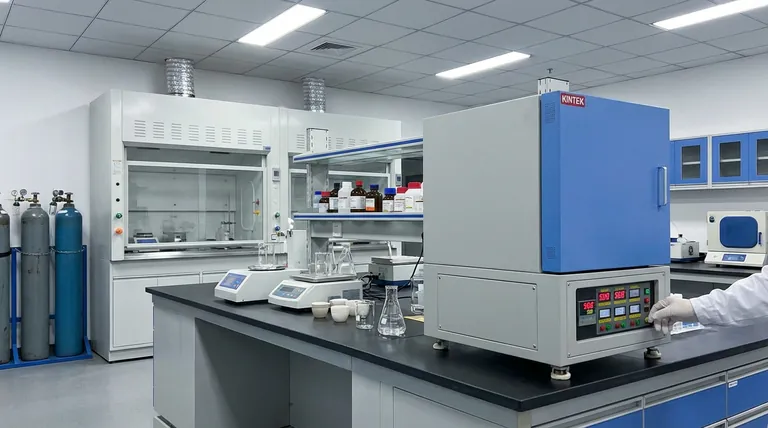
In the synthesis of Pt/Ce(M) catalysts, a muffle furnace serves as the critical reaction vessel for transforming chemical precursors into active catalytic materials.
It provides a controlled air atmosphere heated to 500°C for 4 hours, which is necessary to decompose chloroplatinic acid precursors. This thermal treatment converts these precursors into stable oxide or metallic platinum particles, effectively "activating" the catalyst for future use.
Core Takeaway The muffle furnace does more than simply dry or heat the material; it acts as a precision tool to engineer the Strong Metal-Support Interaction (SMSI). By strictly regulating temperature ramps and dwell times, the furnace defines the final redox characteristics and efficiency of the catalyst.
Establishing the Active Phase
The primary function of the muffle furnace is to facilitate the phase transition of the metal components.
Decomposition of Precursors
The high-temperature environment (500°C) drives the decomposition of chloroplatinic acid. Without this specific thermal energy, the platinum remains locked in a precursor state that is catalytically inactive.
Formation of Stable Particles
The furnace ensures the conversion of the precursor into stable oxide or metallic platinum particles. This step fixes the platinum onto the support structure, preventing it from washing away or degrading during operation.
Oxidation Atmosphere Control
Operating in an air atmosphere allows for the complete oxidation of the components. This oxidative environment is required to burn off ligands and organic residues associated with the raw materials.
Engineering the Metal-Support Interaction
Beyond simple decomposition, the muffle furnace determines how the platinum interacts with the doped ceria support.
Regulating SMSI
The interaction between platinum and the support is known as the Strong Metal-Support Interaction (SMSI). The thermal treatment in the furnace is the mechanism that activates this bond, which is fundamental to the catalyst's stability.
The Criticality of Ramp Rates
Precise control over the heating rate is non-negotiable. A ramp rate of 10°C per minute is used to gradually introduce thermal energy.
Determining Redox Characteristics
The quality of the SMSI formed in the furnace directly dictates the redox characteristics of the final product. If the heating is uncontrolled, the electronic interaction between the platinum and ceria will be suboptimal, reducing catalytic performance.
Understanding the Trade-offs
While the muffle furnace is essential, improper use leads to specific failure modes in catalyst preparation.
The Risk of Thermal Sintering
If the temperature exceeds the optimal 500°C or if thermal distribution is uneven, sintering can occur. This causes the platinum particles to agglomerate (clump together), drastically reducing the surface area and active sites available for reaction.
Incomplete Calcination
Conversely, failing to maintain the temperature for the full 4 hours can lead to incomplete decomposition. Residual precursors may remain on the support, blocking active sites and acting as poisons during catalytic reactions.
Thermal Shock
Ignoring the specific ramp rate (10°C/min) leads to thermal shock. Rapid heating can cause structural collapse or uneven distribution of the platinum on the ceria support, undermining the structural integrity of the catalyst.
Making the Right Choice for Your Goal
To maximize the potential of your Pt/Ce(M) catalyst, tailor your furnace protocols to your specific objectives.
- If your primary focus is Redox Efficiency: Adhere strictly to the 10°C/min ramp rate, as this controlled heating is what establishes the optimal Strong Metal-Support Interaction (SMSI).
- If your primary focus is Catalyst Longevity: Ensure the dwell time is at least 4 hours at 500°C to guarantee the complete conversion of precursors into stable, leaching-resistant oxide or metallic phases.
Success in catalyst preparation relies not just on reaching high temperatures, but on the precision of the thermal journey provided by the muffle furnace.
Summary Table:
| Parameter | Specification | Purpose |
|---|---|---|
| Temperature | 500°C | Decomposes chloroplatinic acid precursors |
| Dwell Time | 4 Hours | Ensures complete phase transition & stability |
| Ramp Rate | 10°C / Minute | Prevents thermal shock & optimizes SMSI |
| Atmosphere | Air | Facilitates oxidation & removes organic residues |
| Key Outcome | Active Phase | Transforms precursors into stable metallic particles |
Optimize Your Catalyst Performance with KINTEK
Precise thermal control is the difference between a high-efficiency catalyst and a failed batch. Backed by expert R&D and manufacturing, KINTEK offers high-performance Muffle, Tube, Rotary, Vacuum, and CVD systems designed for the rigorous demands of material synthesis.
Our lab high-temp furnaces provide the uniform heating and programmable ramp rates essential for engineering Strong Metal-Support Interactions (SMSI) and avoiding thermal sintering. Whether you need a standard setup or a system customized for your unique catalytic research, KINTEK delivers the reliability your laboratory requires.
Ready to elevate your research? Contact our technical experts today to find the perfect furnace solution for your application.
Visual Guide

References
- Matías G. Rinaudo, María R. Morales. Insights into Contribution of Active Ceria Supports to Pt-Based Catalysts: Doping Effect (Zr; Pr; Tb) on Catalytic Properties for Glycerol Selective Oxidation. DOI: 10.3390/inorganics13020032
This article is also based on technical information from Kintek Furnace Knowledge Base .
Related Products
- 1400℃ Muffle Oven Furnace for Laboratory
- 1700℃ High Temperature Muffle Oven Furnace for Laboratory
- 1800℃ High Temperature Muffle Oven Furnace for Laboratory
- 1200℃ Muffle Oven Furnace for Laboratory
- High Temperature Muffle Oven Furnace for Laboratory Debinding and Pre Sintering
People Also Ask
- How does a high-temperature laboratory muffle furnace affect material properties? Transform Anodic Oxide Films Fast
- What is the primary function of a high-temperature laboratory muffle furnace in chemical synthesis? Achieve Precision.
- What is the role of a laboratory high-temperature muffle furnace in H13 steel treatment? Optimize Tool Performance
- How is a laboratory high-temperature muffle furnace utilized to achieve the specific crystalline structure of LaFeO3 catalysts?
- How does a laboratory high-temperature muffle furnace facilitate the homogenization of borosilicate glass samples? Expert Insights



















