
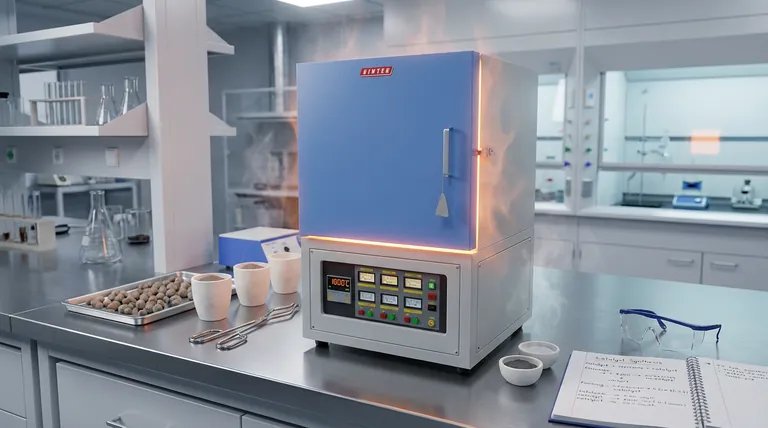
A laboratory muffle furnace acts as the primary architect for the chemical and physical properties of nickel-based bimetallic catalysts. By providing a precise, high-temperature thermal treatment environment (typically around 700°C), it drives the calcination process required to transform raw precursors into highly active, structurally optimized catalytic materials.
Core Takeaway The muffle furnace is not merely a heating device; it is a synthesis tool that governs catalyst performance. By strictly controlling calcination temperature and duration, it facilitates the formation of magnetic nickel-ferrite (NiFe2O4) active sites and engineers a hollow, porous structure within the carbon carrier, directly enhancing the catalyst's ability to activate reactants like persulfate.
Driving Chemical Transformation
Formation of Active Magnetic Components
The primary function of the furnace is to facilitate a specific chemical phase change. It supplies the thermal energy needed to transform metal ions loaded on the surface into nickel-ferrite (NiFe2O4).
This magnetic component is the "engine" of the bimetallic catalyst. Without the precise heat application provided by the furnace, these active sites would not form, rendering the catalyst ineffective.
Decomposition of Precursors
Before the active phase can form, the furnace must decompose the raw materials. It breaks down metal salt precursors (such as nitrates or acetates) into active oxides.
This step ensures that the metal components are chemically available to bond and form the necessary bimetallic structures.
Optimizing Physical Structure
Activating the Support Carrier
Beyond the metals, the furnace optimizes the material that holds them—specifically, the activated carbon carrier.
High-temperature treatment "activates" the carbon. This process modifies the physical scaffold of the catalyst, ensuring it is robust enough to support the reaction.
Engineering Porosity
The thermal treatment creates a hollow porous structure within the catalyst.
This structural evolution is critical for performance. A porous structure maximizes the specific surface area, allowing for significantly improved contact between the reactants and the active sites.
Ensuring Consistency and Purity
Removal of Impurities
The furnace acts as a purification stage. The sustained heat (often several hours) eliminates residual organic templates, surfactants, or moisture that may remain from the initial mixing or drying phases.
Removing these impurities prevents pore blockage, ensuring that the active sites are fully exposed to the reaction medium.
Thermal Field Stability
A high-quality muffle furnace provides excellent thermal field stability. This ensures that the heat is applied uniformly across the entire sample batch.
Uniform heating is vital for reproducibility. It guarantees that every gram of the catalyst undergoes the same transformation, resulting in consistent performance data across different experimental batches.
Understanding the Trade-offs
The Risk of Sintering
While high heat is necessary for activation, excessive temperature or duration can be detrimental.
Overheating can lead to sintering, where the active metal particles merge and grow too large. This reduces the active surface area and degrades catalytic performance.
Atmosphere Control Limitations
Standard muffle furnaces typically operate in an air atmosphere.
If your specific catalyst chemistry requires a completely oxygen-free environment to prevent unwanted oxidation of the carbon support or metal species, a standard box furnace may be insufficient without specialized gas flow modifications.
Making the Right Choice for Your Goal
To maximize the performance of your nickel-based bimetallic catalysts, tailor your furnace usage to your specific synthesis targets:
- If your primary focus is Phase Purity (NiFe2O4 formation): Prioritize temperature precision to reach the exact activation energy required for crystallization without overheating.
- If your primary focus is Surface Area (Porosity): Focus on the heating ramp rate and duration to ensure organic templates are removed slowly enough to preserve the pore structure.
Ultimately, the muffle furnace transforms a mixture of raw chemicals into a precision-engineered tool capable of driving complex chemical reactions.
Summary Table:
| Feature | Function in Catalyst Optimization | Impact on Performance |
|---|---|---|
| Calcination | Facilitates formation of NiFe2O4 active sites | Drives chemical activation & reactivity |
| Precursor Decomposition | Breaks down metal salts into active oxides | Ensures chemical availability of metals |
| Structural Engineering | Creates hollow porous structures in carbon carriers | Increases surface area for reactant contact |
| Purification | Removes residual organics and moisture | Prevents pore blockage & site contamination |
| Thermal Stability | Provides uniform heat distribution | Ensures batch-to-batch consistency |
Elevate Your Material Research with KINTEK
Precision thermal treatment is the foundation of high-performance nickel-based bimetallic catalysts. Backed by expert R&D and manufacturing, KINTEK offers high-performance Muffle, Tube, Rotary, Vacuum, and CVD systems, all fully customizable to meet your specific research needs.
Whether you require strict atmosphere control to prevent sintering or precise temperature ramps to engineer porosity, our lab high-temp furnaces provide the stability and control your innovations deserve.
Ready to optimize your catalyst synthesis? Contact us today to find the perfect furnace solution!
References
- Bo Zhang, Chundu Wu. Preparation of Nickel-Based Bimetallic Catalyst and Its Activation of Persulfate for Degradation of Methyl Orange. DOI: 10.3390/pr12020322
This article is also based on technical information from Kintek Furnace Knowledge Base .
Related Products
- 1400℃ Muffle Oven Furnace for Laboratory
- Laboratory Muffle Oven Furnace with Bottom Lifting
- 1200℃ Muffle Oven Furnace for Laboratory
- High Temperature Muffle Oven Furnace for Laboratory Debinding and Pre Sintering
- 1800℃ High Temperature Muffle Oven Furnace for Laboratory
People Also Ask
- How does a high-temperature laboratory muffle furnace affect material properties? Transform Anodic Oxide Films Fast
- What is the primary function of a high-temperature laboratory muffle furnace in chemical synthesis? Achieve Precision.
- How does a laboratory high-temperature muffle furnace contribute to the final formation of Bismuth Oxide nanosheets?
- How does a laboratory high-temperature muffle furnace facilitate the homogenization of borosilicate glass samples? Expert Insights
- How is a laboratory high-temperature muffle furnace utilized in g-C3N4 synthesis? Optimize Your Thermal Polycondensation



















