
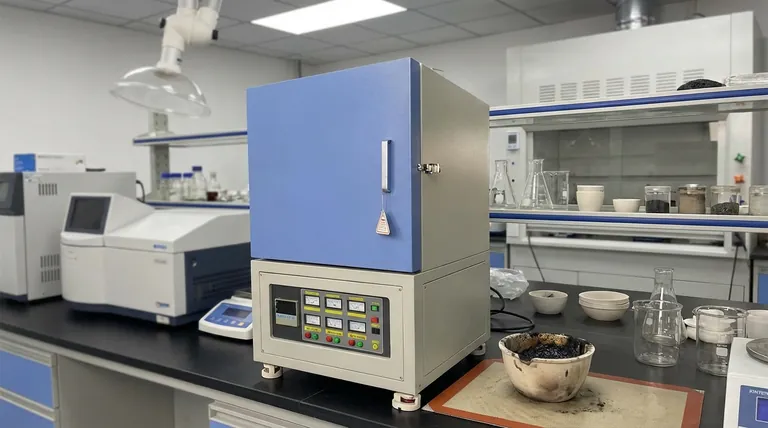
A muffle furnace serves as the critical simulation environment for reproducing the carbonization process that occurs during the thermal decomposition of composite materials. By maintaining a precise high-temperature setting (often around 400 °C for specific studies), it allows researchers to isolate the resulting char residue to evaluate its physical structure and protective capabilities.
The muffle furnace isolates the carbonization process, enabling the detailed morphological analysis of char residues. This step is essential for verifying how effective flame retardant mechanisms—specifically phosphorus-silicon synergies—are at creating physical barriers against heat and combustible gases.
Simulating the Carbonization Process
Creating a Controlled Thermal Field
To accurately analyze combustion residues, you must simulate the intense heat of a fire without the variables of an open flame.
A muffle furnace provides a stable, uniform high-temperature environment. This allows for the controlled thermal decomposition of the composite matrix.
Generating the Char Residue
When exposed to these temperatures, the organic components of the material decompose.
This process leaves behind a dense carbon layer, known as char. This residue is the primary subject of analysis for understanding material behavior under fire conditions.
Verifying Flame Retardant Efficacy
Analyzing Morphology and Density
Once the char is generated, researchers examine its morphology.
The goal is to determine if the residue forms a dense, continuous layer. A porous or fragile layer indicates poor protection, whereas a solid structure suggests high performance.
Confirming the Barrier Effect
The analysis of the residue directly verifies the "barrier effect."
A high-quality char layer acts as a physical shield. It effectively blocks the transfer of heat into the material and prevents combustible gases from escaping to fuel the fire.
Validating Synergistic Mechanisms
The muffle furnace is particularly useful for validating complex chemical synergies, such as the phosphorus-silicon mechanism.
By characterizing the residue, researchers can confirm if these elements successfully collaborated to reinforce the char structure during decomposition.
Understanding the Trade-offs
Temperature Sensitivity
Selecting the correct temperature is critical and depends entirely on the analytical goal.
While 400 °C is used to study char morphology, higher temperatures (e.g., 565 °C or up to 1000 °C) are used for complete burn-off or mineral roasting.
Risk of Over-Decomposition
If the furnace temperature is set too high during a residue analysis, you risk oxidizing the carbon char itself.
This would destroy the very structure you intend to study. Precise thermal control is required to decompose the matrix without obliterating the protective barrier you are trying to evaluate.
How to Apply This to Your Project
When utilizing a muffle furnace for composite analysis, align your temperature parameters with your specific objective:
- If your primary focus is Flame Retardancy: Set the furnace to simulate carbonization (e.g., 400 °C) to preserve the char structure for morphological analysis.
- If your primary focus is Composition Analysis: Increase the temperature (e.g., 565 °C) to achieve complete resin removal for calculating fiber volume fractions and void content.
By matching the thermal environment to the chemical mechanism you wish to verify, you ensure accurate characterization of the material's protective performance.
Summary Table:
| Analytical Goal | Furnace Temperature | Resulting Outcome |
|---|---|---|
| Carbonization Study | ~400 °C | Preserves char morphology for structural analysis |
| Barrier Verification | High-temp Stability | Evaluates density and physical protective layers |
| Composition Analysis | 565 °C - 1000 °C | Complete burn-off for fiber volume/void calculation |
| Mechanism Validation | Controlled Heating | Confirms P-Si synergies in char reinforcement |
Elevate Your Material Analysis with KINTEK Precision
Precise thermal control is the difference between a successful char analysis and destroyed samples. At KINTEK, we understand the delicate balance required for composite research. Backed by expert R&D and manufacturing, we offer a comprehensive range of Muffle, Tube, Rotary, Vacuum, and CVD systems, all fully customizable to meet your unique laboratory specifications.
Whether you are validating phosphorus-silicon flame retardant synergies or performing high-temperature mineral roasting, our high-temp furnaces provide the stability and uniformity your research demands. Contact us today to find the perfect furnace solution for your lab!
References
- Wanchao Wu, Chuanqun Hu. Preparation and Flame-Retardant Properties of DMMP/Nano-Silica/WPU Composite Materials. DOI: 10.3390/polym17081052
This article is also based on technical information from Kintek Furnace Knowledge Base .
Related Products
- 1400℃ Muffle Oven Furnace for Laboratory
- 1700℃ High Temperature Muffle Oven Furnace for Laboratory
- 1800℃ High Temperature Muffle Oven Furnace for Laboratory
- 1200℃ Muffle Oven Furnace for Laboratory
- High Temperature Muffle Oven Furnace for Laboratory Debinding and Pre Sintering
People Also Ask
- What is the primary function of a high-temperature laboratory muffle furnace in chemical synthesis? Achieve Precision.
- How does a high-temperature laboratory muffle furnace affect material properties? Transform Anodic Oxide Films Fast
- What function does a muffle furnace perform in perovskite formation? Optimize Your Thermal Synthesis
- How is a laboratory high-temperature muffle furnace used in agloporite preparation? Optimize Material Synthesis
- How is a laboratory high-temperature muffle furnace utilized in g-C3N4 synthesis? Optimize Your Thermal Polycondensation



















