
The primary purpose is calcination. At 900°C, the furnace induces thermal decomposition, chemically altering the eggshells from calcium carbonate (CaCO3) into calcium oxide (CaO) by forcibly expelling carbon dioxide. This specific temperature is critical to ensure the complete transformation of the material structure.
The process converts inert waste biomass into a functional resource, generating active CaO nanoparticles specifically optimized for catalytic applications.
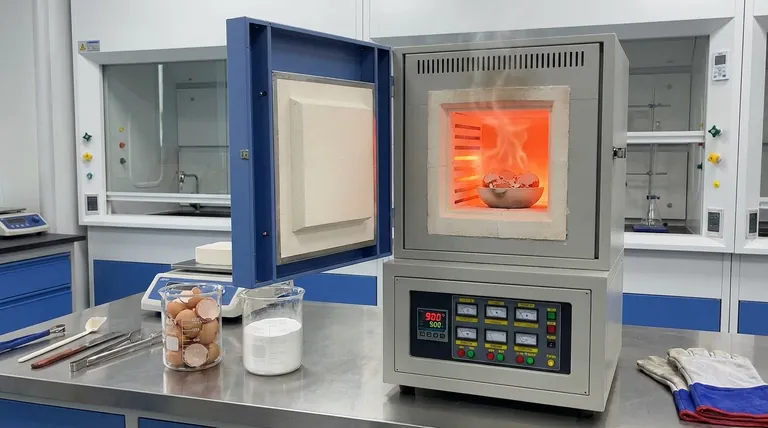
The Mechanism of Transformation
Thermal Decomposition
The fundamental reaction occurring at 900°C is thermal decomposition. Raw eggshells consist primarily of calcium carbonate (CaCO3), which is chemically stable at room temperature.
By applying high heat, you overcome the activation energy required to break the chemical bonds. This drives off carbon dioxide (CO2) as a gas, leaving behind calcium oxide (CaO).
Creation of Functional Nanoparticles
This process does more than simply dry the shells; it fundamentally restructures them.
The calcination process effectively transforms the macroscopic shell structure into CaO nanoparticles. This morphological change is essential for increasing surface area and reactivity.
Why 900°C Matters
Ensuring Complete Conversion
Temperature control is the defining factor in product quality.
If the temperature is too low, the core of the material may remain as calcium carbonate. Reaching 900°C ensures the heat penetrates thoroughly to drive the reaction to completion.
Activation for Catalysis
The goal of this process is to create a material suitable for catalytic applications.
Raw eggshells are largely inert. The high-temperature treatment "activates" the material, creating the chemical properties necessary to function as an effective catalyst in subsequent chemical processes.
Understanding the Trade-offs
Energy Intensity vs. Product Value
The primary trade-off in this process is the energy cost relative to the raw material cost.
While eggshells are a low-cost or negative-cost waste product, maintaining a furnace at 900°C requires significant energy input. This expenditure is only justified because the resulting CaO nanoparticles possess high economic value as catalysts, far exceeding the value of the raw biomass.
Making the Right Choice for Your Goal
To maximize the utility of this process, align your parameters with your specific end-use requirements.
- If your primary focus is Waste Management: Ensure the process runs long enough to reduce volume significantly, though high purity may be less critical.
- If your primary focus is Catalyst Production: Strictly monitor the 900°C threshold to guarantee total decomposition of carbonate into active oxide.
Mastering the calcination temperature is the difference between burning waste and engineering a valuable chemical asset.
Summary Table:
| Feature | Process Details |
|---|---|
| Primary Goal | Calcination (Thermal Decomposition) |
| Chemical Change | CaCO3 → CaO + CO2 |
| Target Temperature | 900°C |
| End Product | Active CaO Nanoparticles |
| Primary Application | Catalytic Processes & Material Engineering |
Elevate Your Material Research with KINTEK
Turning waste biomass into high-value catalysts requires precision heat treatment. Backed by expert R&D and manufacturing, KINTEK offers specialized Muffle, Tube, and Vacuum furnaces engineered to maintain the strict 900°C thresholds necessary for complete calcination.
Whether you need a standard solution or a system customized for your unique laboratory needs, our high-temp furnaces provide the thermal stability your research demands.
Ready to optimize your catalytic applications? Contact us today to find your perfect furnace solution!
References
- Nabil A. Alhemiary. Synthesis of Novel Nanocomposite CaO/AC/ZnO from Biogenic Wastes of Date Palm Seeds from The Najran Region (Saudi Arabia) and Eggshells for Degradation of Methylene Blue. DOI: 10.15379/ijmst.v11i1.3625
This article is also based on technical information from Kintek Furnace Knowledge Base .
Related Products
- 1800℃ High Temperature Muffle Oven Furnace for Laboratory
- High Temperature Muffle Oven Furnace for Laboratory Debinding and Pre Sintering
- 1400℃ High Temperature Laboratory Tube Furnace with Alumina Tube
- 1700℃ High Temperature Muffle Oven Furnace for Laboratory
- 1700℃ High Temperature Laboratory Tube Furnace with Alumina Tube
People Also Ask
- What is the primary function of a high-temperature laboratory muffle furnace in chemical synthesis? Achieve Precision.
- How does a high-temperature laboratory muffle furnace affect material properties? Transform Anodic Oxide Films Fast
- Why is a laboratory high-temperature muffle furnace required for LaNixFe1-xO3 catalysts? Optimize Two-Stage Synthesis
- What role does a muffle furnace play in plant bark mineral analysis? Essential for Precise Dry Ashing & Trace Extraction
- What functions does a laboratory muffle furnace perform for AISI 1025 steel post-processing? Precision Thermal Control



















