
The temperature disparity between the edge and center of a workpiece is driven by the physics of heat transfer within the furnace environment. The edges of the high-entropy alloy absorb radiant energy directly and immediately from the heating elements, while the center must wait for that thermal energy to travel inward via conduction.
The core issue is a competition between two heat transfer mechanisms: rapid surface radiation versus slower internal conduction. The edges heat up instantly due to direct line-of-sight with the heaters, while the center lags behind, creating a temporary thermal gradient until equilibrium is reached.
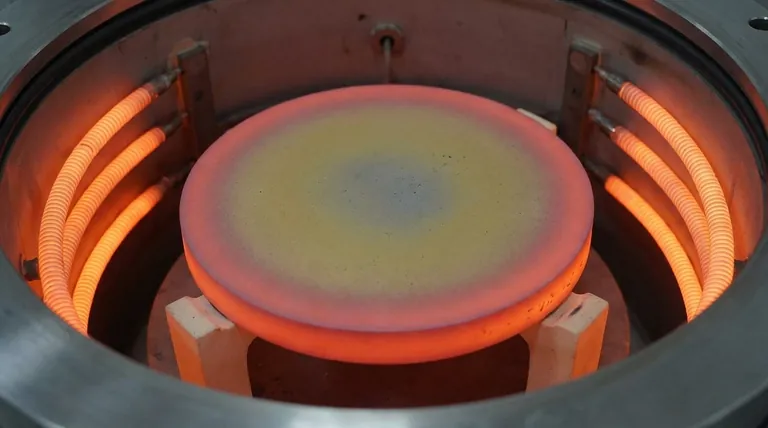
The Physics of the Thermal Gradient
Direct Radiant Exposure
In a sintering furnace, the primary heat source is the heating elements located on the walls.
The edges and sides of your workpiece have a direct "line of sight" to these heaters. Consequently, they absorb radiant heat immediately and intensely as soon as the temperature rises.
The Conduction Lag
While the surface heats up via radiation, the center of the workpiece remains insulated from the direct source.
The core relies on thermal conduction to receive heat. This process involves energy transferring layer by layer from the hot outer surface to the cooler interior.
This physical transfer of energy takes time. This "inherent time delay" means the center will always be cooler than the surface during the active heating phase.
Factors Influencing Uniformity
Furnace Layout
The physical arrangement of the furnace plays a critical role in how severe this gradient becomes.
Heaters are typically positioned on the walls, naturally favoring the outer boundaries of the workspace.
Workpiece Positioning
Where you place the alloy within the chamber alters its exposure.
A workpiece positioned closer to the heating tubes will experience a sharper rise in edge temperature compared to one placed in a "neutral" zone.
Operational Challenges and Trade-offs
The Risk of Rapid Heating
Trying to reach the sintering temperature too quickly exacerbates the problem.
If the furnace ramps up temperature faster than the material can conduct heat, the delta between the edge and the center widens. This can lead to uneven sintering or thermal stress within the high-entropy alloy.
Balancing Time vs. Homogeneity
Precision furnaces are designed to minimize the "thermal equilibrium time"—the time it takes for the center to catch up to the edge.
However, achieving perfect uniformity requires patience. You trade process speed for thermal homogeneity, allowing the conduction process to stabilize the internal temperature.
Optimizing Your Sintering Process
To mitigate these gradients and ensure high-quality sintering of high-entropy alloys, you must focus on equipment configuration and placement.
- If your primary focus is thermal uniformity: Prioritize the precise positioning of the workpiece away from the immediate proximity of heating tubes to reduce the intensity of direct radiation.
- If your primary focus is process efficiency: Utilize furnaces with optimized heating tube layouts designed to shorten the time required for thermal equilibrium.
By understanding that the center always lags behind the edge, you can adjust your heating profiles to allow the necessary time for conduction to complete its work.
Summary Table:
| Heat Transfer Mechanism | Area Affected | Speed | Description |
|---|---|---|---|
| Radiant Heat | Edges / Surface | Immediate | Direct line-of-sight energy absorption from furnace heating elements. |
| Thermal Conduction | Center / Core | Gradual | Layer-by-layer energy transfer from the hot surface to the cooler interior. |
| Thermal Gradient | Entire Workpiece | Variable | The temperature delta between surface and core during the heating phase. |
| Equilibrium Time | Entire Workpiece | Dependent | The time required for internal conduction to match surface temperature. |
Optimize Your Sintering Precision with KINTEK
Don't let thermal gradients compromise the integrity of your high-entropy alloys. KINTEK provides industry-leading high-temperature solutions backed by expert R&D and manufacturing. Our Muffle, Tube, Rotary, Vacuum, and CVD systems are designed to minimize thermal equilibrium time and ensure perfect homogeneity for your most sensitive materials.
Whether you need a standard setup or a fully customizable furnace tailored to your unique research needs, our team is ready to help you achieve superior results.
Ready to enhance your lab's efficiency and heating accuracy?
Contact KINTEK today to discuss your project requirements!
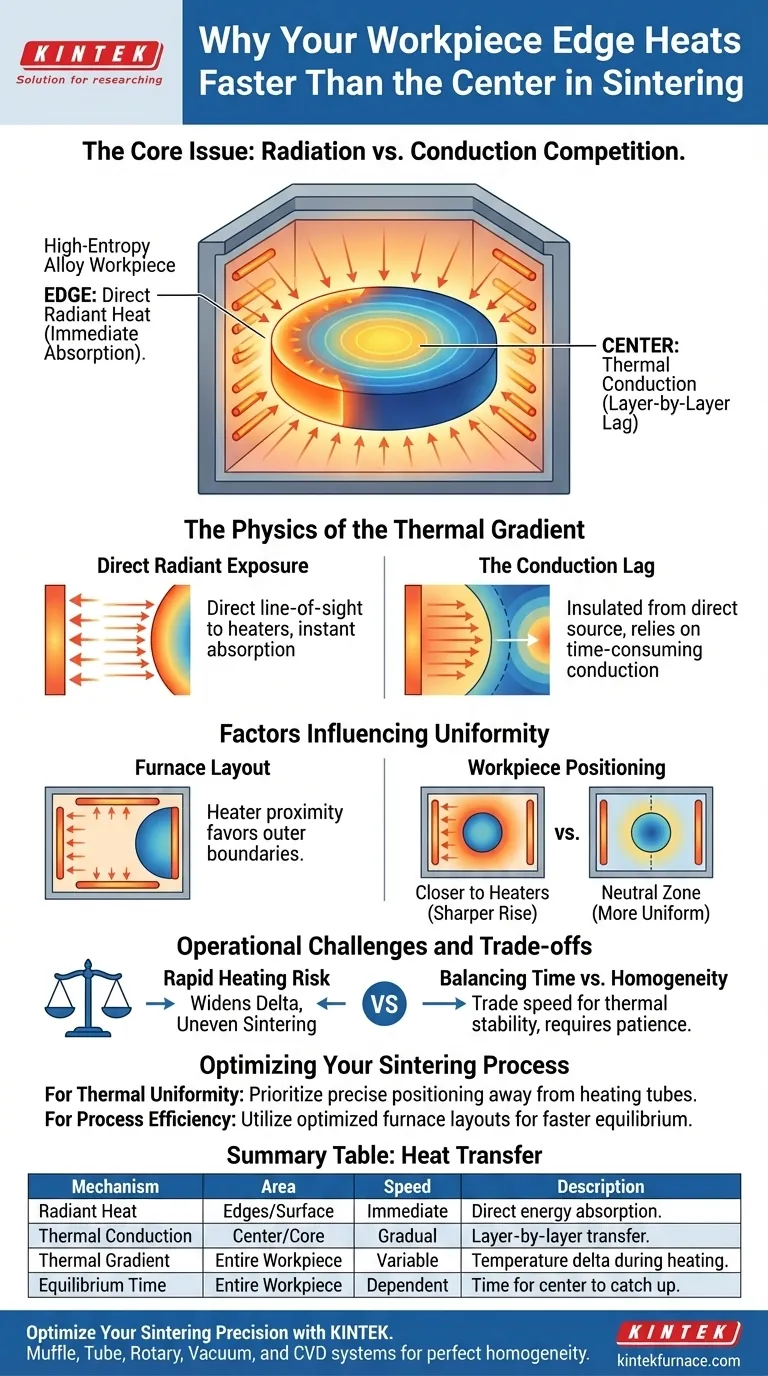
Visual Guide
References
- Yuchen Wang, Haisheng Fang. Research and optimization of temperature uniformity of high-precision muffle furnace. DOI: 10.1088/1742-6596/3009/1/012076
This article is also based on technical information from Kintek Furnace Knowledge Base .
Related Products
- 2200 ℃ Tungsten Vacuum Heat Treat and Sintering Furnace
- High Temperature Muffle Oven Furnace for Laboratory Debinding and Pre Sintering
- 2200 ℃ Graphite Vacuum Heat Treat Furnace
- Vacuum Heat Treat Sintering Furnace Molybdenum Wire Vacuum Sintering Furnace
- 9MPa Air Pressure Vacuum Heat Treat and Sintering Furnace
People Also Ask
- How does a tungsten-heated vacuum sintering furnace prepare (TbxY1-x)2O3 ceramics? Achieve 99%+ Density & Purity
- What wear-resistance enhancements are achieved by powder coating? The Role of Vacuum Sintering Furnaces
- How do compaction pressure and vacuum sintering optimize porous ceramics? Maximize Density & Toughness
- What role does a high-temperature vacuum sintering furnace play in the densification of WC-10(Ni, Ni/Co) alloys?
- What core role does a high-temperature vacuum sintering furnace play in Sm:YAG ceramics? Mastering Optical Clarity



















