
At a high level, box furnaces are versatile workhorses used in nearly every industry that requires the precise heating of materials. Their applications are widespread, including the Aerospace, Automotive, Electronics, Foundry, Military, and Mining sectors, where they are essential for modifying the physical and chemical properties of components.
The core reason for the box furnace's ubiquity is its flexibility. It's a general-purpose tool capable of performing a wide range of critical heat treatment processes on parts of various shapes and sizes, making it an indispensable asset in both production and laboratory settings.
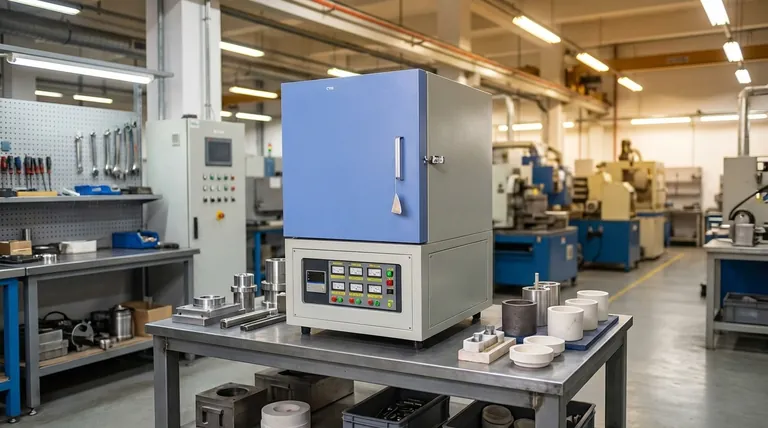
Why Box Furnaces Are So Widely Adopted
The design of a box furnace—an insulated chamber with a front-loading door—lends itself to a variety of applications. This fundamental simplicity is its greatest strength.
Versatility in Heat Treatment Processes
A single box furnace can execute numerous thermal processes. This adaptability makes it a cost-effective investment for many facilities.
Key processes include hardening, annealing, tempering, normalizing, stress relieving, and preheating. This allows manufacturers to alter material properties like strength, ductility, and durability to meet specific engineering requirements.
Accommodating Diverse Components
Unlike more specialized equipment, box furnaces can handle a wide array of part geometries and load sizes.
Their open chamber design is ideal for batch processing, whether it involves a single large component or a basket of many smaller items.
Reliability and Simplicity
The straightforward design of a box furnace contributes to its high reliability and ease of operation.
This makes them suitable for demanding industrial environments where uptime and consistent performance are critical for production schedules.
Key Industrial Applications in Detail
Understanding why specific industries rely on box furnaces clarifies their essential role in modern manufacturing.
Aerospace and Military
In these sectors, material failure is not an option. Box furnaces are used for hardening critical structural components and stress-relieving complex welded assemblies to ensure maximum strength and fatigue resistance.
Automotive and Foundry
The automotive industry uses box furnaces extensively for the heat treatment of engine parts, gears, and drivetrain components. Processes like annealing castings and tempering forged parts are essential for creating durable and wear-resistant vehicles.
Electronics and Mining
In electronics, box furnaces are used for processes like curing protective coatings or calcining materials to create specific powders. In mining, they are used to heat and test ore samples or harden the tough components used in heavy machinery.
Understanding the Trade-offs: Box vs. Tube Furnaces
While box furnaces are highly versatile, they are not the only option. Understanding the role of a tube furnace helps define the ideal use case for each.
The Role of the Box Furnace
A box furnace is the definitive choice for batch processing parts with varied shapes and sizes, especially in ambient air or a modified atmosphere. Think of it as a high-precision industrial oven.
The Role of the Tube Furnace
A tube furnace is a more specialized instrument. It is designed to heat small, uniform samples or powders, often within a tightly controlled atmosphere or vacuum inside a narrow tube.
Types like split-tube or rotating tube furnaces offer specialized capabilities for continuous processing or achieving exceptional temperature uniformity on small samples, applications where a box furnace would be inefficient.
Making the Right Choice for Your Goal
Selecting the correct furnace is critical for achieving repeatable and high-quality results in your thermal process.
- If your primary focus is processing diverse parts in batches: A box furnace provides the essential flexibility to handle various sizes, shapes, and common heat treatments like annealing or hardening.
- If your primary focus is processing small, uniform samples with high precision: A tube furnace offers superior control over the atmosphere and temperature uniformity for specialized laboratory or continuous production tasks.
- If your primary focus is general-purpose material improvement: The box furnace is the industry-standard tool for foundational heat treatments across a vast range of materials and components.
Ultimately, matching the furnace's core design to your specific material and process requirements is the key to successful thermal processing.
Summary Table:
| Industry | Primary Box Furnace Applications |
|---|---|
| Aerospace & Military | Hardening structural components, stress-relieving assemblies |
| Automotive & Foundry | Annealing castings, tempering gears and engine parts |
| Electronics | Curing coatings, calcining powders |
| Mining | Testing ore samples, hardening heavy machinery components |
Struggling to find the right heat treatment solution for your diverse components? KINTEK's advanced box furnaces are engineered for versatility and reliability, perfectly suited for batch processing in demanding industrial environments. Leveraging our exceptional R&D and in-house manufacturing, we provide robust solutions for annealing, hardening, tempering, and more. Our strong deep customization capability ensures your furnace precisely meets your unique production requirements.
Contact KINTEL today to discuss how our high-temperature furnace solutions can enhance your manufacturing process!
Visual Guide

Related Products
- Vacuum Hot Press Furnace Machine Heated Vacuum Press Tube Furnace
- Mesh Belt Controlled Atmosphere Furnace Inert Nitrogen Atmosphere Furnace
- Vacuum Heat Treat Sintering Furnace with Pressure for Vacuum Sintering
- 600T Vacuum Induction Hot Press Vacuum Heat Treat and Sintering Furnace
- Vacuum Hot Press Furnace Machine Heated Vacuum Press
People Also Ask
- Why use Vacuum Hot Press (VHP) for ZnS Ceramics? Achieve Superior IR Transparency and Mechanical Strength
- What safety features are incorporated in vacuum hot press furnaces? Ensure Operator and Equipment Protection
- What are the benefits of the vacuum environment system in a vacuum hot press furnace? Unlock High-Density Sintering
- What considerations guide the selection of heating elements and pressurization methods for a vacuum hot press furnace?
- What is the significance of the vacuum environment for sintering stainless steel? Unlock High-Density Purity



















