
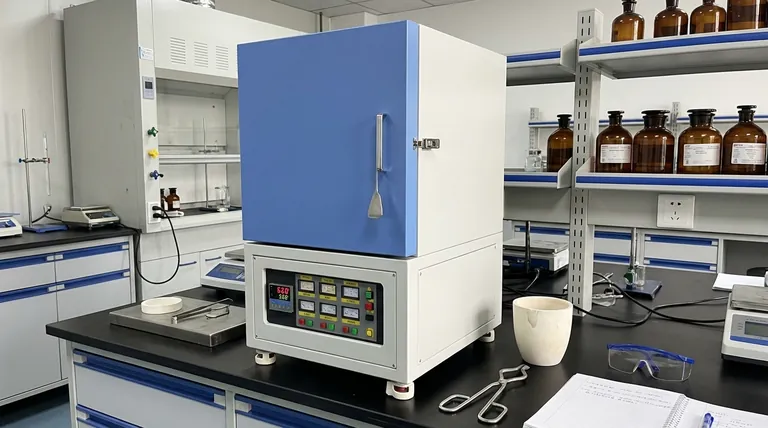
The primary function of a muffle furnace in this context is to drive the thermal polycondensation of a specific precursor mixture.
By maintaining a rigorous temperature of 550°C for a duration of 4 hours, the furnace provides the energy required to react melamine with ammonium chloride. This controlled environment is what forces the incorporation of chlorine atoms into the carbon-nitrogen framework, ultimately yielding the yellow, photocatalytically active solid known as CNM-Cl.
The muffle furnace does not merely dry or heat the material; it acts as a precise reactor that enables the chemical integration of chlorine dopants into the graphitic lattice, directly enhancing the material's electronic properties.
The Mechanics of Synthesis
Facilitating Thermal Polycondensation
The core chemical reaction in synthesizing CNM-Cl is thermal polycondensation. The furnace supplies the high thermal energy needed to transform the raw monomers (melamine and ammonium chloride) into a polymerized structure.
Without this sustained high heat, the precursors would remain chemically distinct rather than forming the unified graphitic carbon nitride backbone.
Precise Temperature Regulation
Success depends entirely on thermal stability. The furnace must hold the environment at exactly 550°C for a continuous 4-hour period.
Deviations from this temperature profile can result in incomplete polymerization or the failure of the chlorine atoms to integrate effectively into the structure.
Enabling Chlorine Doping
The addition of ammonium chloride is intended to modify the material's properties, but this only occurs under specific thermal conditions. The heat facilitates the substitution of atoms within the lattice.
The furnace creates the thermodynamic conditions necessary for chlorine atoms to successfully replace specific sites in the carbon-nitrogen framework, creating the "doped" final product (CNM-Cl).
Ensuring a Contaminant-Free Environment
A critical design feature of the muffle furnace is the physical separation of the heating elements from the sample chamber.
This isolation ensures that the sensitive polycondensation reaction occurs in a clean environment, protected from combustion byproducts that could compromise the purity of the photocatalyst.
Understanding the Trade-offs
High Energy Requirements vs. Material Quality
Achieving the necessary crystallinity for CNM-Cl requires significant energy input over several hours. While energy-intensive, reducing the time or temperature to save resources will likely result in a material with poor structural integrity and weak photocatalytic activity.
The Sensitivity of Doping Levels
The "muffle" design allows for a sealed environment, often involving a covered crucible. While this protects the sample, it also traps evolved gases.
If the ramp rate or maximum temperature is not perfectly calibrated, the pressure from evolved gases can alter the doping density, leading to inconsistency between different batches of CNM-Cl.
Making the Right Choice for Your Goal
To maximize the quality of your Chlorine-doped Graphitic Carbon Nitride, align your furnace operations with your specific research objectives:
- If your primary focus is maximum chlorine integration: Prioritize the stability of the 550°C dwell time to ensure thermodynamic conditions favor full doping.
- If your primary focus is structural crystallinity: Ensure you utilize a controlled ramp rate (e.g., 10°C/min) to allow the polymerized structure to form without defects.
Precision in thermal history is the single most important factor in determining the final catalytic performance of CNM-Cl.
Summary Table:
| Process Component | Role in CNM-Cl Synthesis |
|---|---|
| Primary Reaction | Thermal Polycondensation of melamine and ammonium chloride |
| Temperature Control | Sustained 550°C for 4 hours to ensure lattice integration |
| Chlorine Doping | Facilitates atomic substitution within the carbon-nitrogen framework |
| Chamber Isolation | Prevents contamination from heating elements for high purity |
| Heating Rate | Controlled ramp rates (e.g., 10°C/min) for optimal crystallinity |
Elevate Your Material Synthesis with KINTEK Precision
Achieving the perfect 550°C thermal polycondensation for CNM-Cl requires uncompromising temperature stability and chamber purity. Backed by expert R&D and world-class manufacturing, KINTEK offers high-performance Muffle, Tube, Rotary, Vacuum, and CVD systems—all fully customizable to meet your unique laboratory requirements. Whether you are optimizing chlorine doping levels or enhancing structural crystallinity, our furnaces provide the thermodynamic control necessary for superior photocatalytic results.
Ready to refine your research? Contact our laboratory specialists today to find the ideal high-temperature solution for your next breakthrough.
Visual Guide

References
- Jie Ji, Ren Qian Tee. Chlorine-Doped Graphitic Carbon Nitride for Enhanced Photocatalytic Degradation of Reactive Black 5: Mechanistic and DFT Insights into Water Remediation. DOI: 10.1021/acsomega.5c04017
This article is also based on technical information from Kintek Furnace Knowledge Base .
Related Products
- 1400℃ Muffle Oven Furnace for Laboratory
- 1700℃ High Temperature Muffle Oven Furnace for Laboratory
- 1800℃ High Temperature Muffle Oven Furnace for Laboratory
- 1200℃ Muffle Oven Furnace for Laboratory
- High Temperature Muffle Oven Furnace for Laboratory Debinding and Pre Sintering
People Also Ask
- What is the primary function of a high-temperature laboratory muffle furnace in chemical synthesis? Achieve Precision.
- How does a high-temperature laboratory muffle furnace affect material properties? Transform Anodic Oxide Films Fast
- What role does a laboratory high-temperature muffle furnace play in the treatment of highly contaminated waste glass?
- How is a laboratory high-temperature muffle furnace utilized to achieve the specific crystalline structure of LaFeO3 catalysts?
- How is a laboratory high-temperature muffle furnace used in agloporite preparation? Optimize Material Synthesis



















