
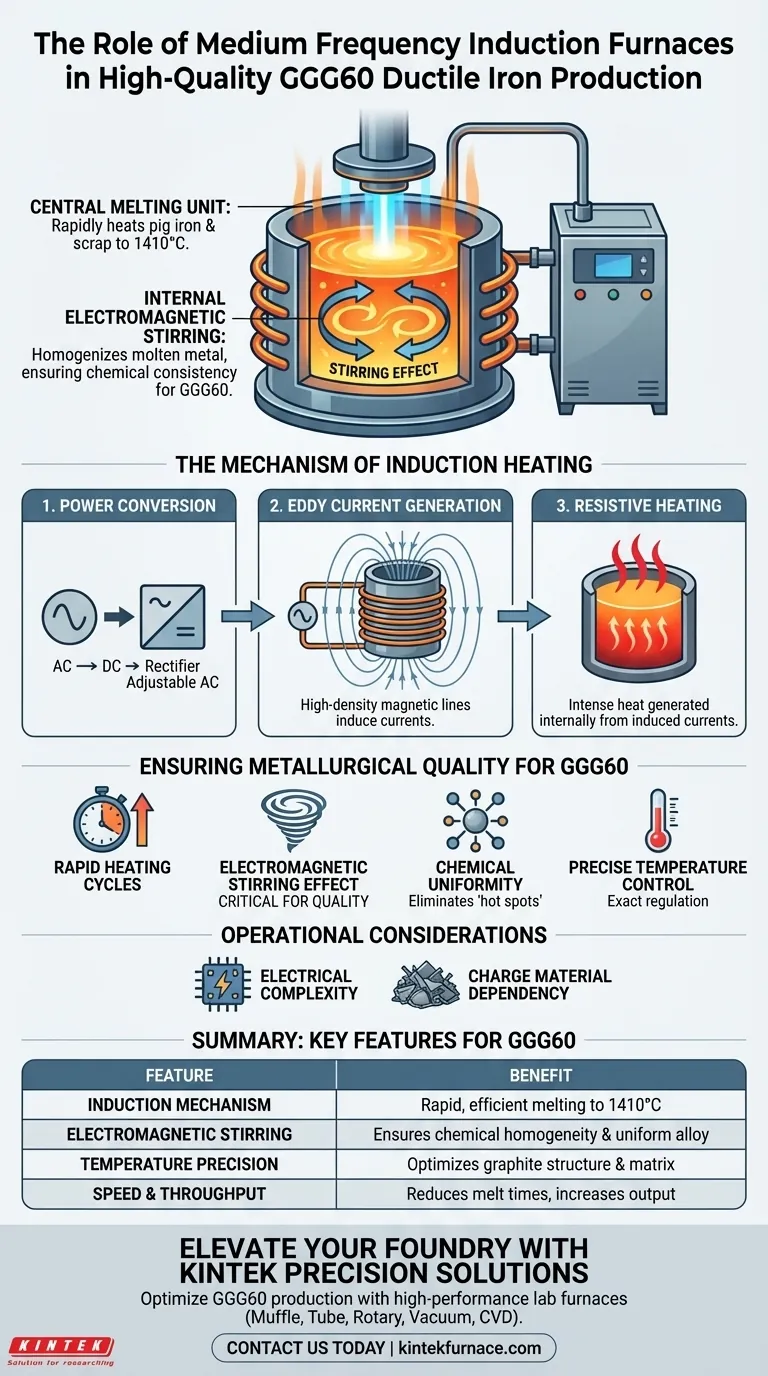
A medium frequency induction furnace serves as the central melting unit for producing high-quality ductile iron, utilizing electromagnetic fields to rapidly heat raw materials like pig iron and scrap steel to temperatures as high as 1410°C. Beyond simple melting, its specific role is to generate an internal "stirring effect" that homogenizes the molten metal, ensuring the chemical consistency required for advanced alloys like GGG60.
While rapid melting is a key feature, the true value of the medium frequency induction furnace lies in its ability to create a chemically uniform matrix through electromagnetic stirring. This uniformity is the prerequisite for achieving the specific mechanical properties and graphite structure demanded by GGG60 ductile iron.
The Mechanism of Induction Heating
Converting Power to Heat
The furnace operates by manipulating electrical current to generate heat directly within the metal. It begins by converting standard three-phase power frequency alternating current (AC) into direct current (DC).
Generating Eddy Currents
This DC is then transformed back into an adjustable AC supply that powers an induction coil. As current flows through this coil, it generates high-density magnetic lines of force that intersect the metal charge.
Resistive Heating
These magnetic fields induce significant eddy currents within the metal itself. As these currents force free electrons to flow through the metal's resistive body, intense heat is generated from the inside out, rather than being applied externally.
Ensuring Metallurgical Quality for GGG60
Rapid Heating Cycles
Efficiency is a primary advantage. The induction process allows for extremely high heating speeds, quickly bringing the charge to the target temperature of 1410°C.
The Electromagnetic Stirring Effect
This is the most critical factor for quality. The induction current naturally produces a stirring effect within the molten bath.
Chemical Uniformity
This stirring action ensures that all alloy elements and chemical components are distributed evenly throughout the melt. For GGG60, which requires a precise matrix structure, this eliminates "hot spots" or areas of poor alloy concentration.
Precise Temperature Control
The furnace allows for exact regulation of the power input. This enables operators to maintain the specific thermal parameters required to optimize the microstructure of the ductile iron before casting.
Operational Considerations and Trade-offs
Electrical Complexity
Unlike simple combustion furnaces, this system relies on complex power electronics to manage the AC-DC-AC conversion. This requires stable power supplies and specialized maintenance of the capacitor and coil systems.
Charge Material Dependency
The efficiency of the heating is directly related to the electromagnetic properties of the charge material. The process relies on the material's resistance to generate heat, meaning the composition of the scrap steel and pig iron must be carefully managed.
Making the Right Choice for Your Goal
To maximize the potential of a medium frequency induction furnace in your foundry:
- If your primary focus is Production Speed: Leverage the high-density magnetic fields to minimize melt times and increase throughput.
- If your primary focus is Material Consistency (GGG60): Prioritize the electromagnetic stirring phase to guarantee a uniform chemical matrix before pouring.
By mastering the balance between rapid heating and electromagnetic stirring, you ensure that every batch of GGG60 meets the rigorous standards required for high-performance applications.
Summary Table:
| Feature | Benefit for GGG60 Production |
|---|---|
| Induction Mechanism | Generates heat internally for rapid, efficient melting up to 1410°C |
| Electromagnetic Stirring | Ensures chemical homogeneity and uniform distribution of alloy elements |
| Temperature Precision | Allows exact regulation to optimize graphite structure and matrix |
| Speed & Throughput | High-density magnetic fields reduce melt times and increase output |
Elevate Your Foundry with KINTEK Precision Solutions
Are you looking to optimize your GGG60 ductile iron production? Backed by expert R&D and world-class manufacturing, KINTEK offers high-performance Muffle, Tube, Rotary, Vacuum, and CVD systems, alongside customizable lab high-temp furnaces tailored to your unique metallurgical needs.
Our advanced heating technology ensures the chemical consistency and precise temperature control your advanced alloys demand. Contact us today to discuss how our customizable furnace solutions can enhance your lab's efficiency and material quality!
Visual Guide
References
- İsmail Aykut Karamanlı, Okan Ünal. Study of the Wear Resistance Plasma Nitrided GGG60 by Optimization of Surface Treatment Conditions Using Response Surface Methodology. DOI: 10.1007/s40962-024-01310-y
This article is also based on technical information from Kintek Furnace Knowledge Base .
Related Products
- 600T Vacuum Induction Hot Press Vacuum Heat Treat and Sintering Furnace
- Vacuum Induction Melting Furnace
- Multi Heating Zones CVD Tube Furnace Machine for Chemical Vapor Deposition Equipment
- 1200℃ Controlled Inert Nitrogen Atmosphere Furnace
- Spark Plasma Sintering SPS Furnace
People Also Ask
- Why use Vacuum Hot Press (VHP) for ZnS Ceramics? Achieve Superior IR Transparency and Mechanical Strength
- How does a vacuum hot press sintering furnace mitigate copper sintering swelling? Solve Fe-Cu Expansion Issues
- How does the vacuum environment in a vacuum hot press sintering furnace protect chromium-containing ceramics? Find out.
- What are the key advantages of vacuum hot press sintering furnaces? Achieve Superior Density and Purity in Materials
- What is the core function of a vacuum hot press sintering furnace in the preparation of high-density RuTi alloys? Achieve Maximum Density and Purity



















