
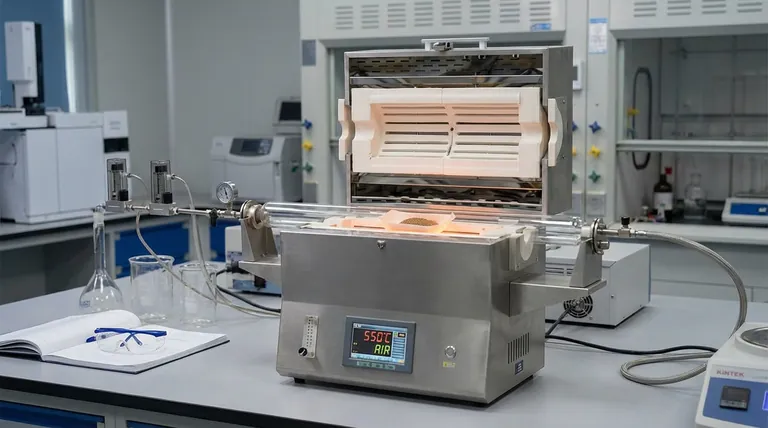
The high-temperature tube furnace acts as the definitive processing chamber for converting dried precursors into functional Niobium Pentoxide (Nb2O5) nanogrids. Its primary function is to facilitate calcination at 550°C in an air environment, a thermal treatment that is essential for both purifying the material and locking in its structural geometry.
The tube furnace provides the precise thermal environment required to decompose organic additives and drive the crystallization of niobium oxide. This process is the key determinant in creating a catalyst support with high specific surface area and optimized surface acidity.
The Mechanism of Synthesis
Pyrolysis of Organic Components
The first critical task of the furnace is to remove organic materials introduced during the precursor stage.
Specifically, the heat drives the pyrolysis (thermal decomposition) of organic components such as melamine and ammonium chloride.
By maintaining a steady 550°C, the furnace ensures these organics are completely burned off, leaving behind only the desired niobium structure.
Promoting Crystallization
Beyond purification, the thermal energy provided by the furnace initiates a phase change in the material.
The heat treatment promotes the crystallization of niobium oxide.
This is not a random hardening; the specific temperature triggers the formation of the unique nanogrid structure, distinguishing it from amorphous or unstructured forms of niobium oxide.
Why the Tube Furnace Design Matters
Precise Temperature Regulation
The synthesis of nanogrids requires exact thermal conditions, not just general heat.
As noted in general furnace architecture, heating coils and internal thermocouples work in tandem to monitor and regulate the chamber.
For Nb2O5, maintaining the temperature strictly at 550°C is vital to achieve the correct balance between removing impurities and preserving the nanostructure.
Controlled Air Environment
The cylindrical tube design, often made of quartz or ceramic, allows for a controlled atmosphere around the sample.
In this specific synthesis, the process requires an air environment.
The tube furnace protects the sample from external contaminants while ensuring the oxygen necessary for calcination is present to facilitate the removal of organic precursors.
Understanding the Critical Variables
Temperature Sensitivity
While the furnace is capable of reaching extremely high temperatures, more heat is not always better.
Deviating significantly from the target 550°C can alter the material properties.
If the temperature is too low, organic residues (melamine/ammonium chloride) may remain; if too high, the nanogrid structure could collapse or sinter, reducing the specific surface area.
Impact on Material Acidity
The thermal treatment is directly linked to the chemical properties of the final product.
The specific calcination process results in a catalyst support with appropriate acidity.
This surface acidity is a functional requirement for the nanogrids' eventual use as a catalyst support, making the furnace's role pivotal in defining the material's chemical utility.
Optimizing the Synthesis Process
To ensure the successful production of high-quality Nb2O5 nanogrids, consider these strategic focus areas:
- If your primary focus is Structural Integrity: Ensure your furnace is calibrated to maintain exactly 550°C to maximize specific surface area without inducing sintering.
- If your primary focus is Chemical Purity: Verify that adequate airflow is maintained within the tube to assist in the complete oxidation and removal of melamine and ammonium chloride byproducts.
The high-temperature tube furnace is not merely a heater, but a precision tool that dictates the purity, geometry, and chemical reactivity of the final nanogrid structure.
Summary Table:
| Process Step | Furnace Function | Key Outcome |
|---|---|---|
| Pyrolysis | High-temp thermal decomposition | Removes organic additives (melamine/NH4Cl) |
| Crystallization | Controlled 550°C thermal energy | Triggers Nb2O5 phase change into nanogrids |
| Calcination | Steady air environment | Ensures purity and optimized surface acidity |
| Atmosphere Control | Sealed tube architecture | Protects sample while allowing oxidation |
Elevate Your Nanomaterial Synthesis with KINTEK
Precision is non-negotiable when synthesizing high-performance Nb2O5 nanogrids. Backed by expert R&D and manufacturing, KINTEK offers high-performance Tube, Muffle, Vacuum, and CVD systems designed to maintain the rigorous thermal stability your research demands. Whether you need precise temperature regulation for calcination or customizable atmosphere controls for complex pyrolysis, our lab high-temp furnaces are tailored to your unique needs.
Ready to optimize your material crystallization? Contact our technical experts today to find the perfect customizable furnace solution for your laboratory.
References
- Zhijun Li, Yu Wang. Solvent-free selective hydrogenation of nitroaromatics to azoxy compounds over Co single atoms decorated on Nb2O5 nanomeshes. DOI: 10.1038/s41467-024-47402-5
This article is also based on technical information from Kintek Furnace Knowledge Base .
Related Products
- 1700℃ High Temperature Laboratory Tube Furnace with Alumina Tube
- 1400℃ High Temperature Laboratory Tube Furnace with Alumina Tube
- 1200℃ Split Tube Furnace Laboratory Quartz Tube Furnace with Quartz Tube
- 1700℃ Controlled Inert Nitrogen Atmosphere Furnace
- Vertical Laboratory Quartz Tube Furnace Tubular Furnace
People Also Ask
- How are high-temperature laboratory tube furnaces applied in long-term vacuum homogenization heat treatments for intermetallic samples?
- How are high-temp tube furnaces used to measure diffusion coefficients per Fick's law? Master Precision Annealing
- How do high-temperature laboratory tube furnaces ensure environmental stability? Precision Thermal Reduction Tips
- How are high-temperature tube furnaces applied in testing ceramic-supported alloy membranes? Insights
- In what scenarios are laboratory high-temperature tube furnaces or muffle furnaces utilized? Study MgTiO3-CaTiO3 Ceramics



















