
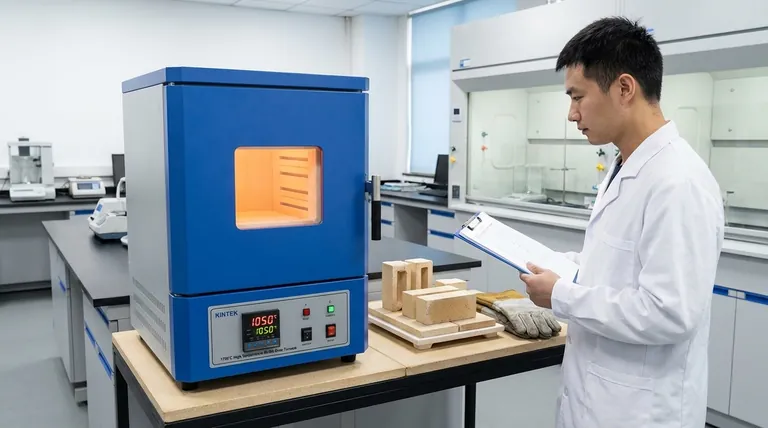
A high-temperature laboratory box furnace serves as the critical engine for sintering, providing the precise thermal environment required to transform raw ceramic materials into durable refractory bricks. Specifically, it maintains a controlled atmospheric environment—typically between 1000°C and 1100°C—to induce essential mineral phase transformations and stabilize the material's internal structure.
The Core Takeaway The furnace does not simply dry or harden the material; it facilitates a complex chemical metamorphosis. By providing a stable thermal field, the furnace drives the conversion of raw minerals into crystalline structures like mullite, directly determining the brick's final strength, density, and porosity.
Driving Critical Phase Transformations
The primary function of the furnace is to facilitate the chemical evolution of the brick's raw materials.
Converting Kaolinite to Mullite
Refractory bricks often begin as mixtures containing minerals like kaolinite. Under the intense heat of the box furnace, these minerals undergo a phase transformation.
The Role of Thermal Stability
During a sustained, constant-temperature dwell period, kaolinite transforms first into metakaolinite and subsequently into mullite crystalline phases.
Why This Matters
Mullite is the key to durability. The presence and quality of these crystals determine how well the brick can withstand high temperatures and mechanical stress in actual industrial use.
Controlling Microstructure and Porosity
Beyond chemical changes, the furnace allows researchers to manipulate the physical architecture of the material.
Regulating Crystal Growth
The precise temperature control of the furnace directly influences the internal microstructure. It dictates the size and distribution of the mullite crystals growing within the brick.
Adjusting Material Porosity
Sintering is fundamentally about densification. The furnace heat causes particles to bond, reducing the volume of open pores and adjusting the material's porosity.
Determining Mechanical Strength
By systematically setting heating curves, researchers can correlate sintering temperatures with core physical indicators. This allows for the optimization of bulk density and flexural strength.
Simulating Industrial Reality
While sintering is the primary process, the laboratory box furnace is also an essential validation tool.
Replicating Kiln Conditions
High-temperature muffle furnaces (a type of box furnace) can reach temperatures up to 1800°C. This capability allows labs to simulate the harsh working conditions of an actual cement kiln.
Thermal Shock and Load Testing
The equipment is used to conduct refractoriness tests and determine the softening temperature under load. It also enables thermal shock stability cycle experiments to ensure the bricks won't crack under rapid temperature changes.
Understanding the Trade-offs
While essential, using a laboratory box furnace requires an understanding of its limitations compared to other sintering technologies.
Atmosphere Limitations
Standard box furnaces typically operate in an air atmosphere. Unlike vacuum sintering furnaces—which are required for oxidation-sensitive materials like titanium alloys—a standard box furnace may not prevent oxidation if the refractory material requires an oxygen-free environment.
Uniformity vs. Volume
Achieving a perfectly stable thermal field depends on how the furnace is loaded. Overloading the "box" can create temperature gradients, leading to uneven sintering and inconsistent mullite formation across the sample batch.
Making the Right Choice for Your Goal
To maximize the utility of a high-temperature laboratory box furnace, align your operational parameters with your specific objective.
- If your primary focus is Material Synthesis: Prioritize the 1000°C–1100°C dwell time to ensure complete transformation of kaolinite into the mullite phase.
- If your primary focus is Quality Assurance: Utilize the furnace's upper limits (up to 1800°C) to perform thermal shock and load tests that mimic extreme industrial failure points.
The precise control of heat is not just about temperature; it is the tool you use to engineer the microscopic survival of your material.
Summary Table:
| Process Function | Key Impact | Critical Mechanism |
|---|---|---|
| Phase Transformation | Mineral Metamorphosis | Conversion of Kaolinite to Mullite crystalline phases |
| Microstructure Control | Densification | Regulation of crystal growth size and distribution |
| Porosity Adjustment | Mechanical Strength | Reduction of open pores to optimize bulk density |
| Industrial Simulation | Quality Validation | Thermal shock testing and load softening evaluation |
Elevate Your Refractory Research with KINTEK Precision
Unlock the full potential of your material synthesis with KINTEK’s high-performance laboratory furnaces. Backed by expert R&D and world-class manufacturing, we provide Muffle, Tube, Rotary, Vacuum, and CVD systems capable of reaching up to 1800°C. Whether you are engineering mullite structures or simulating extreme kiln conditions, our furnaces offer the precise thermal stability and customizable features your lab requires.
Ready to optimize your sintering process? Contact KINTEK Today to Find Your Custom Solution
Visual Guide

References
- Saniya Arinova, Asem Erikovna Altynova. Utilization of Coal Ash for Production of Refractory Bricks. DOI: 10.3390/jcs9060275
This article is also based on technical information from Kintek Furnace Knowledge Base .
Related Products
- 1400℃ High Temperature Laboratory Tube Furnace with Alumina Tube
- 1700℃ High Temperature Laboratory Tube Furnace with Alumina Tube
- 1800℃ High Temperature Muffle Oven Furnace for Laboratory
- 1700℃ High Temperature Muffle Oven Furnace for Laboratory
- 1200℃ Muffle Oven Furnace for Laboratory
People Also Ask
- How does zone-melting in tube furnaces synthesize bismuth micro-wires? Master Single-Crystal Thermoelectric Growth
- How do high-temperature laboratory tube furnaces ensure environmental stability? Precision Thermal Reduction Tips
- How are high-temp tube furnaces used to measure diffusion coefficients per Fick's law? Master Precision Annealing
- How are high-temperature laboratory tube furnaces applied in long-term vacuum homogenization heat treatments for intermetallic samples?
- How are high-temperature tube furnaces applied in testing ceramic-supported alloy membranes? Insights



















