
A high-temperature box furnace serves as a critical catalyst for structural evolution in FTO thin films. It acts as a controlled thermal environment that provides the necessary activation energy to transform the material from a disordered, quasi-crystalline phase into a highly ordered, high-quality polycrystalline state.
Core Takeaway The primary function of the box furnace is to drive the atomic rearrangement of the thin film, facilitating the incorporation of fluorine into the tin oxide lattice. This structural shift is essential for minimizing electrical resistivity and optimizing the film's overall optoelectronic performance.
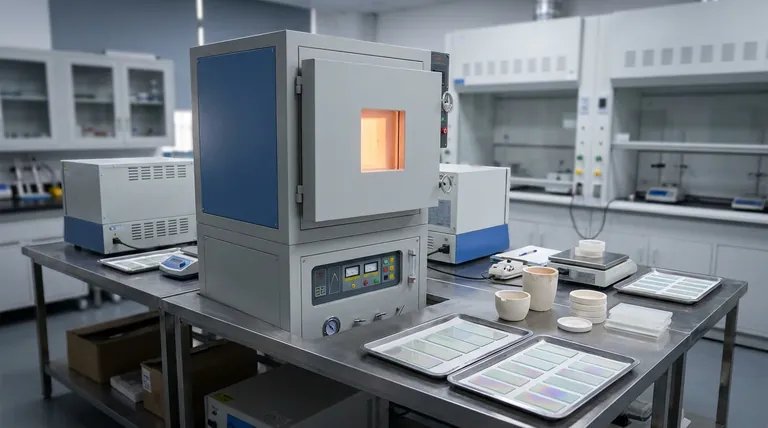
The Mechanism of Structural Transformation
From Quasi-Crystalline to Polycrystalline
As-deposited FTO films often exist in a quasi-crystalline or amorphous state, which limits their performance.
The box furnace provides a uniform thermal field that triggers recrystallization. This thermal energy allows atoms to migrate to energetically favorable positions, transitioning the entire film structure into a stable polycrystalline form.
Promoting Grain Growth
Heat treatment in a box furnace significantly promotes grain growth within the film.
Larger grains reduce the density of grain boundaries. Since grain boundaries act as scattering centers for charge carriers, reducing them is vital for improving electron mobility and electrical conductivity.
Facilitating Lattice Substitution
The most critical chemical change occurs at the atomic level during this annealing phase.
The thermal environment helps fluorine atoms effectively enter the tin oxide lattice. Specifically, the heat enables fluorine to replace oxygen atoms within the structure. This substitution is the fundamental mechanism that "dopes" the material, generating the free carriers necessary for conductivity.
Operational Parameters and Impact
The Optimal Temperature Window
The effectiveness of a box furnace relies on maintaining a precise temperature range, typically between 350°C and 550°C.
Operating within this window ensures sufficient energy for crystallization without inducing thermal degradation or substrate damage.
Optimization of Optoelectronic Properties
The structural changes driven by the furnace directly dictate the final performance metrics of the FTO film.
By ensuring proper lattice integration and grain size, the process significantly reduces electrical resistivity. Simultaneously, the improved crystalline quality enhances optical transparency, making the film highly effective for optoelectronic applications like solar cells or touch screens.
Understanding the Trade-offs
Thermal Uniformity vs. Gradients
While a box furnace is excellent for general annealing, the quality of the "thermal field" is paramount.
Inconsistent heating inside the chamber can lead to uneven grain growth across the substrate. This results in localized variations in sheet resistance, which can compromise the performance of larger devices.
Atmosphere Limitations
Standard box furnaces typically operate in an ambient air environment.
While effective for general crystallization, they lack the precise partial pressure control of a specialized atmosphere or vacuum tube furnace. If your specific FTO stoichiometry requires exact control over oxygen vacancies (beyond simple air annealing), a standard box furnace may lack the necessary atmospheric regulation.
Making the Right Choice for Your Goal
To maximize the utility of a high-temperature box furnace for your FTO process, consider the following:
- If your primary focus is Conductivity: Target the upper end of the temperature window (near 500°C-550°C) to maximize grain growth and fluorine lattice substitution, ensuring the lowest possible resistivity.
- If your primary focus is Substrate Integrity: If using temperature-sensitive substrates (like certain glasses), maintain the process closer to the 350°C lower limit to induce crystallization without warping the base material.
Ideally, prioritize a furnace that guarantees a highly uniform thermal field to ensure that conductivity and transparency are consistent across the entire surface of your thin film.
Summary Table:
| Feature | Role in FTO Post-Deposition Annealing |
|---|---|
| Structural Shift | Transitions film from quasi-crystalline to highly ordered polycrystalline state |
| Grain Growth | Reduces grain boundary scattering to improve electron mobility |
| Doping Mechanism | Facilitates fluorine substitution into the tin oxide lattice for lower resistivity |
| Temp. Control | Maintains critical 350°C - 550°C window for optimal optoelectronic balance |
| Uniformity | Ensures consistent sheet resistance across the entire substrate surface |
Elevate Your Thin Film Quality with KINTEK Precision
Ready to achieve superior conductivity and transparency in your FTO films? Backed by expert R&D and world-class manufacturing, KINTEK offers high-performance Muffle, Tube, Rotary, Vacuum, and CVD systems designed for the rigorous demands of material science. Whether you need standard high-temp box furnaces or fully customizable solutions tailored to your unique research needs, our systems deliver the thermal uniformity and precision your lab requires.
Contact KINTEK today to find your perfect thermal solution!
References
- Paweł Lejwoda, Maciej Thomas. Recovery of Cerium Salts from Sewage Sludge Resulting from the Coagulation of Brewery Wastewater with Recycled Cerium Coagulant. DOI: 10.3390/ma17040938
This article is also based on technical information from Kintek Furnace Knowledge Base .
Related Products
- 1700℃ High Temperature Laboratory Tube Furnace with Alumina Tube
- 1400℃ High Temperature Laboratory Tube Furnace with Alumina Tube
- 1700℃ High Temperature Muffle Oven Furnace for Laboratory
- 1800℃ High Temperature Muffle Oven Furnace for Laboratory
- High Temperature Muffle Oven Furnace for Laboratory Debinding and Pre Sintering
People Also Ask
- How does zone-melting in tube furnaces synthesize bismuth micro-wires? Master Single-Crystal Thermoelectric Growth
- How are high-temperature laboratory tube furnaces applied in long-term vacuum homogenization heat treatments for intermetallic samples?
- How do high-temperature laboratory tube furnaces ensure environmental stability? Precision Thermal Reduction Tips
- How are high-temp tube furnaces used to measure diffusion coefficients per Fick's law? Master Precision Annealing
- How are high-temperature tube furnaces applied in testing ceramic-supported alloy membranes? Insights



















