
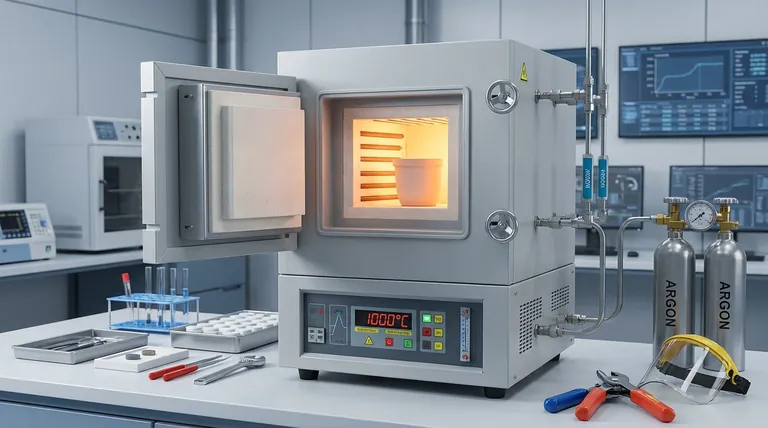
A high-temperature argon atmosphere furnace serves as the critical stabilization vessel for hexagonal boron nitride (h-BN) interface layers. It creates a controlled, inert environment—typically around 1000°C—that densifies the coating while simultaneously preventing the chemical degradation of the underlying substrate.
Core Takeaway The furnace is not merely a heating element; it is a chemical isolation chamber. Its primary function is to transform loosely deposited particles into a cohesive, dense interface layer without allowing oxygen to compromise the structural integrity of the reinforcing fibers.
The Mechanism of Protection and Densification
Preventing Substrate Oxidation
The most immediate function of the argon atmosphere is oxidation prevention.
At the elevated temperatures required for treatment (approx. 1000°C), Silicon Carbide (SiC) fibers are highly susceptible to reacting with oxygen.
The inert argon gas creates a protective blanket, ensuring that neither the SiC fibers nor the h-BN material degrades during the thermal cycle.
Promoting Coating Contraction
For h-BN layers applied via electrophoretic deposition, the coating begins as a relatively loose assembly of particles.
The heat treatment drives the physical contraction of these particles.
This process reduces the porosity of the layer, resulting in a much tighter, more uniform coating structure.
Dehydration of the Deposit
Deposited layers often retain residual moisture or solvents from the deposition process.
The high-temperature environment facilitates complete dehydration of the h-BN particles.
Removing these volatiles is essential to prevent void formation or delamination during subsequent high-stress applications.
Impact on Mechanical Performance
Strengthening the Physical Bond
The combination of contraction and dehydration significantly enhances the physical bond between the h-BN interface layer and the SiC fibers.
A weak bond would lead to premature failure, while this thermal processing ensures the layer adheres sufficiently to the substrate.
Enabling Stress Transfer
A properly heat-treated interface allows for effective stress transfer from the matrix to the fiber.
This mechanical interlocking is vital for the composite material to bear loads effectively.
Facilitating Fiber Pull-out
The ultimate goal of the h-BN interface is to allow for fiber pull-out rather than catastrophic brittle fracture.
By densifying the layer without fusing it chemically to the fiber (which oxidation would cause), the furnace treatment ensures the interface remains weak enough in shear to deflect cracks, absorbing energy during failure.
Understanding the Trade-offs
Atmosphere Purity is Non-Negotiable
The effectiveness of this process relies entirely on the purity of the argon gas.
Even trace amounts of oxygen in the furnace chamber at 1000°C can lead to the formation of silica on the SiC fibers, effectively ruining the interface properties.
Thermal Balance
There is a delicate balance in the heating profile.
Insufficient temperature or time will fail to achieve the necessary density and dehydration, leading to a weak interface.
However, extreme thermal over-processing could potentially alter the microstructure of the underlying fibers, underlining the need for precise temperature control.
Making the Right Choice for Your Goal
To maximize the performance of h-BN interface layers, align your processing parameters with your specific mechanical requirements:
- If your primary focus is Fiber Integrity: Prioritize the purity of the argon atmosphere and leak-check the furnace rigorously to prevent any oxidation of the SiC substrate.
- If your primary focus is Interfacial Strength: Optimize the dwell time at 1000°C to ensure maximum contraction and densification of the electrophoretically deposited particles.
Successful heat treatment converts a fragile deposit into a functional mechanical fuse that defines the toughness of the entire composite.
Summary Table:
| Process Function | Mechanism | Impact on Material |
|---|---|---|
| Oxidation Prevention | Inert Argon Blanket | Protects SiC fibers and h-BN from chemical degradation |
| Coating Densification | Thermal Contraction | Reduces porosity for a tighter, more uniform structure |
| Dehydration | Volatile Removal | Eliminates residual moisture to prevent void formation |
| Interface Optimization | Controlled Thermal Profile | Enables fiber pull-out and energy absorption during failure |
Elevate Your Advanced Material Processing with KINTEK
Precision is non-negotiable when treating sensitive h-BN interface layers. KINTEK provides high-performance high-temperature furnaces—including Argon Atmosphere, Vacuum, CVD, and Muffle systems—designed to deliver the exact thermal balance and atmosphere purity your research demands.
Backed by expert R&D and manufacturing, our systems are fully customizable to your unique heat treatment protocols, ensuring superior fiber integrity and interfacial strength for your composites.
Ready to optimize your thermal cycles? Contact KINTEK today for a custom solution!
Visual Guide

References
- Katsumi Yoshida, Masaki Kotani. Mechanical properties of SiC <sub>f</sub> /SiC composites with h‐BN interphase formed by the electrophoretic deposition method. DOI: 10.1111/ijac.14687
This article is also based on technical information from Kintek Furnace Knowledge Base .
Related Products
- Controlled Inert Nitrogen Hydrogen Atmosphere Furnace
- 1400℃ Controlled Inert Nitrogen Atmosphere Furnace
- 1700℃ Controlled Inert Nitrogen Atmosphere Furnace
- 1200℃ Controlled Inert Nitrogen Atmosphere Furnace
- 9MPa Air Pressure Vacuum Heat Treat and Sintering Furnace
People Also Ask
- How does hydrogen furnace annealing assist in preparing mechanically alloyed powders for compaction?
- How does atmospheric annealing in a controlled hydrogen furnace affect the cold compaction behavior of metal powders?
- What are the characteristics and uses of hydrogen atmospheres in furnaces? Unlock Clean Metal Processing
- What are the characteristics and uses of hydrogen atmosphere in furnaces? Achieve Superior Surface Purity and Bonding
- What controlled-atmosphere furnace conditions are required for sintering powder metallurgy copper alloy compacts? Ideal Setup












