
A tube atmosphere furnace provides a strictly controlled environment defined by precise thermal regulation and specific gas composition. For the heat treatment of nanosheet coatings, the furnace establishes a temperature of 400 °C combined with a flowing oxygen atmosphere. These conditions are engineered to purify the material and solidify the physical bond between the coating and the substrate.
Core Insight: The furnace does not simply heat the material; it acts as a chemical reactor. By combining moderate heat with an oxygen-rich environment, it simultaneously strips away organic contaminants and chemically activates the coating to fuse it with the underlying substrate.
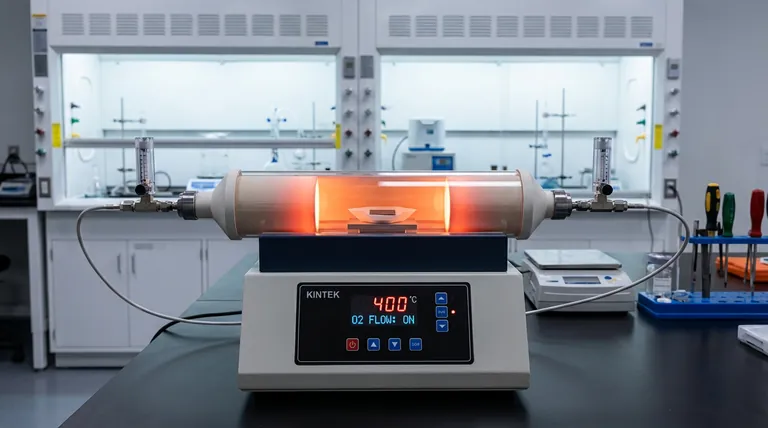
The Critical Mechanisms of Heat Treatment
To understand why these specific conditions are required, we must look at the physical and chemical changes occurring at the nanoscale.
Eliminating Residual Organics
During the initial preparation of nanosheet coatings, organic surfactants and solvents are often used to manipulate the material. These leave behind residues that can inhibit performance.
The 400 °C operating temperature is specifically selected to burn off these residual organic molecules. This ensures the final coating is pure and free from contaminants that could degrade electrical or structural properties.
Strengthening Interfacial Contact
A coating is only as good as its adhesion to the base material. The heat treatment serves a sintering function, moving beyond simple drying to actual structural consolidation.
The thermal energy strengthens the interfacial contact between the nanosheet coating and the substrate (such as NCM). This improved contact is vital for the mechanical stability and longevity of the coated powder.
Facilitating Precursor Decomposition
The coating often begins as a precursor—a chemical "forerunner" that needs to change form to become functional.
The furnace environment promotes the decomposition of these precursors. In this specific application, this reaction is necessary to form functional lithium-niobium oxide layers, converting the raw coating into a chemically active protective barrier.
The Role of Flowing Oxygen
The choice of atmosphere is as critical as the temperature. While some processes require inert gases to prevent reaction, this process utilizes flowing oxygen.
The oxygen flow aids in the oxidation and removal of the carbon-based organic residues mentioned earlier. It creates a reactive environment that facilitates the "cleaning" phase of the heat treatment while supporting the formation of oxide layers.
Understanding Operational Constraints
While the tube furnace offers precision, the specific parameters chosen involve inherent trade-offs that must be managed.
Atmosphere Selectivity
The use of oxygen is specific to oxide coatings and organic removal. In other contexts (such as Silicon Carbide production), oxygen is a contaminant that causes unwanted oxidation.
You must ensure that the atmosphere matches the chemical goal: oxygen for purification and oxide formation, versus inert gases (like Argon or Nitrogen) for preventing oxidation in non-oxide materials.
Thermal Sensitivity
The temperature of 400 °C is a calibrated "sweet spot."
Exceeding this temperature risks damaging the underlying substrate or causing excessive grain growth. falling short leads to incomplete decomposition of precursors, leaving the coating chemically unstable.
Making the Right Choice for Your Goal
The effectiveness of your heat treatment depends on aligning the furnace conditions with your specific material objectives.
- If your primary focus is Purity: Prioritize a consistent flowing oxygen atmosphere to ensure the complete oxidation and removal of organic surfactants.
- If your primary focus is Adhesion: Focus on maintaining stable temperature uniformity at 400 °C to maximize interfacial contact without thermally stressing the substrate.
- If your primary focus is Chemical Functionality: Ensure the cycle duration allows for full precursor decomposition to achieve the desired lithium-niobium oxide structure.
Ultimately, the tube furnace serves as the bridge between a raw chemical mixture and a functional, high-performance composite material.
Summary Table:
| Process Parameter | Condition | Primary Function |
|---|---|---|
| Temperature | 400 °C | Thermal decomposition of precursors & organic removal |
| Atmosphere | Flowing Oxygen | Oxidation of contaminants & oxide layer formation |
| Heat Mechanism | Sintering/Purification | Strengthening interfacial contact with substrates |
| Core Goal | Material Solidification | Creating pure, chemically active protective barriers |
Elevate Your Nanoscience Research with KINTEK Precision
Unlock the full potential of your nanosheet coatings with high-performance heat treatment solutions. Backed by expert R&D and manufacturing, KINTEK offers a comprehensive range of Muffle, Tube, Rotary, Vacuum, and CVD systems, all customizable for your unique laboratory needs. Whether you require precise atmosphere control for oxide formation or high-temperature uniformity for sintering, our lab furnaces deliver the reliability your research demands.
Ready to optimize your material performance? Contact our engineering experts today to find the perfect customizable furnace for your specific application.
References
- Leonhard Karger, Torsten Brezesinski. Protective Nanosheet Coatings for Thiophosphate‐Based All‐Solid‐State Batteries. DOI: 10.1002/admi.202301067
This article is also based on technical information from Kintek Furnace Knowledge Base .
Related Products
- 1200℃ Controlled Inert Nitrogen Atmosphere Furnace
- Mesh Belt Controlled Atmosphere Furnace Inert Nitrogen Atmosphere Furnace
- 1400℃ High Temperature Laboratory Tube Furnace with Alumina Tube
- 1700℃ High Temperature Laboratory Tube Furnace with Alumina Tube
- 1700℃ Controlled Inert Nitrogen Atmosphere Furnace
People Also Ask
- Why is a controlled atmosphere furnace required for 316L debinding? Ensure Structural Integrity & Zero Cracks
- What types of gases are used in controlled atmosphere furnaces? Optimize Material Protection and Transformation
- How does a vacuum or controlled atmosphere furnace facilitate sessile-drop experiments? Optimize Alloy Wetting Analysis
- Why is uniform atmosphere flow important in a controlled atmosphere furnace? Ensure Consistent Results and Avoid Costly Failures
- What factors should be considered when choosing a controlled atmosphere furnace? Ensure Optimal Performance for Your Materials



















