
The high-temperature annealing furnace serves as the critical activation and repair station in the manufacturing of aluminum-silicon hybrid pressure sensors. Specifically, it subjects implanted wafers to temperatures of 900°C for roughly 30 minutes to transform the raw silicon structure into a functional sensing element.
Core Takeaway Use of this furnace is not merely for drying or heating; it is a fundamental chemical processing step. It activates dopant atoms and repairs crystal lattice damage, ensuring the piezoresistive strips possess the electrical stability and sensitivity required for accurate pressure measurement.
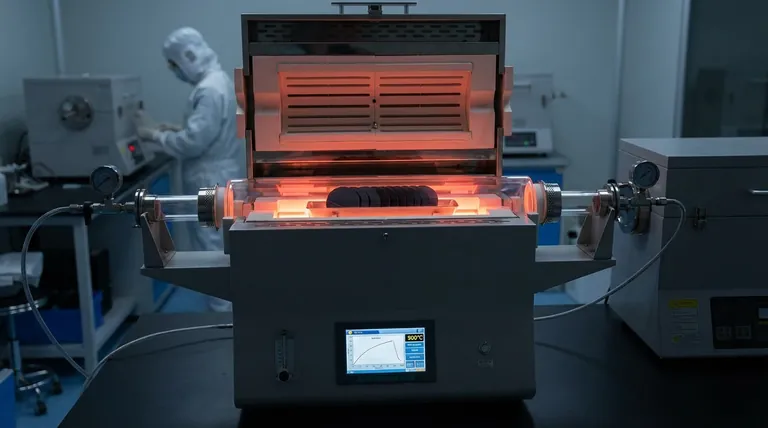
The Mechanism of Sensor Activation
Activating Injected Dopant Atoms
During earlier production stages, dopant atoms (such as boron) are injected into the silicon. Initially, these atoms are electrically inactive.
The annealing furnace provides the thermal energy required to move these dopant atoms into the correct positions within the crystal lattice. This "activation" allows the material to conduct electricity precisely as engineered.
Repairing Lattice Damage
The process of ion implantation is physically aggressive and damages the silicon crystal structure.
High-temperature treatment at 900°C allows the silicon lattice to heal itself. This restoration of the crystal structure is vital for eliminating defects that could cause signal noise or mechanical failure.
Ensuring Uniform Distribution
Consistency is paramount for sensor accuracy. The furnace ensures that the boron ions diffuse evenly throughout the silicon layer.
This uniformity stabilizes the electrical performance of the piezoresistive strips. Without it, the sensor would exhibit unpredictable variations in sensitivity across its surface.
Secondary Functions in Assembly
Curing Electrode Connections
Beyond the silicon treatment, high-temperature furnaces play a role in establishing electrical connectivity.
They provide the environment necessary to solidify and cure gold paste electrodes. At these temperatures, organic components in the paste volatilize, leaving behind a pure conductive path.
Enhancing Component Adhesion
The annealing process facilitates the sintering of gold particles into a continuous film.
This significantly enhances the adhesion between the gold electrode and the ceramic substrate. Strong adhesion is critical for ensuring the long-term stability of signal acquisition, preventing delamination over time.
Understanding the Process Trade-offs
Thermal Budget Management
While high temperatures are necessary for silicon repair, they impose strict constraints on the materials used.
Since aluminum has a melting point below the 900°C annealing temperature, this furnace step must occur before any aluminum metallization or interconnects are applied. Poor sequencing will result in catastrophic component failure.
Diffusion Control Risks
Time and temperature must be balanced with extreme precision.
If the wafers remain in the furnace too long, the dopant atoms may diffuse beyond the intended depth. This "over-diffusion" changes the electrical resistance profiles, potentially pushing the sensor outside of its required specifications.
Optimizing Production for Quality
To ensure the reliability of aluminum-silicon hybrid sensors, the annealing process must be tailored to specific performance goals.
- If your primary focus is Electrical Stability: Prioritize the 900°C maintenance phase to ensure complete activation of boron ions and thorough lattice repair.
- If your primary focus is Signal Integrity: Ensure the ramp-down and electrode curing phases are optimized to create solid, highly conductive gold film connections.
Ultimately, the annealing furnace is the gatekeeper that determines whether a wafer becomes a high-precision instrument or a rejected component.
Summary Table:
| Process Phase | Primary Function | Key Outcome |
|---|---|---|
| Dopant Activation | Thermal energy for lattice placement | Precise electrical conductivity |
| Lattice Repair | Healing ion-implantation damage | Reduced signal noise & mechanical failure |
| Electrode Curing | Volatilization of organic pastes | Pure, high-adhesion gold connections |
| Diffusion Control | Precise time/temp management | Consistent resistance profiles |
Precision Heat Treatment for Next-Gen Sensing
At KINTEK, we understand that in the production of aluminum-silicon hybrid sensors, the furnace is more than a tool—it's the gatekeeper of quality. Backed by expert R&D and manufacturing, KINTEK offers a wide range of high-performance Muffle, Tube, Rotary, Vacuum, and CVD systems, all fully customizable to meet the rigorous thermal budgets of your specific semiconductor or sensing applications.
Ensure maximum yield, superior electrical stability, and perfect lattice restoration with our lab-grade high-temperature solutions. Consult with a KINTEK specialist today to optimize your manufacturing flow.
References
- Min Li, Wenhao Hua. Development of Highly Sensitive and Thermostable Microelectromechanical System Pressure Sensor Based on Array-Type Aluminum–Silicon Hybrid Structures. DOI: 10.3390/mi15091065
This article is also based on technical information from Kintek Furnace Knowledge Base .
Related Products
- 1400℃ High Temperature Laboratory Tube Furnace with Alumina Tube
- 1700℃ Controlled Inert Nitrogen Atmosphere Furnace
- 1700℃ High Temperature Laboratory Tube Furnace with Alumina Tube
- 1400℃ Controlled Inert Nitrogen Atmosphere Furnace
- High Temperature Muffle Oven Furnace for Laboratory Debinding and Pre Sintering
People Also Ask
- How does zone-melting in tube furnaces synthesize bismuth micro-wires? Master Single-Crystal Thermoelectric Growth
- How are high-temp tube furnaces used to measure diffusion coefficients per Fick's law? Master Precision Annealing
- How are high-temperature laboratory tube furnaces applied in long-term vacuum homogenization heat treatments for intermetallic samples?
- How do high-temperature laboratory tube furnaces ensure environmental stability? Precision Thermal Reduction Tips
- How are high-temperature tube furnaces applied in testing ceramic-supported alloy membranes? Insights



















